 Sara Woelk
Jace Watson spent nine semesters working on the GoBabyGo project at Wichita State University before graduating in May. His passion for assistive technology started at home, growing from his experiences with his adopted siblings.
“It’s a personal connection to the program,” he said. “My brother and sister are adopted from Ukraine and have disabilities that affect their motor functions. It was something I wish had been around when they were adopted.”
For 10 years, that hope has become reality for many families, thanks to GoBabyGo.
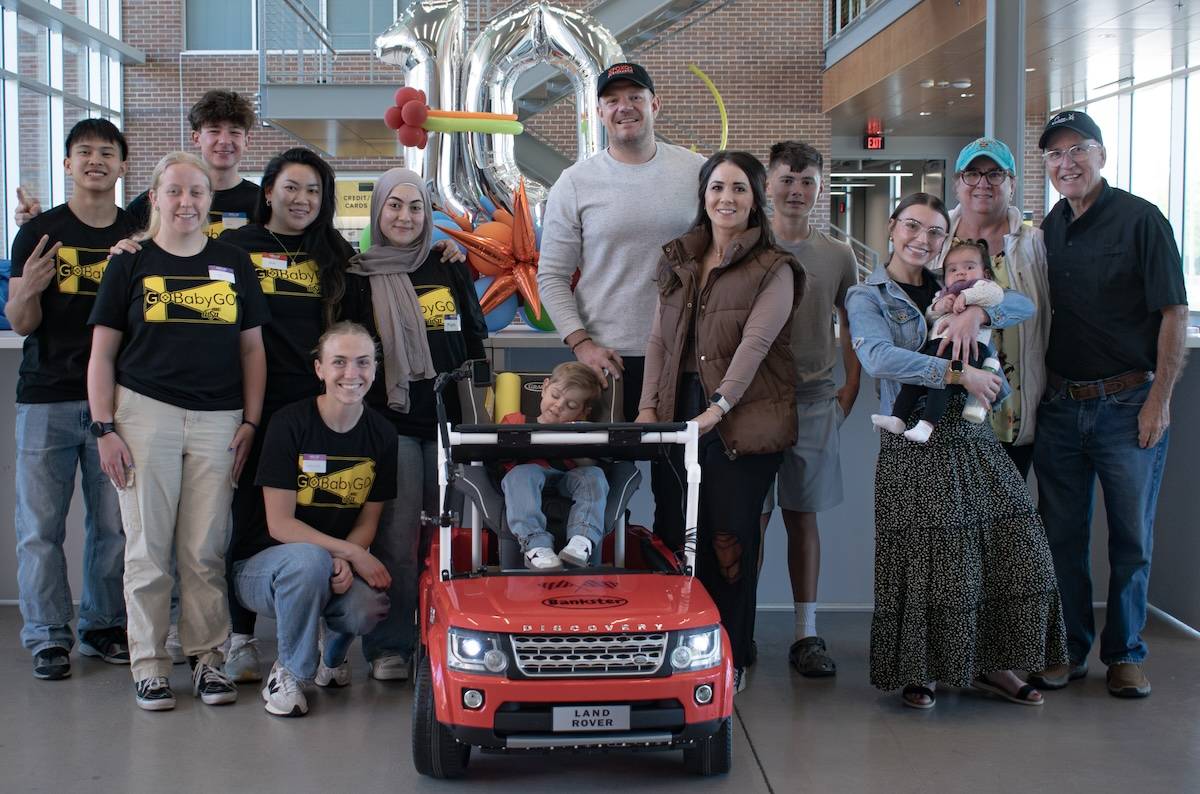
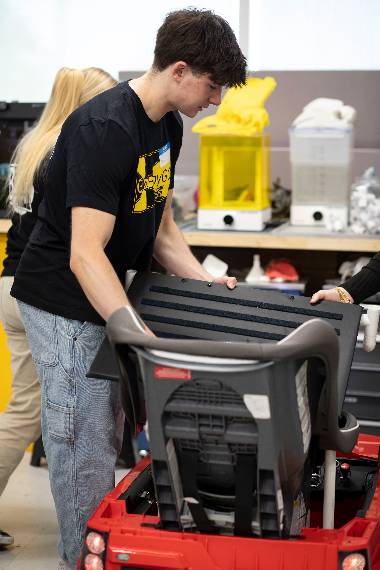
GoBabyGo, a program that modifies children’s cars so that children with disabilities can enjoy more mobility, recently celebrated its 10th anniversary at WSU. In early May, the program had its delivery day, the culmination of months of interdisciplinary work by students, staff and mentors to customize cars at no cost to six families.
 Sara Woelk
The GoBabyGo program, sponsored by the College of Engineering, is a hands-on, applied learning experience that allows graduate and undergraduate students to practice following a budget, measuring children and working with families. They design and select materials, learn new tools and work in interdisciplinary teams.
Since 2016, GoBabyGo delivered 210 cars, which were researched, planned and built by 825 students working with 20 community therapists.
“If a kiddo can keep up with other kiddos, all kinds of learning and interactions happen,” said Beth Watkins, a speech pathologist and co-founder of the program. “And to have a fun way for everybody to be mobile allows a family to participate in a whole different way and to be celebrated. It’s a beautiful feeling.”
Delivery day is the moment when the combination of disciplines such as engineering, physical therapy, human factors, communication sciences and disorders and others results in a new way of experiencing life for a child and family.
“It’s really cute and exciting to see how much their family and their siblings motivate them to want to drive around and make that connection between, ‘I push this down and this is what makes the car go,’” said Vivian Salazar, a junior majoring in mechanical engineering. “Sometimes you have kids who get it right away and it clicks. They’re able to have their siblings running alongside them when, in the past, they weren’t able to experience that.”
Watson, a computer science major from Whitewater, Kansas, served as club president. He watched his siblings grow up with mobility issues. Those experiences led him to devote his time to GoBabyGo. As he prepares for his next step – software engineer with Microsoft in Seattle – he is pleased to see young Wichita State students grab onto the value of the program.
“The most rewarding part is when that passion for assistive technology spreads and grows to other members we bring into GoBabyGo,” he said. “Once we graduate, we have an opportunity to take that passion for assistive technology and help our community.”
The interdisciplinary aspect of the program helps students learn teamwork and adaptability.
“They’re forced to form a cohesive team and learn how to communicate with each other,” said Nathan Smith, lead engineer and co-advisor with Samantha Corcoran. “We have every major in engineering represented. We have physical therapy represented. We’ve worked with the foreign language department.”
Watson emphasized his GoBabyGo experiences in job interviews to show employers the value of his time at college extended beyond the classroom.
“Going through classes doesn’t necessarily mean you’re taking steps outside of those classes to apply what you’ve learned and show how it can affect your community,” he said. “GoBabyGo was an outlet for me to practice my computer science education and apply what I learned to a real-world experience that could help others.”
About Wichita State University
Wichita State University is Kansas' only urban public research university, enrolling more than 25,000 students between its main campus and the WSU Campus of Applied Sciences and Technology (WSU Tech), including students from every state in the U.S. and more than 100 countries. Wichita State and WSU Tech are recognized for being student-centered and innovation-driven.
Located in the largest city in the state with one of the highest concentrations in the United States of jobs involving science, technology, engineering and math (STEM), Wichita State University provides uniquely distinctive and innovative pathways of applied learning, applied research and career opportunities for all of our students. The National Science Foundation ranked WSU No. 1 in the nation for aerospace engineering R&D, No. 2 for industry- and defense-funded engineering R&D and No. 9 overall for engineering R&D.
The Innovation Campus, which is a physical extension of the Wichita State University main campus, is one of the nation’s largest and fastest-growing research/innovation parks, encompassing over 120 acres and is home to a number of global companies and organizations.
Follow Wichita State on social media: