

Artist Robert Bubp’s spring exhibit in the Salina Art Center is built on his question to residents of Salina, Kan.: What should the community of Salina be in the next 25, 50 or 100 years?
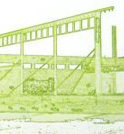
"Started: 2310 Centennial Rd."
Bubp, associate professor of foundations, painting and drawing at Wichita State University, held a series of workshops in Salina that engaged hundreds of its citizens through fall 2008. They talked about city planning, complete with cultural amenities, housing, schools, homeless shelters, green space and community centers.
“We spoke with a diverse range of ages and ethnicities, and found passionate interest and engagement at every level,” said Bubp. “Participants made maps and diagrams and drawings that are included in the exhibition -- they are really fun.”
The community conversations were facilitated by Bubp through collage, text, photographs and dialogue. Meanwhile, he did a series of drawings of various sites in Salina on his own.
“They rim the gallery and form a sort of anchor for the rest of it,” he said. “The work station, which includes a library and computer with exhibition blog access, is to one side of the rest of the show, which includes my site drawings, citizens' comments from seminars projected on the walls and cinderblocks arranged in the center that reflect the results of a voting process that asked in which part of town growth should occur.”
The result is a mixed-media installation at the Salina Art Center of Bubp’s and the community’s drawings, text, sculpture, block constructions and video.
Visitors to the exhibit can access the blog (http://www.vvpsalina.blogspot.com/) and add to the dialogue; they can also use a drawing station set up at the art center for their own ideas and visions.
Bubp asks visitors to consider: What elements define a city? For whom does it exist? Who drives the community-building process? What are the expectations and biases of individuals? What does a planning process look like through the “lens” of an artist?
Although Bubp tends to do big projects that require research, “Vision/Voice/Plan: Salina” involved the coordination of seminars, processing of information and creation of his own works.
“It was as large a job as anything I have done,” he said. “In fact, the work for it continues through the end of the exhibition's run in May.”
He said he will try to update the blog twice a week; he plans to change the citizen comments that are projected on the art center walls about every two weeks.
One thing Bubp really loves about the Salina exhibition is that it challenges the notion of what art is and can be:
“The art was made collaboratively, not by one person; with untrained nonartists; under the aegis of community activism rather than non-functional object-making; and is a continuing process rather than a finite, resolved collection of things.”
The exhibit also challenges the notion of what an art gallery is.
“The institution as a place of artistic mastery and cultural value has been re-purposed as a venue for democratic community action -- to the extent that one can participate after the opening and even without attending. I love that!” he said.
Bubp’s interest in communities and their identities started with a family move from the northeast part of the country to North Carolina. Although he was only 7 at the time, he said shuttling between two culturally distinct regions as he was growing up was fascinating.
“I became acutely aware of the differences in speech, values, climate and geography,” said Bubp.
His research and artwork is informed by those early experiences. Fascinated by communities’ sense of place, he will take that interest to Chico, Calif., this summer and plans a Salina-like experience for Corpus Christi, Texas, for fall 2009.
“I have become interested in focusing research projects in smaller towns/cities, which I believe have a much more palpable sense of place and community at the individual level than do cities, where the place has already happened, in a way,” he said.
Bubp hopes the excitement generated by the project can have a lasting effect.
“In the end,” said Bubp, “I hope residents are more motivated to get involved; that by having a voice in the seminars and seeing their contributions in the show they will be more inclined to care about community planning and their role in it.”