 Courtesy photo
The 26-story building formerly known as the Holiday Inn in downtown Wichita intrigued Derek Landwehr during visits to the Wichita RiverFest as a youngster.
His mother provided brief details about what was the tallest building in Kansas until 1987 and is now known as 250 Douglas Place as part of the Garvey Center.
“I pointed to that building, because it’s a striking building,” he said. “’Are there any stories around there? My mom said, ‘There was a shooting there once.’ That was all I could get.’”

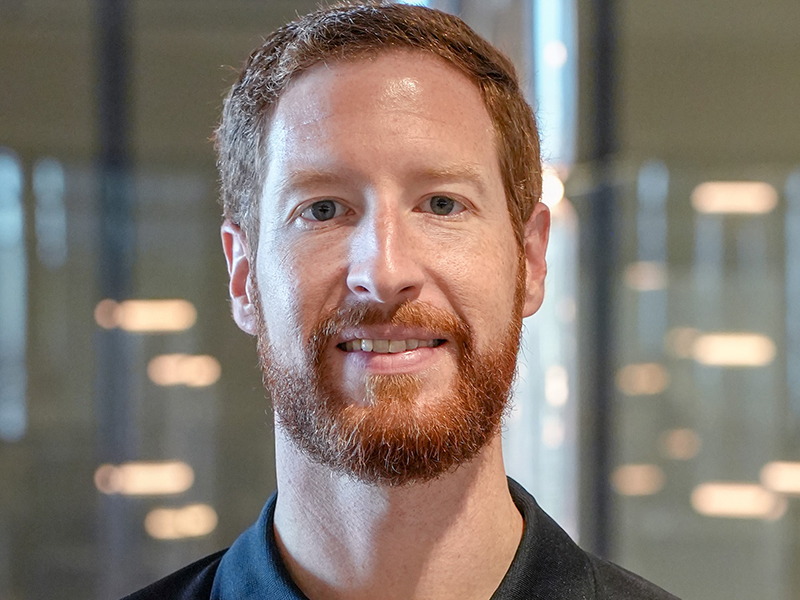
Derek Landwehr
Decades later, Landwehr learned much more about that Aug. 11, 1976, sniper attack as he worked as director of photography for the documentary “Long Echo.” The film will debut at 7 p.m. Aug. 11 on KPTS to mark the 50th anniversary.
Landwehr, a graduate student at Wichita State University, worked on the documentary with journalist and filmmaker Kevin Patrick Allen, who has a personal connection to the event and sniper Michael Soles.
The documentary focuses on the aftermath and the effects on family members of the three people who died and eight wounded that day. It is intentionally not a “true crime” show.
“It is a story of the healing journey and the mental health aspects, rather than a recount of the day itself,” Landwehr said. “They’re still dealing with it. This documentary presents a unique spin on what people think it should be.”
Ralph H. Allen Jr. was chaplain of the Sedgwick County Jail and father of Kevin Patrick Allen. The chaplain counseled Soles and corresponded with him. Soles, 19 at the time of the shooting, is serving life imprisonment at Winfield Correctional Facility.
“The Long Echo is less a crime documentary and more a collection of memoirs,” Kevin Patrick Allen said. “Dad used to say that if you want to really understand someone, you have to view more than an event. Time before, time between, time after. All have to be considered. That’s the approach the film takes with people impacted by that day.”
Landwehr, who attended Bishop Carroll Catholic High School, earned his undergraduate degree in history at Wichita State in 2019. His classes with Dr. Jay Price, professor of history and director of the Local and Community History Program, fed his interest in the subject and influenced his work in documentaries on Kansas topics.
Landwehr is working on his master’s degree in Local and Community History at Wichita State.
“Jay Price has been a great mentor,” Landwehr said. “He’s challenged me in some pretty great ways how to tell stories about local communities.”
Price connected Landwehr with Allen. As director of photography, Landwehr handled camera work, technical equipment and sound.
“Derek reached out to me the moment he learned about the project,” Allen said. “He’s a smart, ambitious guy who had a passion for learning about and sharing this part of Wichita’s history and wanted to do it the right way — without sensationalism but with an appreciation for how it forever altered lives.”
Landwehr believes in the power of visual images a skilled documentarian can use to tell a story.
“I enjoy the closeups,” Landwehr said. “You can see the emotion on people’s faces that you don’t get with a transcript.”
How to watch:
See the documentary by watching KPTS (PBS Kansas Channel 8) live and on-demand through broadcast television, your local cable provider, the PBS Kansas Livestream or through the PBS app.
About Wichita State University
Wichita State University is Kansas' only urban public research university, enrolling more than 25,000 students between its main campus and the WSU Campus of Applied Sciences and Technology (WSU Tech), including students from every state in the U.S. and more than 100 countries. Wichita State and WSU Tech are recognized for being student-centered and innovation-driven.
Located in the largest city in the state with one of the highest concentrations in the United States of jobs involving science, technology, engineering and math (STEM), Wichita State University provides uniquely distinctive and innovative pathways of applied learning, applied research and career opportunities for all of our students. The National Science Foundation ranked WSU No. 1 in the nation for aerospace engineering R&D, No. 2 for industry- and defense-funded engineering R&D and No. 9 overall for engineering R&D.
The Innovation Campus, which is a physical extension of the Wichita State University main campus, is one of the nation’s largest and fastest-growing research/innovation parks, encompassing over 120 acres and is home to a number of global companies and organizations.
Follow Wichita State on social media: