

Experimental Condensed Matter Physics
Condensed matter physics is one of the largest branches of modern physics, studying the macroscopic and microscopic properties of matter. It is one of the most diverse fields of physics, covering everything from mechanics to optics, quantum mechanics, statistical physics, and quantum field theory. Condensed matter interfaces with devices and applications. Physicists at Wichita State University are conducting fundamental research on materials that could herald the next advance in electronics, spintronics, semiconductors, optical solids, spin-based electronics, and other exotic materials such as atomically thin materials and quantum materials.
Faculty
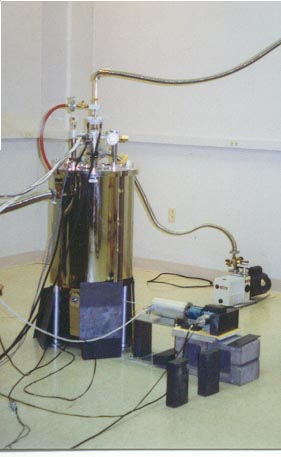
Professor Hamdeh, Wichita State Physics is conducting research in experimental condensed matter physics
focuses on magnetic materials in different forms and states. These systems include
bulk, nano-size particles, and thin films of soft and hard magnets, ferrites, and
magnetic oxides. Other interests include nano-particle catalyst. The primary techniques
for studying these materials are magnetic susceptibility and Mössbauer spectroscopy
in high magnetic fields and at temperatures ranging from 4.2 to 1000 K. The goal of
this work is to correlate the physical magnetic properties to the state of materials
and the size growth of nano-scale particles.
Dr. Kapildeb Ambal is an Associate Professor of Physics at Wichita State University. His current research focuses on investigating fundamental physics that controls the spin and charge transport in condensed matter devices. The projects he is currently working on are: Quantum interactions between single-spin qubits and magnons to enable entanglement and quantum transduction, Quantum sensing of magnetic materials using NV centers, and probing quantum physics in 2D vdW quantum magnets with an aim to uncover novel quantum phenomena