

2026-2027 Graduate Student Handbook
Master of Arts in Communication Sciences and Disorders
Faculty, Staff, and Department Contact Information
- Notice of Nondiscrimination
- Student Code of Conduct
- Academic Integrity Policy
- Standards of Professional Conduct
- Core Functions for Academic and Clinical Success
- Communication
- Motor
- Sensory
- Intellectual/Cognitive
- Interpersonal
- Cultural Responsiveness
- Professional and Scholarly Integrity (CITI) Training Requirement
- Accommodations for Learning and/or Physical Disability
- Grievance Procedures for Graduate Students
- Family Educational Rights and Privacy Act (FERPA)
- Office of Technology Services / WiFi Access / WSU Help Desk
- Student Associations
- Program and Enrollment Fees
- Emergency Information
- Emergency Alert System
- Tornado Emergency Shelter
- Fire Emergency or Drill
- Active Shooter
- Parking Permits / WSU Shuttle
- WSU English Language Proficiency Policy for Admission and Clinical Practice
- Concealed Carry Policy
- Scope of Practice
- Standards for the Certificate of Clinical Competence
- Advising and Plan of Study
- Curriculum for the Master of Arts
- Research Guidelines
- Application for Degree Procedures and Timelines
- Graduation Requirements
- PRAXIS
- Commencement
- Professional Credentialing
- State Licensure
- Clinical Fellowship (CF) / ASHA Membership and Certification (CCC)
- Availability of Transcripts and Diplomas
- Other Employment Resources
- Attendance Policy for College of Health Professions Events
- Code of Ethics
- Universal Precautions
- Background Checks / Substance Abuse Policy
- Student Health and Related Rotation Requirements
- Student Health Information and Insurance
- Immunizations
- Student Health Services
- Confidentiality and HIPAA
- Presence of Students' Children/Family Members in the Clinic
- Student Clinician Dress Code / Personal Grooming Policy
- Social Media Guidelines
- Attendance and Absences
- Mailboxes/Email
- Student Workroom Lockers
- Copier Privileges
- Appropriate Use of Clinic Technology
- Video/Photo/Audio Recording
- Client Files / Point and Click (P&C)
- Clinical Practicum Requirements
- CALIPSO
- SIMUCASE™
- Telerehab
Formative & Summative Student Evaluation and Remediation
- Student Evaluation for Clinical Performance
- Clinical Development Outline
- Clinical Standards and Competencies Grading System
- Professional and Essential Function Grading System
- Clinical Remediation Process
- Student Assistance Plan
- Student Responsibility Regarding a Student Assistance Plan
- Evaluation of Safety and Ethical Practice
- Student Leave of Absence, Withdrawal, Deceleration, or Dismissal
- Voluntary Student Withdrawal
- Voluntary Leave of Absence
- Mandatory Deceleration
- Student Dismissal
Clinic Procedures – Speech-Language Pathology
- Expectations of the Clinician-Supervisor Relationship
- Scheduling Therapy
- Therapy Cancellations by the Student Clinician
- Client Cancellations / No-Shows
- End-of-Semester Procedures
- Maintenance and Cleaning of the Clinic
- Test Check-Out Policy
- Documentation / Forms
- Clinic Hours Policy
- Food Purchasing Policy
- Off-Campus / Externship Opportunities: Speech-Language Pathology
- Off-Campus Practicum Placement Requirements
- Medical & Educational Setting(s) Externship (Required)
- Additional Externship Information
- Appendix A: Student Release of Information Form
- Appendix B: Curriculum by Semester and Year
- Appendix C: Clinic Security Policy
- Appendix D: Clinical Development Outline (CDO)
- Appendix E: Student Assistance Plan (SAP)
- Appendix F: Flowsheet for the CDO and the SAP
- Appendix G: Flowsheet for Academic Concerns
- Appendix H: Artificial Intelligence Policy
- Appendix I: College of Health Professions Use of Personal Devices Policy
- Appendix J: Ahlberg Hall Emergency Plan
- Appendix K: Clinic Emergency Plan
INTRODUCTION
This handbook provides information about policies, procedures, rules, and facts for clinical coursework and academic coursework that affect you as a graduate student in the Department of Communication Sciences and Disorders at Wichita State University. The information included here should help you in answering many questions you might have about the Department and your program of study. We hope that this Handbook will be a resource that is both effective and efficient in providing this information to you.
You will use much of the information in this handbook throughout your graduate program. The better you understand the information in this Handbook, the more you can manage your program. Your advisor, other faculty, and clinical supervisors will work with you on many of the aspects included in this Handbook, but it is critical that you are prepared to ask questions and share in the implementation of your program.
We will ask you to document that you have received a copy of this Handbook and that you have read the information included here. Please do this as soon as you can.
The intent of the Handbook is to help you become better acquainted with our department and the various aspects of the academic and clinical programs we provide. We will do our best to keep the information in the Handbook current and relevant. Constructive feedback to that goal is always welcome. Please direct questions or suggestions to:
Dr. Douglas Parham Chair and Program Director
Department of Communication Sciences and Disorders College of Health Professions
Wichita State University 401B Ahlberg Hall
316-978-5344
douglas.parham@wichita.edu
Best wishes for a successful year!
HISTORY AND MISSION
History
The Department of Communication Sciences and Disorders is one of the oldest on the Wichita State University campus. Originally established in 1934 by Dr. Martin Palmer, the Flo Brown Memorial Speech Laboratory was housed in one room on the fourth floor of Jardine Hall. That one room served as office, classroom, research laboratory and speech clinic! The program moved in 1939 as the Department of Speech Science to a building at 17th and Fairmount.
The first Master of Arts degree in speech science was granted in 1944. The first Master of Arts degree in audiology was granted in 1958 and the first Doctor of Audiology degree (AuD) in 2007. The first Doctor of Philosophy degree (PhD) was granted in 1963.
While the University was willing to support research and academic aspects of the program, it was unable to justify funding the clinical aspects of the major. In 1945, the Institute of Logopedics (defined as the scientific study and treatment of speech defects) was established to provide clinical services. The academic program was renamed to the Department of Logopedics. Both programs moved to new facilities at 2400 Jardine Drive (near 21st St. N. and Grove) in September 1949.
In 1979, another name change occurred to become the Department of Communicative Disorders and Sciences. In 1981, the Department left the grounds of the Institute of Logopedics to take residence in the basement of Hubbard Hall. The Department became the fiscal responsibility of the University as part of the College of Education. Both clinical and academic programs were maintained in this new space.
In 1999, the clinic program moved to its current space in the Eugene M. Hughes Metropolitan Complex. Two important events occurred in 2005: The Department moved from the College of Education to the College of Health Professions and its current home in Ahlberg Hall. With that move came one more name change to the Department of Communication Sciences and Disorders, to reflect the importance of the scientific research foundations of our disciplines. In 2008, a generous donation was provided by Paul and Evelyn Hendren Cassat, which provided funding for clinical improvements and gave us our new name.
Both the Master of Arts and the Doctor of Audiology programs are accredited by the Council of Academic Accreditation of the American Speech-Language-Hearing Association.
Academic Mission and Vision Statements
Vision: To be recognized for leadership, innovation, and excellence in communication sciences and disorders.
Mission: To prepare qualified speech-language pathologists and audiologists as scholars/practitioners who are professionally competent to practice in educational and medical settings on behalf of children and adults who have disorders of communication and related difficulties.
FACULTY AND STAFF CONTACT INFORMATION
Academic Faculty
| Name | Title | Office / Lab | Phone | |
|---|---|---|---|---|
| Douglas Parham, PhD, CCC-SLP | Professor | 401B Ahlberg Hall Lab: 173 MX |
(316) 978-5344 | douglas.parham@wichita.edu |
| Benjamin Kirby, PhD, CCC-A | Associate Professor | 421 Ahlberg Hall | (316) 978-3271 | benjamin.kirby@wichita.edu |
| Imran Musaji, PhD, CCC-SLP | Assistant Professor | 427 Ahlberg Hall Lab: 161 MX |
(316) 978-5634 | imran.musaji@wichita.edu |
| Erin O'Bryan, PhD, CCC-SLP | Assistant Professor | 427A Ahlberg Hall Lab: 174 MX |
Office: (316) 978-3171 Lab: (316) 978-6353 |
erin.obryan@wichita.edu |
| Trisha Self, PhD, CCC-SLP | Associate Professor & PhD Program Coordinator | 411 Ahlberg Hall Lab: 147C MX |
(316) 978-6810 | trisha.self@wichita.edu |
Clinical Faculty
| Name | Title | Office / Lab | Phone | |
|---|---|---|---|---|
| Xiao-Ming Sun, PhD | Professor | 417 Ahlberg Hall Lab: 106/114 Hubbard Hall |
(316) 978-6160 | xiao-ming.sun@wichita.edu |
| Ashley Purdum, MA, CCC-SLP | Clinical Professor | 160 MX | (316) 978-3618 | ashley.purdum@wichita.edu |
| Terese Conrad, MA, CCC-SLP | Clinical Professor | 147B MX | (316) 978-3397 | terese.conrad@wichita.edu |
| Stacey Kampe, AuD, CCC-A | Clinical Professor | 167 MX | (316) 978-6355 | stacey.kampe@wichita.edu |
| Brian Ray, MA, CCC-SLP | Clinical Professor, Board Certified Specialist | 175B MX | (316) 978-3493 | brian.ray@wichita.edu |
| Heather Riikonen, AuD, CCC-A | Clinical Professor | 167 MX | (316) 978-6352 | heather.riikonen@wichita.edu |
| Meghan Schmitt, PhD, CCC-SLP | Clinical Professor | 175A MX | (316) 978-6352 | meghan.schmitt@wichita.edu |
| Danica Seirer, MA, CCC-SLP | Assistant Clinical Professor | 174 MX | (316) 978-6196 | danica.seirer@wichita.edu |
| Kati Sodowsky, MA, CCC-SLP | Clinical Professor | 175A MX | - | - |
| Carly Thomas, MA, CCC-SLP | Assistant Clinical Professor | 174 MX | (316) 978-3392 | carly.thomas@wichita.edu |
| Melissa Vagts, MSP, CCC-SLP | Clinical Professor | 175C MX | (316) 978-7688 | melissa.vagts@wichita.edu |
Department Staff
| Name | Position | Location | Phone | |
|---|---|---|---|---|
| Armen Gazaway | AM Front Desk Coordinator, Clinic | 162 MX | (316) 978-3289 (316) 978-7263 |
armen.gazaway@wichita.edu |
| Denise White | PM Front Desk Coordinator, Clinic | 162 MX | (316) 978-3289 (316) 978-7263 |
denise.white@wichita.edu |
Department Contact Information
| Office | Location | Phone | Fax | Hours | |
|---|---|---|---|---|---|
| Department of Communication Sciences and Disorders | 401 Ahlberg Hall | (316) 978-3240 | (316) 978-3291 | csd@wichita.edu | Mon-Fri, 8 a.m.-5 p.m. |
| Evelyn Hendren Cassat Speech-Language-Hearing Clinic | Eugene M. Hughes Metropolitan Complex Entrance T 5015 E. 29th St. N. |
(316) 978-3289 | (316) 978-7264 | slhclinic@wichita.edu | Mon-Fri, 8 a.m.-8 p.m. |
Mailing Addresses
Department
Department of Communication Sciences and DisordersWichita State University
1845 Fairmount Street
401 Ahlberg Hall
Wichita, KS 67260-0075
Cassat Clinic
Evelyn Hendren Cassat Speech-Language-Hearing ClinicWichita State University
5015 E. 29th Street N., Entrance T
Wichita, KS 67220
GENERAL INFORMATION
Notice of Nondiscrimination
Wichita State University (WSU) does not discriminate in its employment practices, or in its educational programs or activities on the basis of age (40 years or older), ancestry, color, disability, ethnicity, gender, gender expression, gender identity, genetic information, marital status, national origin, political affiliation, pregnancy, race, religion, sex, sexual orientation, or status as a veteran. WSU also prohibits retaliation against any person making a complaint of discrimination or against any person involved or participating in the investigation of any such allegation. Sexual misconduct, relationship violence, and stalking are forms of sex discrimination and are prohibited under Title IX of the Education Amendments Act of 1972, other federal law, and WSU policy. The following persons have been designated to handle inquiries regarding WSU’s non-discrimination policies: the Associate Vice President and University Title IX Coordinator (Telephone: (316) 978-3186), Office of Civil Rights, Title IX & ADA Compliance. For inquiries, please call or visit the Office of Civil Rights, Title IX & ADA Compliance at (316) 978-3186, Wichita State University, 1845 Fairmount, Wichita, KS 67260, Lindquist Hall.
Student Code of Conduct
Wichita State Student Code of Conduct Handbook
Wichita State University is a learning community comprised of Students, Faculty and Staff where freedom of inquiry and freedom of expression are valued. Important aspects of attending the University as a Student are having respect for the rights of others in the community, conducting oneself in a manner that is compatible with the University’s mission and taking responsibility for one’s actions. In addition to exhibiting appropriate maturity and self-control, Students, as members of the University community are expected to conduct themselves in accordance with established standards of behavior and social interaction.
To fulfill its functions of promoting and disseminating knowledge, the University has authority and responsibility for maintaining order and for taking appropriate action.
As members of the WSU community, Students should:
- Accept responsibility for personal behavior and appropriately challenge the behavior of others
- Respect individual differences
- Behave in a manner that is honest and upholds the standards of Wichita State University
- Be an engaged member of the Wichita State University community
The educational process is ideally conducted in an environment that encourages reasoned discourse, intellectual honesty, openness to constructive change and respect for the rights and responsibilities of all individuals. This Code of Conduct is designed for the promotion and protection of such an environment.
The WSU Student Code of Conduct governs individual and group student behavior that occurs on WSU premises or at WSU-sponsored or related events, on shuttle busses or state vehicles, off-campus, if that conduct seriously threatens the safety or well-being of other WSU students, faculty, or staff; conduct that occurs while earning any type of academic credit (e.g., clinical rotations) and conduct that occurs during a student’s enrollment at WSU.
The WSU Student Code of Conduct provides guidelines and further definitions relative to a variety of behaviors/actions including but not limited to:
- Physical abuse, verbal abuse, threats, intimidation, coercion, bullying, stalking, domestic violence, retaliation, discrimination and/or other conduct that threatens or endangers the health or safety of another person.
- Abuse of the Code procedures or processes
- Academic dishonesty in any form (see full WSU policy online, Academic Integrity)
- Alcohol possession or use on WSU premises. Refer to the full Code online regarding alcohol and student organizations and advertisement/sponsorship of activities, events or programs involving alcohol by student
- Assisting, hiring or encouraging another person to commit an act that violates the
- Bribery, attempted bribery, acceptance of a bribe or failure to report a bribe
- Committing acts of dishonesty: cheating, plagiarism, forgery, tampering with elections, attempting to represent the University or organization without permission, using an ID card that does not belong to you and/or allowing someone to use your ID card.
- Cruelty to animals
- Damage or destruction of property
- Participating in a campus demonstration in contravention of University policies on First Amendment
- Demonstrating intent to harm yourself or otherwise posing a danger causing psychological or physical harm to yourself or others.
- Disruptive behavior that unreasonably interferes with classroom or other University activity or with the legitimate activities of any member of the University community.
- Manufacture, possession, use, delivering, selling or distributing of any controlled substance or drug
- Falsifying, forging, defacing, altering, or mutilating in any manner official University documents or representation
- Committing acts of arson, creating a fire hazard, or possessing or using, without proper authorization, inflammable materials or hazardous substances on University property including acts which endanger the property of the University such as altering or misusing fire or safety equipment and making false reports of dangerous conditions, failing to report a fire, and interfering with University/municipal response to emergency
- Conducting, organizing, or participating in any illegal gambling activity on University
- Harassment, an intentional act or series of acts which is extreme, outrageous, or calculated to cause severe embarrassment, humiliation, shame or fright, or which is intended to intimidate or ridicule.
- Hazing in any form
- Posting, affixing, or otherwise attaching written or printed messages or materials on or in unauthorized
- Refusal to comply with an order from authorized officials to leave University premises or cease behavior that violates the Code.
- Possessing, duplicating, or using keys to any University building/facility without authorization by appropriate officials or committing an act of unauthorized entry into or use of University building/facilities.
- Knowingly withholding information or giving false information verbally or in any document or materials submitted to any member of the University community.
- Misuse of University computers or any violation of computer lab (See WSU Acceptable Use Policy and the WSU Information Technology Systems Relative to E-mail Policy)
- Use of communication technology to harass or threaten any person or to disrupt normal University operations or unauthorized use of communication technology.
- Sexual misconduct or sexual
- Engaging in the use of any tobacco product or device including, but not limited to, cigarettes, cigars, e-cigarettes, vaping, hookah, or chewing tobacco within University facilities or campuses.
- Engagement in unauthorized canvassing or
- Attempted or actual theft of any property owned or maintained by the University, any person on campus, or any person attending a University-sponsored event.
- Violation of federal or state laws or county or city
- Violation of Program and Department policies, rules, or
- Engaging or participating in unauthorized possession or use of explosives, firearms, weapons, or other hazardous objects or substances.
Under ADA, universities can enforce conduct standards that are internship, practicum or clinical related and consistent with business necessity, but may need to consider specific accommodations that might be most effective for enabling students to meet those standards. In cases such as these, the supervisor has the right to enforce conduct standards.
A more detailed description of what constitutes violations of the Student Code of Conduct, definitions for various terms, how to report an incident and the process for student disciplinary procedures may be found in the WSU Policies & Procedures Manual 8.05/Student Code of Conduct (https://www.wichita.edu/about/policy/ch_08/ch8_05.php) and Policies & Procedures Manual 8.16/Sexual Misconduct, Relationship Violence, and Stalking Policy for Students. (https://www.wichita.edu/about/policy/ch_08/ch8_16.php).Sanctions for violations of the Code include but are not limited to expulsion, suspension, probation, referral for alcohol or drug counseling, and restitution of damage. Students found in violation of any aspect of the Code of Conduct can be subject to dismissal from the program.
Academic Integrity Policy
Students at Wichita State University are expected to uphold high academic standards. WSU will not tolerate a lack of academic integrity. The Academic Integrity Policy allows for each college to determine outcomes for alleged violations of academic misconduct. The complete Student Academic Integrity Policy, including the appeal process, may be found at the following links: https://www.wichita.edu/about/policy/ch_02/ch2_17.php,
https://cm.maxient.com/reportingform.php?WichitaStateUniv&layout_id=6, and http://www.wichita.edu/about/student_conduct/ai.php.
The fundamental responsibility for the maintenance of the standards of academic integrity rests with each student. It is each student's responsibility to be familiar with University policy on academic integrity and to uphold standards of academic honesty at all times and in all situations.
Standard of Procfessional Conduct
As a health care professional, the SLP must be sensitive to the value of human dignity. This value is manifested in behaviors which demonstrate sensitivity to the well-being of others and honesty in all endeavors. Specific behaviors which support these values include maintenance of confidentiality and honesty concerning personal, academic, and patient care information and demonstration of respect for the psychological welfare of others.
A student enrolled in the SLP Program must demonstrate behaviors consistent with these standards in all areas of the Program. Failure to demonstrate professional behavior may result in a professional warning, other consequences, and/or dismissal from the SLP Program. Please refer to the ASHA Code of Ethics for more information. Behavior that reflects the professional conduct expected of students is evidenced by:
- Demonstrating respect and value of
- Ethical conduct and academic
- Recognition of moral, ethical, and legal implications of
- Integrity in all personal and professional
- Recognition of patients’, clients’, and providers’ rights and
- Respect for oneself, others, and the rights of
- Appreciation of and respect for cultural and value system differences among various
- Appropriate value judgments with respect to interpersonal relationships with peers, faculty, preceptors, and other colleagues (i.e., unprofessional behavior includes dating faculty or preceptors while in the Program and talking about classmates and/or faculty with preceptors and other persons)
- Appearance and hygiene consistent with a clinical
- Punctual attendance at all Program scheduled activities and adherence to deadlines set by faculty regarding tests/assignments.
- Recognition of the inappropriateness of substance use/abuse (e.g., casual or regular use of marijuana, alcohol, or other intoxicating/illegal substances).
- Continuing to Learning is a lifelong process that requires being self-directed and motivated to continually increase knowledge and competency as a SLP.
Core Functions for Academic and Clinical Success
In order to acquire the knowledge and skills requisite to the practice of speech-language pathology, to function in a broad variety of clinical situations, and to render a wide spectrum of patient care, individuals must have skills and attributes in five areas: communication, motor, intellectual-cognitive sensory-observational, and behavioral-social. These skills, many of which are endorsed by the Council of Academic Programs in Communication Sciences and Disorders, April 2023, (updated and replaced the essential functions developed in 2008), enable a student to meet graduate and professional requirements as measured by state licensure and national certification. Many of these skills can be learned and developed during the course of the graduate program through coursework and clinical experience. The summaries of the five areas below were taken from the CAPCSD document “A Guide For Future Practitioners in Audiology and Speech-Language Pathology: Core Functions”.
Communication
“Statements in this section acknowledge that audiologists and speech-language pathologists must communicate in a way that is understood by their clients/patients and others. It is recognized that linguistic, paralinguistic, stylistic, and pragmatic variations are part of every culture, and accent, dialects, idiolects, and communication styles can differ from general American English expectations. Communication may occur in different modalities depending on the joint needs of involved parties and may be supported through various accommodations as deemed reasonable and appropriate to client/patient needs. Some examples of these accommodations include augmentative and alternative communication
(AAC) devices, written displays, voice amplification, attendant-supported communication, oral translators, assistive listening devices, sign interpreters, and other non-verbal communication modes.
- Employ oral, written, auditory, and non-verbal communication at a level sufficient to meet academic and clinical competencies
- Adapt communication style to effectively interact with colleagues, clients, patients, caregivers, and invested parties of diverse backgrounds in various modes such as in person, over the phone, and in electronic
Motor
Statements in this section acknowledge that clinical practice by audiologists and speech-language pathologists involves a variety of tasks that require manipulation of items and environments. It is recognized that this may be accomplished through a variety of means, including, but not limited to, independent motor movement, assistive technology, attendant support, or other accommodations/modifications as deemed reasonable to offer and appropriate to client/patient needs.
- Engage in physical activities at a level required to accurately implement classroom and clinical responsibilities (e.g., manipulating testing and therapeutic equipment and technology, client/patient equipment, and practice management technology) while retaining the integrity of the process
- Respond in a manner that ensures the safety of clients and others
Sensory
Statements in this section acknowledge that audiologists and speech-language pathologists use auditory, visual, tactile, and olfactory information to guide clinical practice. It is recognized that such information may be accessed through a variety of means, including direct sensory perception and /or adaptive strategies. Some examples of these strategies include visual translation displays, text readers, assistive listening devices, and perceptual descriptions by clinical assistants.
- Access sensory information to differentiate functional and disordered auditory, oral, written, and visual communication
- Access sensory information to correctly differentiate anatomical structures and diagnostic imaging findings
- Access sensory information to correctly differentiate and discriminate text, numbers, tables, and graphs associated with diagnostic instruments and tests
Intellectual/Cognitive
Statements in this section acknowledge that audiologists and speech-language pathologists must engage in critical thinking, reasoning, and comprehension and retention of information required in clinical practice. It is recognized that such skills may be fostered through a variety of means, including assistive technology and /or accommodations/modifications as deemed reasonable and appropriate to client/patient needs.
- Retain, analyze, synthesize, evaluate, and apply auditory, written, and oral information at a level sufficient to meet curricular and clinical competencies
- Employ informed critical thinking and ethical reasoning to formulate a differential diagnosis and create, implement, and adjust evaluation and treatment plans as appropriate for the client/patient's needs
- Engage in ongoing self-reflection and evaluation of one's existing knowledge and skills
- Critically examine and apply evidence-based judgment in keeping with best practices for client/patient care
Interpersonal
Statements in this section acknowledge that audiologists and speech-language pathologists must interact with a diverse community of individuals in a manner that is safe, ethical, and supportive. It is recognized that personal interaction styles may vary by individuals and cultures and that good clinical practice honors such diversity while meeting this obligation.
- Display compassion, respect, and concern for others during all academic and clinical interactions
- Adhere to all aspects of relevant professional codes of ethics, privacy, and information management policies
- Take personal responsibility for maintaining physical and mental health at a level that ensures safe, respectful, and successful participation in didactic and clinical activities
Cultural Responsiveness
Statements in this section acknowledge that audiologists and speech-language pathologists have an obligation to practice in a manner responsive to individuals from different cultures, linguistic communities, social identities, beliefs, values, and worldviews. This includes people representing a variety of abilities, ages, cultures, dialects, disabilities, ethnicities, genders, gender identities or expressions, languages, national/regional origins, races, religions, sexes, sexual orientations, socioeconomic statuses, and lived experiences.
- Engage in ongoing learning about cultures and belief systems different from one's own and the impacts of these on healthcare and educational disparities to foster effective provision of services.
- Demonstrate the application of culturally responsive evidence-based decisions to guide clinical
This document should be considered a living document and therefore reviewed by CAPCSD at regular intervals to ensure that current terminology, practice, and ideas are reflected.” If a student cannot develop and apply the teachable skills listed above, a remediation process will be initiated.
Professional and Scholarly Integrity (CITI) Training Requirement
Completion of a training program in professional and scholarly integrity is a graduation requirement for all master’s and doctoral students enrolled at Wichita State University. The training, at a minimum, must cover these four topical areas:
- Research misconduct;
- Publication practices and responsible authorship;
- Conflict of interest and commitment; and
- Ethical issues in data acquisition, management, sharing and
Additional CITI modules may be required for your thesis/nonthesis project. The Graduate School expects that students will complete this training requirement by the end of their first year of graduate study at Wichita State University. The graduate school requires the use of CITI (Collaborative Institutional Training Initiative) training modules to comply with this requirement. See instructions here: https://www.wichita.edu/academics/graduate_school/psit/index.php
Accommodations for Learning and/or Physical Disability
Reasonable accommodation of a physical (includes psychological or psychiatric) or learning disability will be provided if the Department of Communication Sciences and Disorders is notified in writing with appropriate documentation of the disability and approval by the WSU Office of Student Accommodations and Testing (OSAT).
If you have a physical, psychiatric/emotional, or learning disability that may impact your ability to carry out assigned course work, you are encouraged to contact OSAT; Grace Wilkie Hall, room 203, (316) 978-3309 (voice/tty) (316-854-3032 videophone). OSAT will review your concerns and work with you and the department to determine what academic and/or accommodations are necessary and appropriate for you. All information and documentation of your disability is confidential and will not be released by OSAT without your written permission.
The federal definition is as follows: “A person with a disability”:
- has a mental or physical impairment which substantially limits one or more of such person's major life activities,
- has a record of such an impairment; or
- is regarded as having such an ”
“Major life activities” includes functions such as caring for oneself, performing manual tasks, walking, seeing, hearing, speaking, breathing, learning, and working.”
OSAT requires differing types of documentation based on the specific disability or disabilities. Detailed eligibility guidelines as well as documentation guidelines adopted by the Kansas Association of Higher Education and Disability are available on the OSAT website: https://www.wichita.edu/services/disabilityservices/Students/servicepolicies1.php.
Due to the nature of the activities performed in many clinical settings, OSAT will work directly with the practicum site to identify reasonable accommodations for the student. It is the student’s responsibility to request a consideration of accommodation by contacting WSU Office of Student Accommodations and Testing. Please note that accommodations are not retroactive.
Grievance Procedures for Graduate Students
When a dispute arises between a student and clinical or academic faculty member regarding a grade, academic honesty, academic freedom, mistreatment, or other matter, the student’s first responsibility is to arrange an appointment with the faculty member to discuss the issue. If mutual satisfaction is not reached in this manner, the next step is to contact either the graduate coordinator (academic concerns) or the clinic director (clinic concerns). After doing so, if the concern still has not been addressed, the next step is to arrange an appointment with the department chair who will work to resolve the dispute. Should the department chair be unsuccessful in attempts to mediate, a set of policies and procedures have been implemented by the Graduate School to successfully resolve such issues.
These policies have been provided below and may be found at: https://www.wichita.edu/academics/graduate_school/currentstudents/complaint_procedures.php
The Department of Communication Sciences and Disorders at WSU expects students to follow the Grievance Policies and Procedures of the Graduate School at WSU. If concerns still exist, students may contact the Council on Academic Accreditation (CAA) at the ASHA Action Center [Members: 800-498-2071; Non- Members: 800-638-8255]. Further information may be found on the ASHA website at https://caa.asha.org/programs/complaints/
Family Educational Rights and Privacy Act of 1974 (FERPA)
In compliance with the “Family Educational Rights and Privacy Act of 1974” (FERPA), the following constitutes the institution’s policy on providing appropriate access to educational records, while protecting their confidentiality.
Wichita State University accords all rights under the law to students. Those rights are: 1) the right to inspect and review the student’s education records; 2) the right to request the amendment of the student’s education records to ensure that they are not inaccurate, misleading, or otherwise in violation of the student’s privacy or other rights; 3) the right to consent to disclosures of personally identifiable information contained in the student’s education records, except to the extent that FERPA authorizes disclosure without consent; 4) the right to file with the U.S. Department of Education a complaint concerning alleged failures by Wichita State University to comply with the requirements of FERPA; and 5) the right to obtain a copy of Wichita State University’s student records policy. A complete copy of the policy may be found in the Wichita State Catalog. Students will be notified of their FERPA rights by publication in the Undergraduate and Graduate Catalogs.
A complete copy of the policy, including the definition of “directory information”, may be found in the Wichita State Graduate Catalog and at: https://www.wichita.edu/services/registrar/FERPA/ferpa.php .Forms are provided on the Office of the Registrar’s website for consent to disclose educational records or to prevent disclosure of directory information.
Students wishing to inspect and review educational records maintained in the Department of Communication Sciences and
Disorders or the Evelyn Hendren Cassat Speech-Language-Hearing Clinic must submit a written request to the Department Chair.
Permission to Communicate forms (Appendix A) are also available to you in the CSD Department for the purposes of communicating with non-institutional persons or organizations at various stages of the clinical track program. Examples, among others, are:
- Communication with external clinical practicum sites/supervisors
- Supervisor references to prospective employers
- Reporting your progress prior to (and after) graduation to agencies for state licensure, hearing aid dispensing licenses, and applications for certification of clinical competence
- Discussing information with University Support Services such as Office of Student Accommodations and Testing or Success coaches.
If your file is marked as “Confidential” with the Office of the Registrar because of a prior request to prevent disclosure of your directory information, departmental release forms will not be valid until that restriction is released.
Office of Technology Services / WIFI Access / WSU Help Desk
The Office of Technology Services provides technology support and services for the College of Health Professions (CHP). A quiet computer and study lab for CHP students (100 Ahlberg Hall) is staffed during hours posted online at www.wichita.edu/ots. Students have access to computers, printers, a photocopier, a video player, and carrels for studying.
Wireless access on campus is available to students in most buildings on the main campus and satellite campuses, including our clinic. How to connect? Find WSU Secure in the list of available networks and click “Connect”. A window will pop up asking for your password. Enter your myWSU ID and password. Need assistance, go to https://www.wichita.edu/services/its/Wireless_network_more_info.php for additional details.
The WSU Technology Help Desk answers a wide range of technical questions about the use of WSU services. You can ask for assistance in person at 120 Jabara Hall, by phone at (316) 978-4357, or email helpdesk@wichita.edu. Additional details about services/hours are online at www.wichita.edu/helpdesk.
Student Associations
Graduate students are also encouraged to join the student divisions of their professional organizations.
- The American Speech-Language-Hearing Association’s (ASHA) student division is the National Student Speech-Language-Hearing Association (NSSLHA). National NSSLHA membership provides benefits that help students stay current on advancements in the field, enhance their academic knowledge, find internships and employment, network with other students with similar interests, and save money on products and services. See more at https://www.nsslha.org/ .
- The American Academy of Audiology’s (AAA) student division is the Student Academy of Audiology (SAA). See more at: https://saa.audiology.org/
- Become a student member of the Kansas Speech-Language-Hearing Association (KSHA) at ksha.org. Look for information on the annual conference which is held in the fall.
Program and Enrollment Fees
All CSD students are assessed a fee of $20.00 per credit hour for all courses taken within the College of Health Professions.
All students who have a declared major within the Department of Communication Sciences and Disorders (CSD) are assessed a program fee in the amount of $60.00 per credit hour.
- Support maintenance, development and enhancement of clinical facilities, equipment, and research
- Recruit, develop and retain high quality faculty and clinical
- Support development and retention of clinical practicum opportunities in the
- Enhance computer software to support acquisition of data collection tools needed to meet accreditation requirements and maintain quality programs.
CSD students in the MA-CSD program are assessed a one-time enrollment fee in the amount of $150.00 in the fall semester. These fees, pro-rated across your program, are used to cover costs for the following items:
- Consumables in the Speech-Language-Hearing Clinic (e.g., copies, paper, ink, test materials)
- Clinic security badges
- Training (e.g., CPR certification, First Aid)
- CALIPSO documentation system membership and one-time student registration
- Liability insurance premium
Students who participate in clinical practicum are required to purchase liability insurance on a yearly basis for as long as they are engaged in a practicum in the CSD program. The department contracts for group coverage which provides each enrolled student coverage in the amount of $1,000,000/$3,000,000.
- Other related items, as Emergency Information
Emergency Information
Emergency Alert System
The Shocker Alert System is the quickest way on campus to transmit emergency messages. In a designated emergency, a message will be sent to email accounts or via mobile/text messaging. The service is free, and students may sign up through the University website at https://www.wichita.edu/services/shockeralert/. The Shocker Alert System will also advise students if the University closes due to adverse weather conditions. You can also call the inclement weather line at (316) 978-6633.
Fire, medical, or police services can be obtained via outdoor emergency telephone kiosks located around campus. Kiosks can be identified by an emergency logo and blue light source. Campus telephones are also available for emergencies. City of Wichita emergency services can be activated by dialing 911. The phone number for assistance from the WSU Police Department is 316-978-3450.
Tornado Emergency Shelter
Tornado WATCH: Conditions are favorable for a tornado to develop in and close to the watch area.
Tornado WARNING: A tornado has been sighted by spotters or is indicated by radar and is occurring or imminent in the warning area.
Weekly Siren Test: Mondays at 12:00 PM
WHEN CITY SIRENS SOUND OR A TORNADO WARNING IS IN EFFECT, GO TO THE BASEMENT OF:
Ahlberg Hall via the northwest stairwell to Room 135 or Advanced Education in General Dentistry (AEGD) via the east door and stairwell. This building is located across the parking lot from the Cassat Speech-Language-Hearing Clinic. For those individuals with disabilities that make travel to the AEGD building difficult, the Audiology booths in rooms 166 and 168 may be utilized as a shelter.
Fire Emergency or Drill
Evacuate the building via the nearest exit when fire alarm sounds. No exceptions!
In Ahlberg Hall, use either the northeast or southeast stairs. Assemble on the far side of the east (faculty/staff) parking lot until all clear is sounded by an Emergency Building Coordinator (EBC).
Active Shooter
Students are encouraged to review the Armed Intruder or Active Shooter and other important information related to campus safety available online at the WSU Campus Safety homepage: (https://www.wichita.edu/_training/d774c354/emergency_guide/armed_shooter.php).
Parking Permits / WSU Shuttle
Wichita State’s main campus is a permit-only parking environment on weekdays when classes are in session. WSU students, faculty, staff and visitors wishing to park on campus during the enforcement period must register online with the Shocker Parking Management System to park legally. Visit www.wichita.edu/parking for details.
The WSU Shuttle System is a free service to students, faculty, staff and visitors to WSU during the Fall and Spring semesters (there is no shuttle service during the Summer semester). It is provided as an alternative to parking on the WSU main campus. There are two shuttle routes available: The Metroplex Route and the Campus Route. Visit www.wichita.edu/shuttle for details.
WSU English Language Proficiency Policy for Admission and Clinical Practice
The Graduate School at WSU has established an English Language Proficiency policy for applicants whose native language is not English. Admission to one of the graduate programs in the Department of Communication Sciences and Disorders requires a score of 100 on the TOEFL (iBT), with a minimum of 23 on the speaking portion of the iBT, a 600 on the TOEFL (PBT), a 7.5 on the IELTS, or a 73 on the PTE. The full WSU Graduate School English Language Proficiency policy can be accessed at the following URL: https://www.wichita.edu/academics/gradschool/ApplicationandAdmission/GradEnglishProficiency.php
Concealed Carry Policy
The Kansas Legislature has legalized concealed carry on public university campuses. Guns must be out of view, concealed either on the body of the carrier, or backpack, purse or bag that remains under the immediate control of the carrier. Gun owners must familiarize themselves with WSU’s Concealed Carry Policy at https://www.wichita.edu/services/strategic_communications/wsunews/weapons_policy_documents.php and the Kansas Board of Regent’s policy at https://kansasregents.org/about/policies-by-lawsmissions/board_policy_manual_2/chapter_ii_governance_state_universities_2/chapter_ii_full_text#weapons
If you believe that there has been a violation of this policy, please contact the University Police Department at (316) 978-3450.
ACADEMIC GUIDELINES
Scope of Practice
Scope of practice documents are an official policy of the American Speech-Language-Hearing Association (ASHA) defining the breadth of practice within the professions of speech-language pathology and audiology.
The speech-language pathologist is the professional who engages in clinical services, prevention, advocacy, education, administration, and research in the areas of communication and swallowing. Audiologists provide comprehensive diagnostic and treatment/rehabilitative services for auditory, vestibular, and related impairments. These services are provided to individuals across the life span from infancy through geriatrics; to individuals from diverse language, ethnic, cultural, and socioeconomic backgrounds; and to individuals who have multiple disabilities. Given the diversity of the client population, ASHA policy requires that these activities are conducted in a manner that takes into consideration the impact of culture and linguistic exposure/acquisition and uses the best available evidence for practice to ensure optimal outcomes for persons with communication disorders.
The complete scope of practice in speech-language pathology document is available on the ASHA website at https://www.asha.org/policy/SP2016-00343/
Standards for the Certificate of Clinical Competence
The ASHA Certificate of Clinical Competence is the recognized professional credential for speech-language pathologists (CCC-SLP) and audiologists (CCC-A). The Master of Arts program in the Department of Communication Sciences and Disorders at Wichita State University is designed to provide the academic and clinical experiences required to obtain ASHA certification after successful completion of the degree program.
The complete set of standards and implementation procedures for speech pathology are available on the ASHA website at https://www.asha.org/Certification/2020-SLP-Certification-Standards/ .
Advising and Plan of Study
To officially define a program of study for a graduate degree, MA students must have a Plan of Study. The process of filing an acceptable Plan of Study is not complete until the student has received the approved copy from the Graduate School. Failure to meet the deadline for filing an acceptable Plan of Study may result in a delay in graduation or the loss of credit planned for use in the program.
Curriculum for the Master of Arts
The Master of Arts curriculum includes a minimum of 54 hours in the following coursework, typically completed in a two-year, full-time sequence (5-6 semesters).
Core Courses (40 credit hours)
- CSD 705 Counseling in Communication Disorders (2 credit hours)
- CSD 710 Autism Spectrum Disorder (3 credit hours)
- CSD 809 Language and Literacy (3 credit hours)
- CSD 810 Motor Speech Disorders (2 credit hours)
- CSD 812 Aphasia (3 credit hours)
- CSD 814 Speech Sound Disorders (2 credit hours)
- CSD 815 Augmentative and Alternative Communication (1 credit hour)
- CSD 817 Voice Disorders (3 credit hours)
- CSD 818 Fluency Disorders (3 credit hours)
- CSD 819 Cognitive Communication Disorders (2 credit hours)
- CSD 832A Critical Thinking in Clinical Practice I (2 credit hours)
- CSD 832B Critical Thinking in Clinical Practice II (1 credit hours)
- CSD 832C Critical Thinking in Clinical Practice III (2 credit hours)
- CSD 834 Interprofessional Evidence-Based Practice (1 credit hour)
- CSD 836 Professional Writing and Clinical Documentation (1 credit hour)
- CSD 837 Clinical Assessment of Speech-Language Disorders (1 credit hour)
- CSD 838 Supervisory Process in SLP and Audiology (1 credit hour)
- CSD 839 Pediatric Dysphagia (2 credit hours)
- CSD 840 Adult Dysphagia (2 credit hours)
- CSD 841 Augmentative and Alternative Communication Lab (1 credit hour)
- CSD 842 Cultural and Linguistic Diversity in SLP (1 credit hour)
- CSD 843 Orofacial Myofunctional Disorders (1 credit hour)
Practica (minimum 11 credit hours)
- CSD 821 Educational Settings Practicum (3 credit hours)
- CSD 822 General Clinic Practicum (One hour for four semesters) (4 credit hours)
- CSD 823 Medical Settings Practicum (3 credit hours)
- CSD 831 Auditory Assessment-SLP Practicum (1 credit hour)
Research Project (3 credits): Nonthesis or Thesis Nonthesis
- CSD 891 Nonthesis Research (3 credit hours)
Thesis
- CSD 891 Nonthesis Research (1 credit hour)
- CSD 895 Thesis Research (1 credit hour)
- CSD 899 Thesis (1 credit hour) (3 credit hours)
Prior to admission to the graduate program, students are expected to have completed the following courses:
Additional Foundational Courses Required for ASHA Certification
Biological Sciences (content cannot be related to CSD)
Physical Sciences (must be a physics or chemistry course; content cannot be related to CSD)
Statistics (content cannot be research methods)
Social Sciences and Behavioral Sciences (e.g., psychology, sociology, public health,
or anthropology)
Prerequisites (WSU CSD undergraduate courses are in parentheses)
Acoustic and Perceptual Phonetics (CSD 506)
Anatomy and Physiology of the Speech Mechanism and Auditory System (CSD 301)
Applied Phonetics (CSD 306)
Auditory Development and Disorders (CSD 251)
Aural Rehabilitation (CSD 504)
Communication in Special Populations: Children (CSD 512)
Early Language Development (CSD 304)
Neuroscience of CSD (CSD 605)
Please see Appendix B for the two-year sequence of courses (which is used for the Plan of Study)
Program Retention
Students not judged as performing satisfactorily academically, clinically, professionally or by performance on the clinical and written competency examinations will meet with the faculty and clinical supervisors of the MA program to discuss progress and review the results of the evaluations.
A Student Assistance Plan (SAP) will be developed by the program faculty (as appropriate). A time frame during which improvements in performance are expected will be discussed with the student. The plan will be updated in conjunction with failure to make progress on one or more goals. If significant improvement in performance is not demonstrated within a specified period of time, then dismissal from the program will be recommended to the Graduate School.
Grades of C+ (2.33 points per credit hour) or lower in any class experience, a GPA that drops below the required 3.00, and/or behavior including cheating, plagiarism, or other unprofessional behavior during the program of study will result in an Academic Warning which will be placed in the student’s file. Any combination of two warnings (academic, clinical, or professional) can result in the student’s dismissal from the program.
Additional information from the WSU Graduate School regarding dismissal is available at this link: https://catalog.wichita.edu/graduate/academic-information/academic-progress/academic-standing/#dismissaltext
Research Guidelines
Each student in the Master of Arts program will complete either a thesis or nonthesis research project prior to the completion of their program. Either project may result in presentation(s) in a professional venue (e.g., WSU’s Graduate Research and Scholarly Projects forum (GRASP), Kansas Speech-Language-Hearing Association or the American Speech-Language-Hearing Association). Students will work with an assigned faculty member for their research projects. Faculty are assigned based on student interest areas and/or ongoing faculty research projects.
A thesis is typically an independent project in which a student collects data and analyzes findings. It requires a review of literature, methods, results, and discussion sections. A thesis is completed under the direction of a faculty mentor.
Another departmental faculty member and a faculty member from outside of the CSD Department are also involved in a thesis project. Students enroll in a total of three (3) credit hours (CSD 891 [1 hour], CSD 895 [1 hour] and CSD 899 [1 hour]).
The nonthesis project may be completed in teams (usually no more than 2 or 3 students per project). These projects may involve an aspect of a larger project where the students are collecting or analyzing a portion of the data that makes up a bigger research project. These projects may also involve qualitative data analysis or survey methods. Students enroll in a total of three (3) credit hours of CSD 891.
Application for Degree Procedures and Timelines
All graduate degree candidates are required to formally file the Application for Degree and Exit Survey with the Graduate School at the beginning of their last semester in the program. The application is located under “Graduation Links” in the myWSU portal. Fee: $25.00
The timelines for the application for degree and all graduation requirements are posted at: https://www.wichita.edu/academics/gradschool/DegreeCompletion/Deadlines.php
Failure to meet posted filing deadlines will result in a delay in graduation!
Students should compare their Plan of Study against their transcripts at the beginning of their final semester. Revisions to the Plan of Study must be submitted if there are inconsistencies and requests should be made to the instructor of any courses with incomplete grades. Notifications of the completion of graduation requirements will be sent to the Graduate School after clinical hours from the final practicum course have been submitted to the Clinic Director. Practicums that end beyond the posted deadline will most likely also have a delayed graduation date if the University has already processed student records for that semester.
Graduation Requirements
To successfully complete the MA program, students must:
- Maintain/earn a grade point average of at least 3.000 in all courses on the WSU Plan of Study (excluding transfer work) and for all graduate level coursework taken at WSU. Additional policies are printed in the Degree and Certificate Completion section of the WSU Graduate Catalog.
- Complete a mentored research project (nonthesis or thesis) during their second
- Complete formative and summative comprehensive evaluations given by the
- Have sufficient clinical clock hours (at least 25 observation hours and at least 375
clinical contact hours) to satisfy American Speech-Language-Hearing Association (ASHA)
requirements for the Certificate of Clinical Competence (CCC).
- Students must complete each practicum entirely regardless of whether or not they have earned the minimum number of clinical hours required for ASHA certification.
- Demonstrate competence in clinical knowledge and
PRAXIS
- Take the PRAXIS examination in Speech-Language Pathology and report the official result to (1) the CSD Department, (2) the American Speech-Language-Hearing
Association (ASHA) if the student plans to hold certification with ASHA, and (3) the
Kansas Department for Aging and Disability Services (KDADS) if the student is planning
on remaining in Kansas after graduation). For students moving to other states, the
third set of official scores should be sent to the desired state’s respective licensure
boards. Contact the Graduate Coordinator for
- Testing windows are scheduled on a monthly Plan accordingly as it can take up to 4 weeks for official results to arrive.
- Recipient codes: 0098 – WSU Department of Communication Sciences and Disorders 5031
– American Speech-Language-Hearing Association (ASHA)
7272 – Kansas Department for Aging and Disability Services (KDADS) AND/OR contact ETS for other State Agencies’ codes. - Passing score: 162
- A passing score on the PRAXIS exam is required for state licensure and ASHA
Commencement
Degrees are conferred at the close of the summer (July/August), fall (December), and spring (May) semesters. Commencement ceremonies are held only in December and May. Details are available online at www.wichita.edu/commencement.
All master's degree candidates for spring and summer graduation are eligible to participate in the May ceremony, while candidates for the fall semester are eligible to participate in the December ceremony.
Regalia for the commencement ceremony is sold at the University Bookstore, located inside the Rhatigan Student Center. The graduate hood color for MA-CSD programs is WHITE with the University’s white tassel.
Professional Credentialing
State Licensure
The CSD Department will send a memo to the State of Kansas licensing agency listed below at the conclusion of each student’s program verifying the completion of all coursework and clinical hours. It is the student’s responsibility to complete all other application requirements for state licensure.
- Kansas Department for Aging and Disability Services (KDADS), Health Occupations Credentialing Website: https://www.kdads.ks.gov/licensing-policy/health-occupations-credentialing/applications-forms
Contact: Karen Torbert, Licensing Administrator: (785)-296 0061 Karen.Torbert@ks.gov Applying to another state? Students should consult the ASHA website (https://www.asha.org/advocacy/state/) for information on the licensing requirements and contact information for all state agencies. Contact the Graduate Coordinator for guidance.
Clinical Fellowship (CF) / ASHA Membership and Certification (CCC)
Consult the ASHA website (https://www.asha.org/certification/) for details regarding clinical fellowship and/or certification requirements for each discipline. Review the membership dues information for details about discounts for recent graduates and NSSLHA members.
Students complete all pages of the current Application for the Certificate of Clinical Competence for their discipline and send them to the CSD Department for signature. The original pages are either picked up by the student or returned to the student by mail. It is the student’s responsibility to submit the application to ASHA. The departmental signature can be requested at the conclusion of the program or near the end of a clinical fellowship experience if one is required.
Availability of Transcripts and Diplomas
Students may request final transcripts and diplomas from the WSU Registrar (www.wichita.edu/transcript). Official transcripts with a degree statement (including graduation date, degree awarded, and any institutional honors earned) are available approximately one month after the semester’s last grading period has concluded. For example, transcripts may be available beginning mid-June for spring graduates or mid-August for summer graduates.
Students may request a degree verification letter from the WSU Graduate School if documentation of the degree is needed in the interim between the end of term and availability of transcripts. This letter will only be generated after all degree requirements have been met and grades in all courses listed on the Plan of Study have been finalized by the Registrar.
Other Employment Resources
- Kansas Rural Opportunity Zones (https://www.kansascommerce.gov/program/taxes-and-financing/rural-opportunity-zones-roz/)
Attendance Policy for College of Health Professions (CHP) Events Including TeamSTEPPS
Unexcused absences will not be tolerated. After any unexcused absence, the graduate student must meet with the graduate coordinator and CSD departmental TeamSTEPPS coordinator (or appropriate faculty member for other events) to determine appropriate disciplinary action.
Excused absences from TeamSTEPPS and other CHP events are defined as absences in which the graduate coordinator and CSD departmental TeamSTEPPS coordinator were notified prior to the event (preferably one week in advance and no later than 24 hours in advance when possible) and should occur only in emergencies such as illness. If you are ill, please do not attend College of Health Professions events. When you have had a fever that is greater than 100.4 degrees, vomiting, or uncontrolled gastrointestinal issues, please do not return until you have gone 24 hours without these symptoms. Reasons that would not justify an excused absence include studying, working on class projects, working as a graduate assistant or other employment, scheduled non-emergency appointments or events, etc.
If a situation arises that causes the student to need an excused absence, the student should contact the graduate coordinator, CSD departmental TeamSTEPPS coordinator (or other appropriate faculty member), and the faculty member serving as the College of Health Professions TeamSTEPPS coordinator to inform them of the absence. Students are required to complete any make-up assignments from the event.
GENERAL CLINIC INFORMATION
The clinic objectives are to:
- Provide clinical services to individuals with communicative and hearing disorders
- Provide consultative services to agencies in the community
- Provide facilities and opportunities for students to develop diagnostic and clinical skills to demonstrate competencies required for entry in the professions
- Promote the generation and dissemination of new information through clinically applicable
Code of Ethics
All faculty, staff and students who participate in service delivery in the WSU Evelyn Hendren Cassat Speech- Language-Hearing Clinic must follow the Code of Ethics of the American Speech-Language-Hearing Association (ASHA). You are expected to know this code and follow it in all clinical practice . Questions regarding interpretation of the Code of Ethics can be referred to clinical supervisors and faculty or to the ASHA Action Center [Members: 800-498-2071; Non-Members: 800-638-8255].
The ASHA Code of Ethics may be found at: www.asha.org/code-of-ethics
Universal Precautions
Universal Precautions is an approach to prevent and control infection. All human blood and certain human body fluids should be treated as if known to be infectious for HIV, Hepatitis B, and other blood-borne pathogens. Blood-borne pathogens refer to pathogenic microorganisms that are present in human blood and can cause disease in humans. Universal Precautions shall be observed in all patient care settings to prevent contact with blood or other potentially infectious materials. Under circumstances in which differentiation between body fluid types is difficult or impossible, all body fluids shall be considered potentially infectious materials.
Hand Washing : Any part of your body that comes into contact with blood or body fluids (e.g., saliva) should be washed immediately (or as soon as possible) with soap and water after removal of gloves or other protective equipment. Splashes of blood or other secretions into the eyes, nose, or mouth should be immediately irrigated or flushed with water.
Procedures : All procedures involving blood or other potentially infectious materials should be performed in such a manner as to minimize splashing, spraying, spattering, and generation of droplets of these substances.
Gloves : Gloves should be worn when it can be reasonably anticipated that persons may have contact with blood, saliva, secretions, other potentially infectious materials, mucous membranes, and non-intact skin; when performing access procedures; and when handling or touching contaminated items or surfaces.
Disposable (single use) gloves, should be replaced as soon as practical when contaminated or as soon as feasible if they are torn, punctured, or when their ability to function as a barrier is compromised.
Masks, Eye Protection, Gowns and Caps: Masks, in combination with eye protection such as goggles or glasses with solid side shields or chin-length face shields, should be worn whenever splashes, spray, spatter, or droplets of blood or other potentially infectious materials may be generated and eye, nose, or mouth contamination can be reasonably anticipated. Appropriate protective clothing such as, but not limited to, gowns, aprons, lab coats, clinic jackets, or similar outer garments shall be worn in occupational exposure situations. The type and characteristics will depend upon the task and degree of exposure anticipated. Adapted from OSHA Regulations: Blood-borne Pathogens.
Complete regulations concerning blood-borne pathogens may be found at: http://www.osha.gov/SLTC/bloodbornepathogens/index.html
Background Checks / Substance Abuse Policy
Before participating in clinical practicum, all students will be required to pass a background check and drug screen. Students are required to obtain, pay for, and successfully pass these requirements according to guidelines provided by the department. Prior misdemeanor or felony convictions reported by the student will be reviewed on an individual basis. Verification of this background check may be required by an affiliated facility when a student is completing an off-campus practicum experience. It is the student’s responsibility to submit that information directly to the facility.
It is the policy of the Evelyn Hendren Cassat Speech-Language-Hearing Clinic that no student shall report to a clinical assignment with the presence of illegal drugs or alcohol in his or her body. Suspicion of substance abuse may include: (1) observable phenomena while in the clinic, such as direct observation of the manifestations of being under the influence of a drug or alcohol; (2) abnormal conduct or erratic behavior while in the clinic or a significant deterioration in performance of clinical duties; or (3) a report of drug use provided by a reliable and credible source and independently corroborated. Any student determined to be in violation of this policy is subject to disciplinary action, which may include mandatory drug screening and/or termination from the program, even for the first offense.
A student may appeal this decision and/or request readmission to a practicum assignment in writing to the CSD Department Chair.
Student Health and Related Rotation Requirements
Student Health Information and Insurance
Wichita State University requires students to have health insurance coverage in effect throughout their entire Program. A student may have personal (Family) insurance coverage or maintain coverage through the university’s Student Health. Information from Student Health is provided to students prior to the fall semester of their first year in the program. Copies of your health insurance plan must be on file with the Program (upload your copy into your local folder in CALIPSO documents) prior to your first day in the clinic. This must be updated when expired or changed. Expenses related to any illness or injury (including needle stick or blood-borne pathogen exposure) are the responsibility of the student – not of the preceptor on rotation, facility, or the SLP Program.
Immunizations
Because of the placements that are part of the Program, students have potential contact with
infectious patients/materials, putting them at risk for transmission of diseases, some of which are vaccine preventable. Likewise, patients may be at risk from contact with an infected student. Maintenance of immunity and health is an essential part of infection prevention and control. All students must provide current immunizations in congruence with Program policies and the CDC. Students must provide proof of vaccinations and annual influenza vaccine; documentation should be uploaded into MyRecordTracker account. If CDC immunization requirements change, students will be notified and expected to update immunizations accordingly. Failure to comply with these requirements may result in inability to be placed in certain clinical observations or rotations.
Students must also meet requirements of each assigned external clinical site and thus may need additional immunizations or screenings if required by that site. Students who elect for an international clinical rotation may have other immunization requirements and must review the CDC traveler’s web site (http://wwwnc.cdc.gov/travel) to determine additional needed immunizations as well as view any travel advisories.
Student Health Services
Student Health Services is an on-campus health care facility that provides primary care services. All services are confidential. An appointment is required for most services. Student Health Services is located in the YMCA on main campus; 978-4792. Personal health expenses are your responsibility. Supervisors or the department are not responsible for any expenses related to illness or injury of students on clinical rotations, including accidental injury or exposure to blood-borne pathogens.
Confidentiality and HIPAA
In accordance with the Health Insurance Portability and Accountability Act of 1996 (HIPAA) and the ASHA Code of Ethics, all information concerning past and present clients is strictly confidential. You will be trained annually on HIPAA during your time in the program.
If a client’s parent/caregiver asks to see a client’s file, the supervisor should be contacted. The clinic must comply with the freedom of information requests, but the supervisor has the right to be present to interpret the reports. Under no circumstances should a student release information either orally or in writing without the supervisor’s consent. A release of information form must be signed by the client or responsible party before reports can be transmitted to other professionals or agencies.
If e-mail is sent a process of encryption will be utilized according to the Clinic Security Policy. Whenever possible all forms in PHI will be removed. For added security, the following disclaimer must be included in the body of the e-mail:
IMPORTANT NOTICE: This message is intended only for the use of the individual or entity to which it is addressed and may contain information that is privileged, confidential and exempt from disclosure under applicable law. If you have received this message in error, you are hereby notified that we do not consent to any reading, dissemination, distribution or copying of this message. If you have received this communication in error, please notify the sender immediately and destroy the transmitted information.
Presence of Students’ Children/Family Members in the Clinic
It is the policy of the Clinic to discourage students from bringing their children/family members to clinic sessions as well as to work/play areas in the clinic/offices. Confidentiality prohibits children from observing clinic sessions and visiting or staying in the work areas. Furthermore, the presence of children can disrupt clinic organization. The Clinic recognizes, however, that extenuating circumstances occur in which alternative child-care arrangements cannot be made. In such events, limited permission may be granted on an individual basis through prior contact with the clinical supervisor or Clinic Director.
In some cases, a student’s children may be recruited to serve as peer models or conversation partners for various clinical groups. In this case, permission to be in the Clinic will be authorized by the clinical supervisor.
Student Clinician Dress Code / Personal Grooming Policy
The personal grooming of all student clinicians and observers must be appropriate to the professional atmosphere. Clothing should be neat and clean and should allow freedom of movement. The clinic scrubs that you have purchased are considered clinic attire and should be worn when you are seeing clients. Visible tattoos must be covered and body piercings (tongue, nose, lip, eyebrow, etc.) are not allowed. Clinic-issued nametags are to be worn when providing clinical services.
Clinical Attire Requirements:
- Approved clinic scrubs
- Visible tattoos must be covered
- Body piercings are not allowed (tongue, nose, lip, eyebrow, )
- Hair style should be neat, clean and in good Human hair colors only.
- Jewelry must be professional and
- Clothes must cover all undergarments and be of a length that covers chest, stomach area and lower back at all times
- Skirts must be at least knee length when the student is
- Closed-toed shoes
- Scrubs must cover cleavage, stomach, and lower back at all times, including when the student clinician is bending, stooping, or reaching.
- If wearing a shirt under scrubs, must be solid colored
- See attached link for additional options for ordering clinic attire. https://wsucsd.logodepotstores.com/
When you are not seeing clients but are within ANY part of the clinic area (which includes the 148-conference room and student workrooms), you are required to refrain from wearing any of the items listed below in the “inappropriate in the clinical setting” list. It is up to the discretion of your external supervisor whether clinic scrubs are to be worn at external practicum sites and additional dress code regulations may be required of students while at an off-campus facility.
The following items will be considered inappropriate in the clinical setting at all times:
- tight fitting and/or extremely revealing
- excessively short shirts/skirts
- dirty, holey denim jeans
- excessive or strong perfume
- non-WSU logo apparel
- open-toed shoes
- long or artificial fingernails or excessive decorative fingernail polish
Clinic attire is required when you are seeing client(s). If an item is in doubt, it is suggested that you bring a change of clothes as a back-up plan. The supervisor will have final authority as to what is appropriate dress or grooming. Student clinicians may be prevented from participating in Clinic activities if it is determined that dress and/or grooming are inappropriate. Individuals who have questions concerning the dress code/grooming policy, should contact the Clinic Director or their supervisor.
Social Media Guidelines
Online social networks such as Facebook, Instagram, Snapchat, X (formerly known as Twitter) and others have become popular communication tools. These forums offer unique opportunities for people to interact and keep in contact and have great potential to augment friendships and professional interactions. As professionals with a unique social obligation, speech-language pathology and audiology students as well as faculty and staff must be cognizant of the public nature of these forums and the permanent nature of postings therein. While these sites offer terrific potential to bolster communication with friends and colleagues, they are also a potential forum for lapses of professionalism and professional behavior. These sites may give the impression of privacy, but postings and other data should be considered in the public realm and freely visible by many people.
The following guidelines apply to the use of social media by CSD faculty, staff, and students. Social media guidelines for WSU departments and employees are available on the Visual Identity Standards website ( https://www.wichita.edu/services/strategic_communications/brand_standards/social_media_playbook.php ) and in the Security Policy located in Appendix C of this handbook. Please read over the information in both of these places.
- Interactions with clients on these sites is not Interactions between students and faculty or clinical supervisors is strongly discouraged.
- Postings on social network sites are subject to the same professionalism standards as any other personal The permanence and written nature of these postings make them even more subject to scrutiny than most other forms of communication. Students may be subject to disciplinary actions within the Department for comments that are either unprofessional or violate client privacy. Statements made by you on online networks will be treated as if you verbally made the statement in a public place.
- In online social networks, the lines between public and private, personal and professional are blurred. Just by identifying yourself as a WSU student or staff member, you are creating perceptions about WSU to all who have access to your profile. Be sure that all content associated with you is consistent with your position at the school and WSU’s values and professional standards.
- Use of these social networking sites can have legal Comments made regarding care of clients or that portray you or a colleague in an unprofessional manner can be used in court or other disciplinary proceedings (e.g., State Licensing Boards).
- Unprofessional posts by others on your page reflect very poorly on you. Please monitor others’ posts to your profile and work to ensure that the content would not be viewed as It may be useful to block posts from individuals who post unprofessional content.
- Keep in mind that statements and photos posted on these sites are potentially viewable by future employers, and even if deleted can be recovered under certain circumstances. Be aware too, that images can be downloaded by and forwarded to It is not uncommon for potential employers to search for the social network profiles of potential hires, and there are many examples of people not being offered a job because of findings on social networking sites.
- Relationships online with supervisors and faculty or other students are governed by the WSU policy against sexual harassment. Cyber stalking, requests from those who you supervise to engage in activities outside of work, and inappropriate postings to social networking sites while supervising trainees can all be considered forms of sexual harassment.
- It is advisable that you set your privacy profile so that only those people to whom you provide access may see your personal information and photos.
- Avoid sharing identification numbers (e.g., address, phone numbers, birthdate or other data that could be used to obtain your personal records) on your personal profile.
- Others may post photos of you and may “tag” you in the It is your responsibility to make sure that these photos are appropriate and not embarrassing or professionally compromising. It is wise to “untag” yourself from any photos as a general rule and to refrain from tagging others unless you have explicit permission to do so.
- HIPAA regulations apply to comments made on social networking sites, and violators are subject to the same prosecution as with other HIPAA violations.
- Online discussions of specific clients should be avoided, even if all identifying information is excluded. It is possible that someone could recognize the client to which you are referring based on the context of your post.
- Refrain from accessing personal social networking sites while at work or in clinical work
Attendance and Absences
Students are to arrive at the Clinic or rotation sites with enough time to be ready to start the session 15 minutes prior to the scheduled appointment time. All materials should be prepared and the treatment room set-up prior to the start of the session. Unexcused absences from the clinic or clinical rotations will not be tolerated. After any unexcused absence, the clinician must meet with the supervisor to determine appropriate disciplinary action.
Excused absences, defined as absences in which the clinical supervisor was notified prior to the client’s arrival (preferably 24 hours when possible), should occur only in emergencies such as illness. If you are ill, please do not come to clinic. When you have had a fever that is greater than 100.4 degrees, vomiting, or uncontrolled gastrointestinal issues, please do not return to clinic until you have gone 24 hours without these symptoms. Reasons that would not justify an excused absence include studying, working on class projects, working as a graduate assistant or other employment, scheduled non-emergency appointments, etc.
If a situation arises that causes the clinician to need an excused absence, the student should contact the supervisor who will provide guidance of expectations. Speak with your supervisor proactively to learn their preference for handling student clinician absences. A written professional warning will be issued to any student who misses clinic for any reason other than illness/emergency.
Mailboxes/Email
All students are assigned a mailbox in the student workroom. Clinicians must check their mailboxes and email on a regular basis and are encouraged to do so frequently each day. Mailboxes should be cleaned out at the end of the semester. Clinicians are not to remove items from another clinician’s mailbox without authorization.
Students must check their email daily. Students are required to use their student “@shockers.wichita.edu” email account for ALL email communications with clients/guardians and clinical supervisors. Keep your personal and professional lives separate! Personal email accounts (Gmail, Yahoo, etc.) are not appropriate for clinic business.
Student Workroom Lockers
Students will be assigned a locker in the student workroom. Students may purchase locks to secure items in the lockers. In order to accommodate all students, two students may share one locker. Although locks may be used for security, it should be noted that valuables should be kept in one’s possession or locked in cars. Lockers must be cleaned, and locks removed the final day of each semester. Any remaining locks will be cut, and items may be discarded.
Copier Privileges
Each CSD student with a Copier-Printer Access Code is allotted 300 black and white copies/prints and 85 color copies/prints per academic semester. This is slightly adjusted depending on the rotation you are in. When these limits are exceeded, the student access code will be disabled, and any copying and printing will need to go through the Administrative Assistant. A charge of $0.05 per copy will be assessed and due upon job completion. Copier/printer usage will be actively monitored. Clinic staff will do their best to inform students if they are approaching the semester limit and students may request a usage reading at any time. Unused copying and printing amounts do not accumulate from one academic semester to the next.
Appropriate Use of Clinic Technology
Clinic devices need to remain in the clinic building unless approval is obtained by the Clinic Director. Please see the Clinic Security Policy in Appendix C for guidance on appropriate use of clinic technology.
Video/Photo/Audio Recording
Note : No clinician should use personal devices (cell phones, iPads, etc.) to video or audio record clients. Recordings can only be completed on clinic iPads with written consent from client/guardian on file. Please see the Clinic Security Policy in Appendix C for more information on this topic.
Client Files / Point and Click (P&C)
Client files, prior to the installation of P&C Electronic Medical Records (EMR), are located in the Clinic Copy Room. Files are arranged alphabetically according to the client’s last name. Since the installation of the P&C EMR, new client files are scanned into the records system. No client paper files may be taken out of the clinic area for any reason . Please see the Clinic Security Policy in Appendix C for information on document de-identification.
Client paper and electronic files should be kept up to date. This includes making sure all information is recorded correctly (i.e., contact information is accurate, HIPAA forms signed, reports signed, etc.) If contact information in the client’s chart is incorrect, please notify the Front Desk Coordinator. It is recommended to utilize P&C Patient Portal for all correspondence with clients.
Policies and procedures for using P&C during clinical practicum at the Clinic have been distributed to faculty, clinical educators, and students as available. All CSD speech language and audiology graduate students will receive training in using the system. Questions regarding access to/use of this system should be addressed to your Clinical Supervisor, the Front Desk Coordinator, or the Clinic Director.
Clinical Practicum Requirements
The primary purpose of clinical practicum is to help students become competent in the assessment and treatment of various communication disorders. For this reason, students are required to be continuously enrolled in practicum courses during their graduate work, regardless of whether they have met the ASHA clock-hour requirements in certain categories. Please note that the department has final authority on when, where, and how the clinical practicum assignments are made and scheduled.
- Students are required to complete clinical practicum hours in accordance with the current standards of the American Speech-Language-Hearing Association (ASHA).
- Any new clinician who has had prior supervised clinical observation hours and/or experience at another institution must provide a copy of these clock hours during the first semester in which they enter the program. This form must be signed by a supervisor who holds the ASHA Certificate of Clinical Competence (CCC-SLP or CCC-A).
- Although the facility has a responsibility to help students obtain clinical competencies and hours to be eligible for ASHA certification, students are responsible for keeping track of their clinical hours and informing the supervisors of any specific needs.
CALIPSO
Wichita State University uses the CALIPSO web-based application for tracking the development of knowledge and skills for each graduate student. In addition, CALIPSO allows for tracking clock hours and competencies. CALIPSO manages key aspects of clinical education designed specifically for training programs in speech-language pathology and audiology. It offers the unique feature of interactive and customized data dashboards that enable interaction between students and supervisors.
At the start of your graduate program, you will be provided with instructions on how to use the program and a PIN number to register your CALIPSO account. Your login will always be your WSU student email account address (e.g., jxsmith1@shockers.wichita.edu) and the password will be the one you generate during the registration process. Students are expected to enter both their contact information and at least one emergency contact on their CALIPSO account and to update them at the start of each semesterthroughout the program.
Throughout their graduate program, each student must adhere to departmental notifications and policies for keeping his/her CALIPSO account current and complete. This includes scanning in of documents into your local folder under the blue “clinical placement” link and selecting “public.” This will allow only you and your supervisors to have access to these documents from CALIPSO. Clock hours are to be submitted to each supervisor for approval twice each semester – at midterm and at the conclusion of the semester. Supervisors may request more frequent updates from students at their discretion. Forms are available in CALIPSO should students want to keep a duplicate paper record of hours for their own records. Semester clinical grades may be delayed if clock hours are not submitted and approved on time for that semester.
At the conclusion of each clinical experience, students can be required to meet with their supervisor(s) to discuss the evaluation(s) that determined their semester clinic grade. If the student was supervised by more than one person, each supervisor will submit a separate evaluation which will be weighted based on the percentage of clock hours with that student. Students are also expected to complete a Supervisor Feedback Form at the end of each semester for every supervisor they have worked with that term. This feedback is reviewed by the Clinic Director or a designated person with administrator level access in the program prior to being sent to the supervisor. The feedback form will be anonymous to the supervisor.
All students are expected to monitor their progress regarding completion of the ASHA certification standards in place at the time they intend to apply for clinical certification. In CALIPSO, clinical competencies are tracked in the “Cumulative Evaluation” section and competencies/learning objectives obtained through academic coursework are tracked in the “KASA” section. The Cumulative Evaluation section is populated by results from supervisor evaluations submitted throughout the program; an average result of Adequate (3.0) is required in each competency listed. Prior to graduation, students must have met the required amount of clinical clock hours, have a completed KASA, and have no flagged (orange) items on their Cumulative Evaluation. The program reserves the right to request additional information throughout the program in order to verify a student’s completion of clinical certification and state licensure requirements. Approximately one month after graduation, the students will be locked out of CALIPSO to limit access for FERPA purposes. All information that the student wants copies of, should be printed prior to being locked out.
SIMUCASE TM
MA-SLP students can earn some clinical clockhours using virtual cases. The CSD Program uses SimuCase TM to that end.
“SimuCase is a web-based simulated case study application designed to support best practice in speech-language pathology. It provides numerous cases in multiple settings. This learning tool encourages the user to measure and improve clinical decision-making in assessment and intervention. Users might be university students, practicing speech-language pathologists, speech-language pathology assistants, or those who want more experience in with a specific type of case. The user practices screening, assessment, and intervention methods while interacting with virtual clients, family members, and professionals. By asking the right questions, collaborating with appropriate professionals, and using proper assessment and intervention tools, the user can make a diagnosis and recommendation. Virtual simulations allow practice in a safe, nonthreatening environment and are intended to build knowledge, skill, and professional judgment—qualities that contribute to successful, competent clinicians” (SimuCase TM User Guide 3.0, page 5).
SimuCase TM will be a required “textbook” for specific CSD 822 clinical practica. In addition, Simucase TM is a required “textbook” for some of your courses. Students will be required to sign up and pay for this access when instructed at mid-term of the first semester. Please wait until you are told to purchase Simucase TM so that you may receive the full benefit of the subscription throughout your program.
Telerehab
Telerehab may be utilized during the graduate program to provide services to clients and to offer students hours toward graduation, licensure, and certification. The amount and type of supervision required for telerehab may differ than those required for in-person service provision. The graduate program follows the recommended guidelines of the American Speech-Language-Hearing Association (ASHA) and the Council for Clinical Certification in Audiology and Speech-Language Pathology (CFCC) for hour calculation and supervision. It is up to the student to provide internet access and computer equipment if they plan to do the session from home.
FORMATIVE & SUMMATIVE STUDENT EVALUATION & REMEDIATION
Student Evaluation for Clinical Performance
CSD coursework and core functions should be considered as a baseline for participation in clinical education. Although evaluation of learning will be based on the ASHA Standards and Competencies, it will not necessarily be limited to these. Adequate performance, as indicated by the grades of A and B, will require additional independence in research, study, integration, and application by the student beyond the learning objectives. Evaluation of learning will be determined utilizing various formats (e.g., objective testing, case studies, written skills, verbal skills, small group work, data collection, and performance of clinical skills).
Students will be evaluated based on clinical standards and competencies, and on professional behaviors (e.g., Core Functions for Academic and Clinical Success) by a binary system (e.g., met or not met). These components will be scored in CALIPSO as clinical performance evaluations at midterm and/or the end of the semester. Please note that midterm evaluations are not typically completed during the summer semester.
Evaluations will be completed by those supervising in the current clinical experience. All components of this evaluation process must be successfully completed to be eligible for graduation from the Wichita State University Master of Arts in Speech-Language Pathology Program.
Clinical Development Outline
Every new student will start the program with a Clinical Development Outline (CDO; see Appendix D). The student must meet the requirements of the university as well as demonstrate a set of knowledge and skills as defined by ASHA certification standards. It is possible for a student to make a passing grade in a course/practicum and still not demonstrate all of the knowledge and skills and/or professional behaviors at a level of independence that meets an adequate standard or the code of conduct. The areas requiring improvement will be identified when a student does not meet a competency in a clinical experience. Goals and recommendations will be developed for the student to complete in order to demonstrate competency in the areas(s) identified. The individual who initiates the development outline, along with the Clinic Director, will determine if the goals have been achieved in the designated time frame. A copy of the outline is distributed to the student at the beginning of the semester. The supervising clinician will keep the original copy of the CDO throughout the semester until it is either met or completed. At that time, it will be scanned into the local folder in CALIPSO by the student as described in the CALIPSO section above. For students who do not meet the objectives of the Clinical Development Outline, a Student Assistance Plan (SAP) will be developed (see Appendix E and page 38). A flowsheet describing this process is located in Appendix F.
Clinical Standards and Competencies Grading System
Students’ first semester in clinic is Clinical Practicum I. Students’ second semester in clinic is Clinical Practicum II, and so on. Most students will finish Clinical Practicum IV prior to enrolling in external practica, CSD 821 Educational Practicum and CSD 823 Medical Practicum. Rarely, students will have Clinical Practicum V before they enroll in external practica.
WSU uses a +/- grading scale for final grades and to calculate grade point averages. In this class, grades are assigned according to the following chart. See Performance Rating Scale in CALIPSO for further information.
Students will receive a numerical grade for each rotation reflecting the various components of the clinical skills, competencies, and standards. Numerical grades will be determined based on the following categories depending on level of independence from supervisor:
- Problem solving/critical thinking
- Data collection
- Ability to provide assessment
- Ability to provide written and verbal feedback to client, caregivers, and clinical educators
- Development and adjustment of treatment plans
- Ability to provide visual, verbal, physical supports for scaffolding
If there is a question regarding your grade, you have the right to contact the clinical supervisor regarding the specific factors which may have affected your grade. If concerns are unresolved, you have the right to contact the Clinic Director or Graduate Coordinator regarding your grade. If you do not agree with the grade, an appeal with supporting rationale should be submitted in writing following the Graduate School appeal process.
Professional and Core Function Grading System
CALIPSO also tracks information on Professional Practice, Interaction, and Personal Qualities. The Program expects all speech-language pathology students to model professional and ethical conduct, in the clinical setting. Examples of non-professional behaviors are listed in the Student Code of Conduct that is listed earlier in this handbook. Professional behaviors are included under the Core Functions for Academic and Clinical Success in this handbook and could also include:
- Making a commitment to your education
- Showing up on time and ready to learn
- Demonstrating flexibility, accountability, and reliability
- Being respectful of your colleagues, faculty, guest speakers, Program and University
- Being honest and ethical
- Being friendly and welcoming; exhibiting the ability to work in a team environment
- Listening and seeking to understand the perspectives of others
- Being known for your manners and courtesy
- Maintaining your personal image
- Appropriately balancing time and stress management
- Developing good problem-solving skills
- Focusing on a positive outlook, adaptability, and good communication skills
Clinical Remediation Process
Student Assistance Plan
In order to successfully practice in the field of speech-language pathology, students must demonstrate superior educational/medical knowledge and critical thinking skills as well as the ability to comprehend and synthesize large quantities of new knowledge quickly and accurately. If a student is having clinical difficulties, it should be addressed promptly. Under all circumstances, it is the student’s responsibility to notify the Program of any academic problems and initiate procedures to obtain assistance from University support systems like the Office of Student Accommodations and Testing, Counseling and Psychological Services, or the CHP Success Coach. Because the WSU CSD Department is charged with determining which students can apply academic knowledge into clinical practice, the assessment of each student includes assessment of overall numerical clinical grades, ability to learn and apply clinical knowledge, and the ability to professionally exhibit the Core Functions for Academic and Clinical Success.
A student who 1) receives an overall rotation numerical grade of C+ or lower, AND/OR 2) fails to obtain a “met” on any of the supervising speech-language pathologist’s evaluation of professional skills may be required to meet with the Clinical Supervisor and/or Clinical Director. The Clinical Director and/or External Placement Coordinator may also contact an external site supervisor by phone or in person to gather additional information and insight into the situation. Actions resulting from this meeting can include any of the following:
- Receipt of a clinical and/or professional warning
- Development of a Student Assistance Plan (SAP; Appendix E) which can include but is not limited to repeating a clinical rotation, being pulled from a rotation, deceleration in the program, additional study in specific content areas, or referral to Counseling and Psychological Services, Office of Student Accommodations and Testing, or CHP Success Coach.
- The student will be informed in writing of the areas of remediation identified, if a warning (academic or professional) is assigned, and which goals or recommendations are being put in place to provide This is documented in a Student Assistance Plan (SAP). The SAP will be updated in conjunction with failure to make progress on one or more goals. A student who disagrees with a plan may initiate a formal written appeal to the Graduate School. Students on a Student Assistance Plan may not be placed in external practicum sites (CSD 821 and CSD 823) until they have met the goals of their plan.
Student Responsibility Regarding a Student Assistance Plan
It is particularly important that a student be capable of recognizing both strengths and weaknesses in their academic and clinical backgrounds, education, and training. Any student having clinical difficulty should meet with the individuals who are directing their Student Assistance Plan to identify problem areas and appropriate resources and/or methods of resolving them. Please note that recommendations for seeking out additional University support like the Office of Student Accommodations and Testing, and/or meeting with the CHP Success coach may be made. All the student’s efforts must be directed toward successful completion of the Student Assistance Plan. You should make every effort to correct any problem before it results in a low or failing grade.
Evaluation of Safety and Ethical Practice
Due to the increased level of obligation to client safety and ethical practice during clinical training, students with potential clinical or professional challenges cannot be allowed to provide care to clients, even in a supervised, educational environment. Therefore, any student not meeting minimum requirements may be subject to additional remediation, delayed graduation, or dismissal from the Program. When a Student Assistance Plan (SAP) is deemed appropriate, an individualized plan will be developed by the clinical supervisor and/or the Clinic Director. The student may be required to enroll in an additional course as a part of that plan. The SAP may or may not result in delayed graduation. Where severe deficiencies exist, dismissal may be deemed appropriate.
Student Leave of Absence, Withdrawal, Deceleration, or Dismissal
Voluntary Student Withdrawal
Any student wishing to voluntarily withdraw from the Program must submit a written request to the Graduate Program Coordinator. A student who withdraws should not expect to be automatically readmitted at a later date. A decision on how a withdrawal will affect future matriculation in the Program will be decided by the Graduate Program Coordinator and a committee of other individuals from the department.
Voluntary Leave of Absence
A leave of absence may be requested due to extenuating circumstances such as illness, pregnancy, personal or family issues, military leave, etc. The student must submit a written request for a leave of absence to the Graduate Program Coordinator. Approval of the leave of absence and how it will affect future matriculation will be decided by a committee comprised of the Graduate Program Coordinator and other members from the department. Decisions will be based upon the academic standing of the student at the time of the request, length of the requested absence, and timing of the absence in relation to the curriculum. The Graduate School will charge a readmission fee if the leave of absence is longer than 12 months.
Mandatory Deceleration
Mandatory deceleration occurs when a student is required to complete an altered plan of study that is different from their co-hort. The Department may require mandatory deceleration as a means to remediate deficiencies and as a preventative measure to avoid further academic or professional difficulty. The SLP curriculum is designed as an integrated, cumulative, lockstep program. Therefore, a recommendation of deceleration requires the student to either re-start the Program with another cohort of students, or take a break for a certain time period before joining the same or a new co-hort. The decelerated student must comply with any revisions in curricular requirements, changes in fees/tuition, and changes to the Student Handbook of their new graduating class. The decelerated student will repeat any curriculum specified and is required to pay full tuition for any repeated components. Please note that deceleration may extend the anticipated length of program and may result in delayed graduation. Final decision-making authority on deceleration and what it looks like will be made by a committee comprised of the Graduate Coordinator and four other faculty members from the department.
Student Dismissal
Students will be notified in writing by the Graduate Program Director if substandard clinical or professional performance results in a recommendation of dismissal by the Graduate School. Please see Process for Dismissal Flowsheet in Appendix G. If dismissal by the Graduate School occurs, students will have the right to appeal following the grievance procedures for graduate students referenced earlier in this handbook (see Appendix G and page 18 above).
Grounds for dismissal from the Program include—but are not limited to—the following:
- Failure to comply with Program requirements for attendance, ethical conduct, academic honesty, patient safety, academic standards, or technical standards
- A single grade of “C+” or lower on any clinical course, earned after the development of a Student Assistance Plan
- Two warnings (academic, clinical, and/or professional); this could be a combination of these different types of warnings
- Academic misconduct
- Student is deemed unsafe to provide patient care as determined by clinical supervisor/faculty
- Termination of an external rotation by the supervisor or Program faculty as the result of poor or inadequate clinical or professional performance on the part of the student
- Failing to do remedial work as outlined in the Student Assistance Plan within a prescribed time period or if quality of remedial work is unsatisfactory as determined by the clinical educator or director
- Abuse of controlled substances (e.g., prescription pain medications) and alcohol; use of illegal substances (e.g., marijuana, cocaine). Rotations may require random testing for these and other substances. Student compliance is required.
Summative Assessment for the Program
Students in the MA-CSD program complete a comprehensive, summative assessment at the conclusion of each of three semesters (first year fall, first year spring, and second year fall) coinciding with Critical Thinking/CSD 832A, B, and C. Students are informed at the beginning of the semester regarding the date of the oral, comprehensive summative assessment that takes place during an individualized meeting with an assigned faculty member. During the last month of the semester, a study preparatory session is held and the timed schedule with assigned faculty member is released. In CSD 832 A and B, during this study preparatory session, the questions are released so students can prepare their written responses in advance of their individualized meeting. These responses are collected by the instructors in advance of the meeting.
Remediation process
Students providing less than satisfactory answers (for example, an 11 or less on the rubric in CSD 832A) are notified by the instructor. Students review and re-write their written response and meet with the instructor to discuss their edited response.
Scores
Students' feedback and scores are stored in Calipso under student information -> KASA -> CSD 832A Critical Thinking in Clinical Practice I, CSD 832B Critical Thinking in Clinical Practice II, CSD 832C Critical Thinking in Clinical Practice III -> Attachments.
CLINIC PROCEDURES – SPEECH-LANGUAGE PATHOLOGY
Expectations of the Clinician-Supervisor Relationship
The expectations of the clinician-supervisor relationship are outlined below:
- The clinician will confer with the supervisor prior to scheduling clients for
- A supervisory meeting time will be Meetings are usually held weekly. Students are expected to attend all scheduled meetings unless otherwise excused by the supervisor.
- The supervisor will review written semester objectives by the second week of the
- The supervisor will observe therapy and evaluations a minimum of 25% of the time for all The level of supervision may be adjusted as appropriate for the clinician’s level of training and competence.
- Preliminary copies of semester progress reports will be completed by each clinician and will be returned by the supervisors according to the supervisor’s It is recommended that students keep a copy for their own records before submitting the report to the supervisor.
- Supervisory feedback may be completed by each supervisor in written form after each observation of therapy, or as appropriate.
- Mid-term and end-of-term evaluations will be completed in CALIPSO by each Individual meetings can be scheduled but are not required.
Scheduling Therapy
Client scheduling is completed before the semester. The Clinic Director and clinical supervisors make initial assignments. These are based upon the student clinician’s level of experience, class load, availability, and clients’ needs. Students will generally receive a client/clinician/supervisor schedule in their email at the start of each semester. Student clinicians should check their email and/or mailboxes in the Clinic regularly in order to receive important information. A plan will be made between the supervisor and student for contacting the client, start dates, and any other items that need to be completed before starting.
Therapy Cancellations by the Student Clinician
In the event a clinician absence is unavoidable, the clinician is to:
- Refer to the “Attendance and Absences” section of this
- Notify the supervisor 24 hours prior to the time of
- Notify the client or caregiver 24 hours prior to the time of therapy unless directed otherwise by the
- Cancelled therapy sessions may be required to be re-scheduled. Your supervisor will determine If a session is to be re-scheduled, arrange for an adequate make-up session with the client. Inform your supervisor of the time and place of this make-up session.
Client Cancellations / No-Shows
Student clinicians are expected to wait fifteen minutes after the scheduled therapy time before contacting the client to inquire about attendance for the therapy. If the client arrives late, the clinician should consult with the supervisor about whether to proceed with therapy or to reschedule. If the client does not show for therapy within 15 minutes of the scheduled time and does not inform the clinic or clinician about canceling prior to the time of therapy, the clinician should record this as “No Show” on the appointment in PNC.
Attendance is expected to remain at 80% or higher throughout the semester. If attendance is below 80% at mid-term, the clinical supervisor should be notified. Dismissal from clinical services may be considered. If a client has 3 no-shows in a semester, the clinical supervisor should be notified. Dismissal from clinical services will be considered.
End-of-Semester Procedures
At the end of each semester, student clinicians are required to observe the required check-out procedures from their current supervisors. Failure to complete all of the requirements by the appropriate date(s) may result in the student receiving a failing grade for clinical practicum for the semester. Any student clinician who is in doubt of any aspects of the check-out procedures should check with their supervisor(s).
Maintenance and Cleaning of the Clinic
The clinician is responsible for all set-up and clean-up of the items needed for therapy. The clinician is to return all clinic therapy items to the appropriate area. Tables, chairs, and therapy rooms should be disinfected after each treatment session with the cleaning solution provided by the clinic. Proper cleaning bottles are located in each clinic room, and in the copy room. Please reference the CSD 822 BB shell for more specific information on disinfection processes.
Any unusual cleaning or maintenance needed should be reported to the Clinic Director or Front Desk Coordinator immediately (i.e., large spills, defective equipment, etc.).
Test Check-Out Policy
- Reserve tests on the reserve list located at the front desk of the
- Check the reserve list to make sure the desired test has not been reserved by
- All testing materials must be checked out through a clinical staff Both the student and a clinical staff member must write their names on the check-out list.
- Overnight policy: Tests may be checked out after 5:00 pm and must be returned by 8:00 am the following If a test is checked out on Friday, it must be returned by 8:00 am on Monday.
- When a test is returned, a clinical staff member must initial the test check-out
Documentation / Forms
Your Clinical Supervisors will help you adapt the following information within the Point and Click system. Student clinicians are responsible for keeping their clients’ files up to date, which includes:
- Chart Maintenance
Writing, updating, and filing any clinical documentation, progress reports, plans of care, encounter notes, etc. that the supervisor feels are necessary. Any misc. notes or phone calls can be documented with the non-encounter notes in PNC.
- Agency Reports and Correspondence
Agency reports and any correspondence with clients, parents, guardians, teachers, other facilities, etc. must be scanned. Everything is scanned in chronological order.
- Release of Information Form
A release of information form must be signed by the client/caregiver before releasing any client healthcare information outside of the clinic. A separate release is used for photo/video/audio sharing. Please ensure these are up to date before releasing the information.
Clinic Hours Policy
The clinic hours operate from 8:00 am to 8:00 pm Monday through Thursday and 8:00 am to 6:00 pm on Friday. This schedule changes slightly when clinic is not in session or during the summer semester. Students cannot be in the clinic outside of 8:00 am to 10:00 pm Monday through Thursday and 8:00 am to 8:00 pm on Friday. In the event that arrangements are made outside of clinic hours, an employee of the clinic must be present on site during this time.
Food Purchasing Policy
Any clinic purchases for a client must be recommended and approved by the supervisor. For groups (e.g., aphasia group, supper club, etc.) and camps, food will be purchased from a pre-determined budget either weekly or prior to the start of camp. If students wish to purchase or bring food items not provided by the clinic for a special craft or snack activity, they are welcome to but will not be reimbursed for those items .
All purchase requests must be completed via the approved request form (found on CSD 822 Bb) and must include exact link and quantity. All forms must be signed/approved by the supervisor and sent to Savina Jahnke by 4:00p on Thursday prior to day of need. If this procedure is not followed, items will not be purchased by the Clinic.
Off-Campus / Externship Opportunities: Speech-Language Pathology
Off-Campus Practicum Placement Requirements
In some circumstances, students may request a special practicum assignment off-campus, apart from the required Educational and Medical externship placements. These placements require arrangement and approval by the Clinic Director.
Each student must complete, with an acceptable level of performance, supervised practicum at the WSU Evelyn Hendren Cassat Speech-Language-Hearing Clinic prior to his/her first off-campus clinical experience. Acceptable performance includes but is not limited to a passing grade in CSD 822 and demonstration of initiative and independence in clinic practicum experiences, including professionalism.
Off-campus practica are:
- Designed to provide graduate students with an opportunity for practical experience in carefully selected professional environments and with diverse populations.
- Available only with the consent of the Clinic
- Available only at sites approved by the Clinic
- Typically eight or sixteen weeks in length (some placements may be ten to twelve weeks in length).
- Available only at sites where the supervisor(s) hold(s) a current ASHA CCC in the appropriate
- Available only at sites where the supervisor(s) agree to observe at least 25% of all therapy
- Available only when an affiliation agreement has been completed with the
Medical & Educational Setting(s) Externship (Required)
This externship allows the graduate student to acquire knowledge and skills which are unique to an educational/medical setting. Each student is assigned to an ASHA certified speech-language pathologist for direct supervision. A clinical supervisor serves as a consultant to the graduate student and as a liaison between Wichita State University, the cooperating speech-language pathologist, and the school district/healthcare facility.
This externship is intended to be taken during the second year of the graduate program. Students enroll in CSD 821 Educational Settings Practicum (3 credit hours). Depending on schedules and other clinic assignments, students may be assigned to a full-time placement (every day, all day for eight weeks), or a part-time placement (20 hours per week for a 16-week semester.) Students do not get to choose a full-time vs part-time schedule, but their preference may be taken into consideration by the Clinic Director. Some coursework or other practica can be taken concurrently with educational externship if the student has a 16-week arrangement.
A student may complete a second medical externship in a specific area of interest. They are required to enroll in CSD 824 (1 credit hour) in order to complete an additional medical externship.
Due to affiliation agreement requirements, at this time, externship placements in Colorado are not permitted.
Additional Externship Information:
Educational and medical externships may be assigned outside of the Wichita metropolitan area. Students also have the option of going out of state for their externship experience, although this often requires the student to pay additional fees (i.e. additional background checks, relocation, etc.). Any additional fees accrued are the student’s responsibility.
An affiliation agreement must be current and in place between Wichita State University and the externship facility in order for a student to be placed at any site. To assign practica sites appropriately, students are required to complete a CSD Request for External Placement Form one year in advance of the semester during which they plan to complete their educational practicum. Detailed externship information will be provided to all students during January of their first year in the program. Please note that the Clinic Director and Department Chair have final say on placement sites for students.
All students are required to complete an application process for externship placement, whether they are staying local or going out of state for placement. The purpose of the process is to best match students in a setting they will be successful in and are motivated to learn from. Interviews are required as part of this process and are to be completed in conjunction with faculty/staff from Shocker Career Accelerator. In addition, all students are required to submit a cover letter and resume to the Clinic Director as part of the application process. Some settings require an interview with the student prior to approving their placement.
Appendices
Appendix A: Student Release of Information Form
College of Health Professions
Evelyn Hendren Cassat Speech-Language-Hearing Clinic
Permission to Communicate
Student Name:___________________________________
WSU ID:___________________________________________
I give permission for the following individuals at the Wichita State University Evelyn Hendren Cassat Speech-Language-Hearing Clinic:
- ___________________________________________
- ___________________________________________
- ___________________________________________
- ___________________________________________
- ___________________________________________
To communicate with the following practica supervisor(s) and potential future employers regarding my performance at Wichita State University and their facility.
- ___________________________________________
- ___________________________________________
- ___________________________________________
- ___________________________________________
Signature ___________________________________________
Date ___________________________________________
Appendix B: Curriculum by Semester and Year
Master of Arts in Communication Sciences and Disorders (Speech-Language Pathology)
Curriculum Plan: 2026-2028
Revised May 19, 2026
The Master of Arts in Communication Sciences and Disorders (Speech-Language Pathology) program requires full-time study over two years. Students complete 54 credit hours across 5-6 semesters.
Important: Curriculum requirements may change. Contact the Department of Communication Sciences and Disorders for the most current information. Students complete degree requirements according to the academic policies in effect when their Plan of Study is filed with the Graduate School.
First Year
Fall Semester (15 Credit Hours)
| Course | Course Title | Credits |
|---|---|---|
| CSD 812 | Aphasia | 3 |
| CSD 814 | Speech Sound Disorders | 2 |
| CSD 818 | Fluency Disorders | 3 |
| CSD 831 | Auditory Assessment - SLP Practicum | 1 |
| CSD 832A | Critical Thinking in Clinical Practice I | 2 |
| CSD 836 | Professional Writing and Clinical Documentation | 1 |
| CSD 839 | Pediatric Dysphagia | 2 |
| CSD 822 | General Clinic Practicum | 1 |
Spring Semester (16 Credit Hours)
| Course | Course Title | Credits |
|---|---|---|
| CSD 705 | Counseling in Communication Disorders | 2 |
| CSD 710 | Autism Spectrum Disorder | 3 |
| CSD 809 | Language and Literacy | 3 |
| CSD 815* | Augmentative and Alternative Communication (AAC) | 1 |
| CSD 817 | Voice Disorders | 3 |
| CSD 832B | Critical Thinking in Clinical Practice II | 1 |
| CSD 837 | Clinical Assessment of Speech-Language Disorders | 1 |
| CSD 891 | Nonthesis Research | 1 |
| CSD 822 | General Clinic Practicum | 1 |
Summer Semester (4 Credit Hours)
| Course | Course Title | Credits |
|---|---|---|
| CSD 841 | AAC Lab | 1 |
| CSD 843 | Orofacial Myofunctional Disorders | 1 |
| CSD 891 | Nonthesis Research | 1 |
| CSD 822 | General Clinic Practicum | 1 |
Second Year
Fall Semester (10 Credit Hours)
| Course | Course Title | Credits |
|---|---|---|
| CSD 810 | Motor Speech Disorders | 2 |
| CSD 819 | Cognitive Communication Disorders | 2 |
| CSD 832C | Critical Thinking in Clinical Practice III | 2 |
| CSD 838 | Supervisory Process in SLP and Audiology | 1 |
| CSD 840 | Adult Dysphagia | 2 |
| CSD 822 | General Clinical Practicum | 1 |
Spring Semester (9 Credit Hours)
| Course | Course Title | Credits |
|---|---|---|
| CSD 834* | Interprofessional Evidence-Based Practice | 1 |
| CSD 842 | Cultural and Linguistic Diversity in CSD | 1 |
| CSD 891 | Nonthesis Research | 1 |
| CSD 821 | Educational Settings Practicum | 3 |
| CSD 823 | Medical Settings Practicum | 3 |
Summer Term
No required coursework unless a clinical placement extension is needed.
Program Notes
- * Indicates a January pre-session course.
- Total program credit hours: 54.
- Program length: Two years (5-6 semesters).
- Clinical practicum experiences occur throughout the curriculum.
- Students should consult their academic advisor regarding course sequencing, practicum placements, and graduation requirements.
Clinical Placement Note
Students who complete a 16-week CSD 821 Educational Settings Practicum during the spring semester and do not complete the CSD 823 Medical Settings Practicum in the same semester will continue their practicum experience during the summer term.
Appendix C: Clinic Security Policy
Review the Cassat Speech-Language-Hearing Clinic Security Policy via the Sharepoint site link below. Please note the following: 1) You will need to be logged in using you myWSUID login and password, 2) The site is titled “WSU Privacy Website Information”, and 3) You will need to navigate to Appendix C in the covered and non-covered entities document to review the Cassat Speech-Language- Hearing Clinic Privacy and Security Policy. 4) The policy is also copied on the next two pages for your convenience.
Evelyn Hendren Cassat Speech-Language Hearing Clinic (Covered Entity)
Privacy and Security Operational Policy and Standards for Wichita State University Covered and Non-Covered Healthcare Components
Facility Description: The WSU Cassat Speech-Language-Hearing Clinic (SLHC) is located in a single-story building in the southwest corner of the Metropolitan Complex. The floor plan identifies the clinic boundaries as an enclosed section in the lower-left (southwest) portion of the building. The enclosed area includes clinic rooms, corridors, and related spaces. Arrows indicate access control points and Access Control Rooms associated with entrances connecting the clinic to adjacent areas of the complex.
Wichita State University
Eugene M. Hughes Metropolitan Complex
5015 E. 29th Street North
Corner of Oliver and 29th Street North
(316)978-3258
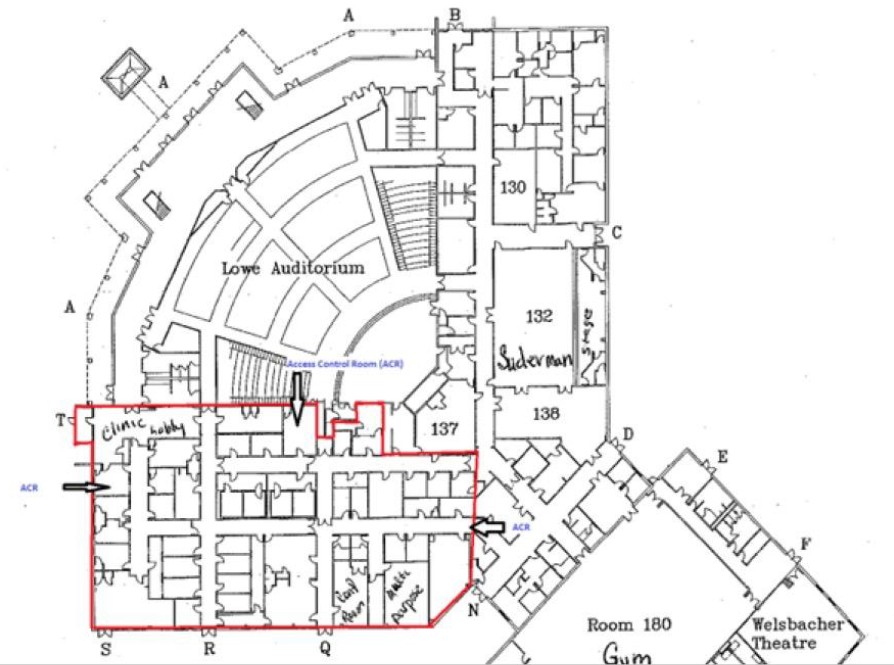
SLHC Bulding Floor Plan - click to enlarge image.
Appendix D: Clinic Development Outline (CDO)
Clinical Development Outline
Communication Sciences and Disorders
Wichita State University
The student must meet the requirements of the university as well as demonstrate a set of knowledge and skills as defined by ASHA certification standards. It is possible for a student to make a passing grade in a course/practicum and still not demonstrate all of the knowledge and skills needed in practice.
When a student does not meet a competency in a clinical experience, the areas requiring attention will be identified and goals and recommendations will be developed for the student to complete in order to demonstrate competency in the area(s). The individual(s) who initiate the development outline will determine if the goals have been achieved in the designated time frame.
A copy of the outline is distributed to the student and scanned into their local folder in CALIPSO. If a student does not meet the qualifications of the CDO by the end of the first fall semester, a Student Assistance Plan will be developed, and the Clinic Director and the Graduate Coordinator are notified.
Student: _______________________________________ Supervisor: _______________________________________ Semester: ____________________
Date of Current Plan: ________________________________________________
Areas Identified (Knowledge and Skills) and Goals to be Completed (Specific and Measurable)
Evaluation Skills
- By the end of the Fall Semester, the student will obtain a minimum score of 3.0 in CALIPSO pertaining to how they administer and score a diagnostic test correctly (Std V-B, 1c).
- By the end of the Fall Semester, the student will obtain a minimum score of 3.0 in CALIPSO pertaining to how they interpret, integrate, and synthesize test results, history, and other behavioral observations to develop a diagnosis (Std V-B, 1e).
- By the end of the Fall Semester, the student will obtain a minimum score of 3.0 in CALIPSO pertaining to how they complete administrative and reporting functions necessary to support evaluation (Std V-B, 1f).
Intervention Skills
- By the end of the Fall Semester, the student will obtain a minimum score of 3.0 in CALIPSO pertaining to how they select or develop and use appropriate materials/instrumentation (Std V-B, 2c).
- By the end of the Fall Semester, the student will obtain a minimum score of 3.0 in CALIPSO pertaining to how they use appropriate models, prompts, or cues while allowing time for patient response.
- By the end of the Fall Semester, the student will obtain a minimum score of 3.0 in CALIPSO pertaining to how they complete administrative and reporting functions necessary to support intervention (Std V-B, 2f).
Professional Practice, Interaction, and Personal Qualities
- By the end of the Fall Semester, the student will obtain a "Met" in CALIPSO pertaining to how they adhere to the ASHA Code of Ethics and conduct themselves in a professional, ethical manner (Std IV-E, V-B, 3d).
- By the end of the Fall Semester, the student will obtain a "Met" in CALIPSO pertaining to how they assume a professional level of responsibility and initiative in completing all requirements.
- By the end of the Fall Semester, the student will obtain a "Met" in CALIPSO pertaining to how they demonstrate openness and responsiveness to clinical supervision and suggestions.
- By the end of the Fall Semester, the student will obtain a "Met" in CALIPSO pertaining to how they display organization and preparedness for all clinical sessions.
Date to be Completed: ________________________________________________
Supervisor's Signature: ________________________________________ Date: ________________
Student's Signature: ________________________________________ Date: ________________
Other: ________________________________________ Date: ________________
Outcome
☐ Achieved
☐ Continue Plan
☐ Revise Plan
Supervisor's Signature: ________________________________________ Date: ________________
Student's Signature: ________________________________________ Date: ________________
Other: ________________________________________ Date: ________________
Revised: 05/15/2024
Appendix E: Student Assistance Plan (SAP)
Student Assistance Plan
Communication Sciences and Disorders
Wichita State University
The student must meet the requirements of the Program as well as demonstrate a set of knowledge and skills as defined by ASHA certification standards. It is possible for a student to make a passing grade in a course/practicum and still not demonstrate all of the knowledge and skills required for practice.
When a student does not meet a competency in a clinical experience, the areas of study requiring attention will be identified and goals and recommendations will be developed for the student to complete in order to demonstrate competency in the area(s). The individual who initiates the plan will determine if the objective(s) have been achieved in the designated time frame.
A copy of the plan is distributed to the student and uploaded into the student's local folder in CALIPSO.
Student: _______________________________________ Supervisor: _______________________________________ Semester: ____________________
Date of Current Plan: ________________________________________________
Area(s) Identified (Knowledge and Skills)
________________________________________________________________________________
________________________________________________________________________________
________________________________________________________________________________
Goals to be Completed (Specific and Measurable)
________________________________________________________________________________
________________________________________________________________________________
________________________________________________________________________________
________________________________________________________________________________
Recommendations for Completion
________________________________________________________________________________
________________________________________________________________________________
________________________________________________________________________________
________________________________________________________________________________
Date to be Completed: ________________________________________________
Supervisor's Signature: ________________________________________ Date: ________________
Student's Signature: ________________________________________ Date: ________________
Other: ________________________________________ Date: ________________
Outcome
☐ Achieved
☐ Continue Plan
☐ Revise Plan
Supervisor's Signature: ________________________________________ Date: ________________
Student's Signature: ________________________________________ Date: ________________
Other: ________________________________________ Date: ________________
Revised: 05/15/2024
Appendix F: Flowsheet for the CDO and the SAP
Flowsheet for Clinical Course Concerns
Clinical Development Outline (CDO) and Student Assistance Plan (SAP)
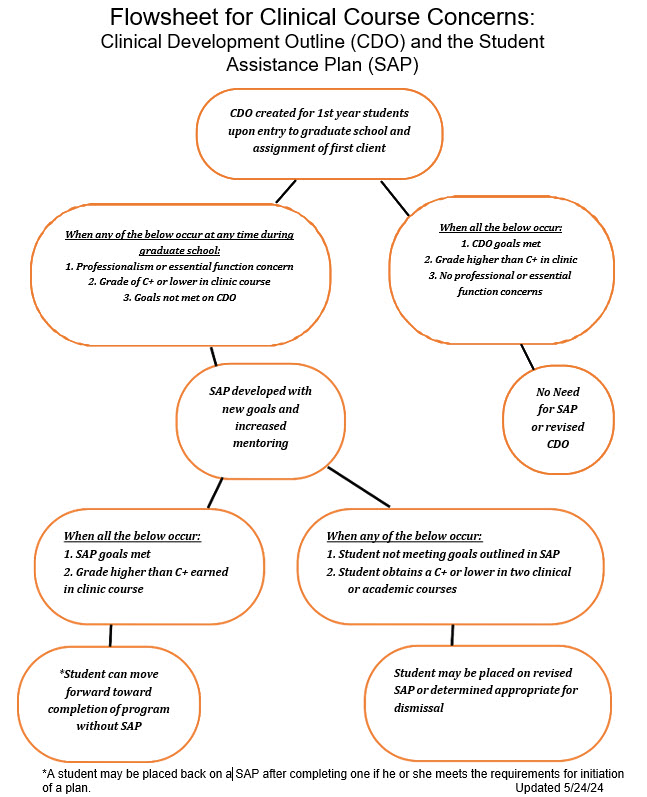
Graphic version for Flowsheet - click to enlarge image.
Text version for Flowsheet shown below.
Step 1
A Clinical Development Outline (CDO) is created for first-year students upon entry to graduate school and assignment of their first client.
Step 2
If any of the following occur at any time during graduate school:
- Professionalism or essential function concern
- Grade of C+ or lower in a clinic course
- Goals not met on the CDO
↓
SAP developed with new goals and increased mentoring.
If Concerns Are Not Present
When all of the following occur:
- CDO goals are met
- Grade higher than C+ in clinic
- No professional or essential function concerns
↓
No need for SAP or revised CDO.
* Student may continue toward completion of the program without SAP.
Review of SAP
When all of the following occur:
- SAP goals are met
- Grade higher than C+ earned in clinic course
↓
Student may move forward toward completion of the program without SAP.
Additional Review Required
If any of the following occur:
- Student is not meeting goals outlined in the SAP
- Student obtains a C+ or lower in two clinical or academic courses
↓
Student may be placed on a revised SAP or determined appropriate for dismissal.
Note: A student may be placed back on a SAP after successfully completing one if he or she meets the requirements for initiation of a plan.
Updated: 5/24/24
Appendix G: Flowsheet for Academic Course Concerns
Flowsheet for Academic Course Concerns
Academic Warnings and Graduate School Probation
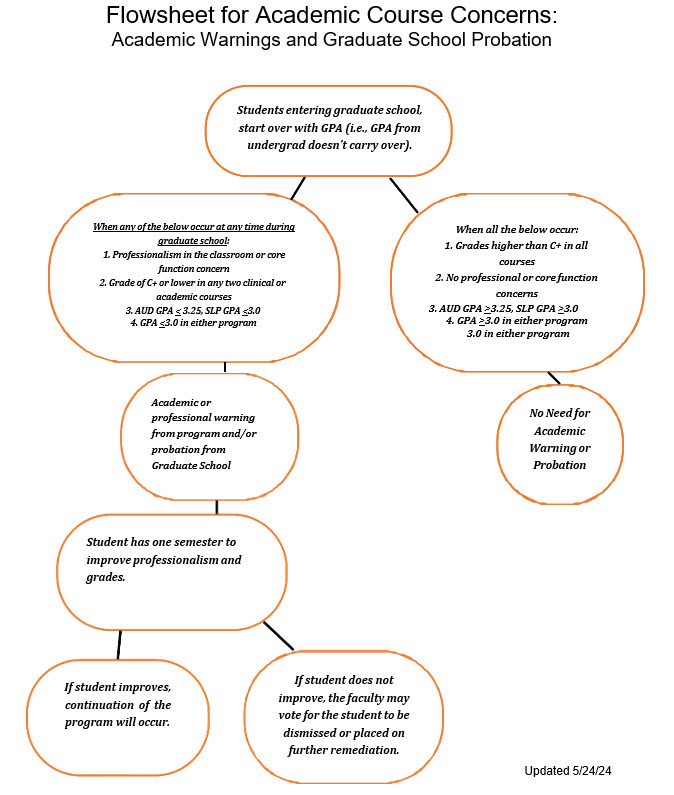
Graphic version for Flowsheet - click to enlarge image.
Text version for Flowsheet shown below.
Starting Point
Students entering graduate school start over with their graduate GPA. Undergraduate GPA does not carry over.
When Academic or Professional Concerns Occur
If any of the following occur at any time during graduate school:
- Professionalism concern in the classroom or a core function concern
- Grade of C+ or lower in any two clinical or academic courses
- AUD GPA ≤ 3.25 or SLP GPA ≤ 3.0
- Overall GPA ≤ 3.0 in either program
↓
Academic or professional warning from the program and/or probation from Graduate School.
Following an Academic Warning or Probation
Student has one semester to improve professionalism and grades.
↓
If the student improves, continuation in the program will occur.
↓
Student continues in the program.
If Improvement Does Not Occur
If the student does not improve, the faculty may vote for the student to be dismissed or placed on further remediation.
↓
Possible dismissal from the program or additional remediation.
If Academic Standing Remains Satisfactory
When all of the following occur:
- Grades higher than C+ in all courses
- No professional or core function concerns
- AUD GPA ≥ 3.25 or SLP GPA ≥ 3.0
- Overall GPA ≥ 3.0 in either program
↓
No need for academic warning or probation.
Updated: 5/24/24
Appendix H: Artificial Intelligence
Please note in particular that Unauthorized Use or Possession of Materials or Resources (WSU Policy 2.17, item IV.B.2) includes unauthorized use of generative AI like ChatGPT or GPT4.
In this program, all use of generative AI is prohibited unless you clearly identify any generated content and appropriately cite the tool used. If you use it to format a paper, clearly state you did so and cite the tool. If you use it to make an image, clearly state you did so and cite the tool. If you use it to help you write, clearly say so, and cite the tool.
There are some appropriate AI uses we may talk about in classes; however, AI is not a person, and cannot be responsible for plagiarism—if you use an AI and it plagiarizes, copies, or messes up something, you are responsible.
Any student suspected of unauthorized use of generative AI may be asked to demonstrate their mastery of the assignment learning outcomes in an alternate format, such as a verbal interview or an additional problem set, before a determination is made as to whether an academic integrity violation report is warranted.
Appendix I: College of Health Professions Use of Personal Devices Policy
Use of Personal Electronic Devices in the Clinical Setting
CHP students, faculty and staff may not use personal cell phones, recording devices, or other electronic communication devices in patient serving areas, except within designated areas of the clinical practice site/WSU clinic. CHP students, faculty and staff must adhere to all specific college and clinic policies, procedures, and professional behaviors pertaining to the use of electronic devices during clinical lab time (including clinical conference times). Expectations are covered annually by clinical management along with HIPAA training, or as new CHP students, faculty and staff are introduced to the clinic setting.
Computer use during patient care activities should be restricted to clinical care activities only on WSU owned or approved devices. Use of clinical computers for personal communication, personal entertainment, non-academic, or to work on academic assignments is strictly prohibited.
Inappropriate use of any electronic device during clinical work may result in dismissal from the clinical setting. Inappropriate use of electronic devices within the clinical setting constitutes unprofessional behavior and can result in disciplinary action such as a code of academic integrity violation with CHP’s Dean’s Office. Inappropriate use of electronic devices that results in a violation of HIPAA (Health Insurance Portability and Accountability Act) will be reported as outlined in the college’s policy. Violations of this policy, HIPAA or the Code of Conduct, may result in unsuccessful completion of the clinical portion of the course.
Approved 12/9/2024
Appendix J: Ahlberg Hall Emergency Plan
Wichita State University College of Health Professions
Ahlberg Hall - 1845 Fairmount St. Wichita, KS 67260
Emergency Procedures
TORNADO
- Remain calm and offer assistance to others.
- Take the nearest staircase and go to the first floor.
- Do not panic or push others while heading towards the first floor.
- Remain on the first floor until the all clear is given by emergency personnel.
MEDICAL EMERGENCY
- Call 911 immediately.
- Avoid leaving the injured person(s) except to summon help.
- Do not move the injured person(s).
- Render first aid or CPR if you are trained and feel comfortable doing so.
SUSPICIOUS PERSON
- Do not let a stranger into locked or secured areas for any reason.
- Do not confront or attempt to stop any person from leaving the area.
- Move to a safe location and call WSU Police at 316-978-3450.
SUSPICIOUS OBJECT
- Do not disturb, touch or use electrical devices near object.
- Move at least 100 yards from the object to a safe location and call 911.
ACTIVE SHOOTER
- WHEN SAFE TO DO SO, CALL 911.
- AVOID
- Pay attention to your surroundings.
- Have an exit plan.
- Move away from the source of the threat as quickly as possible.
- The more distance and barriers between you and the threat, the better.
- DENY when getting away is difficult or maybe impossible.
- Create barriers to prevent or slow down a threat from getting to you.
- Turn off the lights.
- Remain out of sight and quiet by hiding behind large objects and silencing your phone.
- DEFEND because you have the right to protect yourself.
- Be prepared to defend yourself.
- Be aggressive and committed to your actions.
- Do not fight fairly. THIS IS ABOUT YOUR SURVIVAL.
EARTHQUAKE
- STOP; Running is the most common cause of injury during an earthquake.
- DROP; Make sure your head is not the tallest thing in the room.
- COVER; Get under a desk or table to protect yourself from falling objects.
- HOLD; Whatever you are under, hold on tightly until the shaking stops.
- When tremors stop, evacuate the building.
- Check yourself and others for injuries and call 911 if medical help is needed.
- Report your status to school officials.
- Look out for further information through email, RAVE texts, and social media(s).
- Avoid using cell phone lines except for emergency calls.
- Use text messages for other contacts.
FIRE
- PULL NEAREST FIRE ALARM!
- Alert other people as you evacuate the building.
- Use staircase to leave the building. Do NOT use elevators!
- Once outside, go towards the Northwest corner of the building, closest to the RSC.
- If safe to do so, take all personal items.
- If there is time, secure all equipment and materials before evacuating.
- Assist persons with disabilities and/or special needs.
- Do not re-enter building(s) until directed by emergency personnel.
HAZARDOUS MATERIALS
- CALL 911!
- Notify affected personnel immediately and evacuate the contaminated area.
- Move to a safe distance of at least 100 yards.
- Advise others to stay clear of contaminated area.
- If needed, render first aid or CPR only after consulting with 911 dispatchers.
- Wait for further instructions from emergency personnel.
- Police & Fire 911
- WSU Police 316-978-3450
- Custodial 316-978-3444
SHOCKER ALERT SYSTEM
With the Shocker Alert System, WSU will contact you by email when there is an emergency
or weather alert that affects the campus. To sign up for text alerts through the emergency
notification system, Rave at https://www.wichita.edu/services/shockeralert/
Appendix K: Clinic Emergency Plan
Wichita State University College of Health Professions
Eugene M. Hughes Metropolitan Complex
5015 East 29th St., Wichita, KS 67620
Emergency Procedures
TORNADO
- Remain calm and offer assistance to others.
- Take the nearest exit and head to the designated tornado shelter: WSU General Dentistry Practice building (AEGD) basement.
- If you cannot move to the designated tornado shelter, you can shelter in place in the audiology booths (room 166 and 168).
- Remain in shelter until the all clear is given by emergency personnel.
MEDICAL EMERGENCY
- Call 911 immediately.
- Avoid leaving the injured person(s) except to summon help.
- Do not move the injured person(s).
- Render first aid or CPR if you are trained and feel comfortable doing so.
SUSPICIOUS PERSON
- Do not let a stranger into locked or secured areas for any reason.
- Do not confront or attempt to stop any person from leaving the area.
- Move to a safe location and call WSU Police at 316-978-3450.
SUSPICIOUS OBJECT
- Do not disturb, touch or use electrical devices near object.
- Move at least 100 yards from the object to a safe location and call 911.
ACTIVE SHOOTER
- WHEN SAFE TO DO SO, CALL 911.
- AVOID
- Pay attention to your surroundings.
- Have an exit plan.
- Move away from the source of the threat as quickly as possible.
- The more distance and barriers between you and the threat, the better.
- DENY when getting away is difficult or maybe impossible.
- Create barriers to prevent or slow down a threat from getting to you.
- Turn off the lights.
- Remain out of sight and quiet by hiding behind large objects and silencing your phone.
- DEFEND because you have the right to protect yourself.
- Be prepared to defend yourself.
- Be aggressive and committed to your actions.
- Do not fight fairly. THIS IS ABOUT YOUR SURVIVAL.
EARTHQUAKE
- STOP; Running is the most common cause of injury during an earthquake.
- DROP; Make sure your head is not the tallest thing in the room.
- COVER; Get under a desk or table to protect yourself from falling objects.
- HOLD; Whatever you are under, hold on tightly until the shaking stops.
- When tremors stop, evacuate the building.
- Check yourself and others for injuries and call 911 if medical help is needed.
- Report your status to school officials.
- Look out for further information through email, RAVE texts, and social media(s).
- Avoid using cell phone lines except for emergency calls.
- Use text messages for other contacts.
FIRE
- PULL NEAREST FIRE ALARM!
- Alert other people as you evacuate the building.
- Use staircase to leave the building. Do NOT use elevators!
- Once outside, go towards the Southwest corner of the building.
- If safe to do so, take all personal items.
- If there is time, secure all equipment and materials before evacuating.
- Assist persons with disabilities and/or special needs.
- Do not re-enter building(s) until directed by emergency personnel.
HAZARDOUS MATERIALS
- CALL 911!
- Notify affected personnel immediately and evacuate the contaminated area.
- Move to a safe distance of at least 100 yards.
- Advise others to stay clear of contaminated area.
- If needed, render first aid or CPR only after consulting with 911 dispatchers.
- Wait for further instructions from emergency personnel.
- Police & Fire 911
- WSU Police 316-978-3450
- Custodial 316-978-3444
SHOCKER ALERT SYSTEM
With the Shocker Alert System, WSU will contact you by email when there is an emergency
or weather alert that affects the campus. To sign up for text alerts through the emergency
notification system, Rave at https://www.wichita.edu/services/shockeralert/