

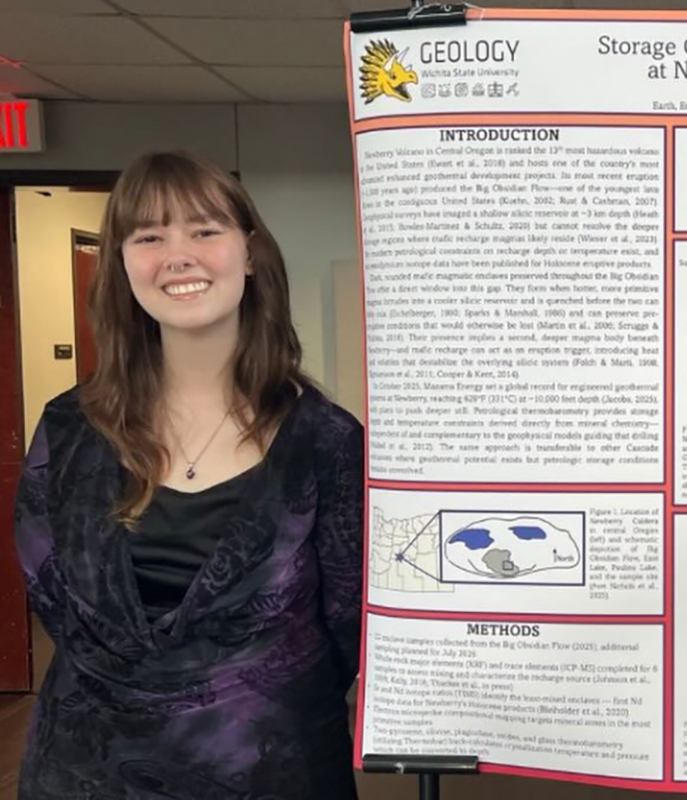
Elizabeth Small, a geology master’s student at Wichita State University, is turning a childhood fascination with rocks into valuable experience for her future career.
Through an applied learning position with Wichita State’s Geology Department, Elizabeth works as an Applied Learning Student Assistant for Geological Collection Curation. She plans to graduate in spring 2027.
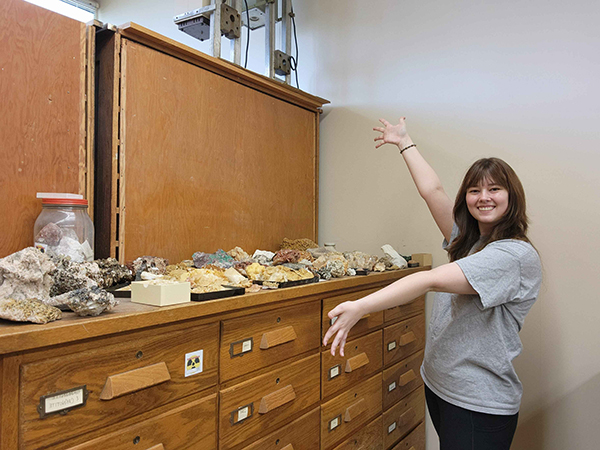
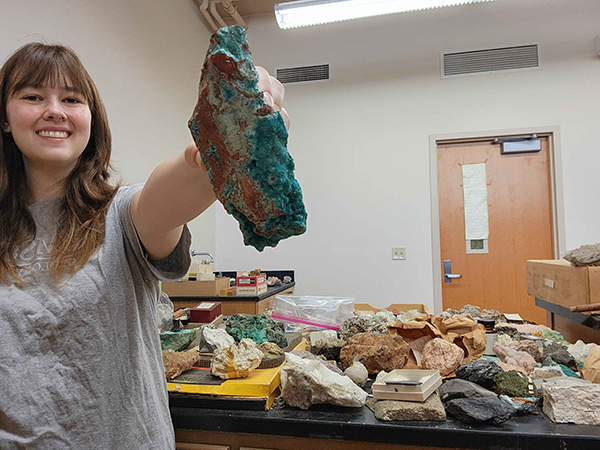
In her role, Elizabeth identifies and organizes rock and mineral samples within the department’s geological collection. The work requires her to carefully examine each specimen’s physical and optical properties and maintain accurate records so the collection remains a useful resource for students, faculty and researchers.
For Elizabeth, one of the most valuable aspects of the position has been working with a much wider variety of specimens than she has encountered through coursework alone.
“Learning to identify more complex specimens in hand samples has sharpened skills that carry directly into my research,” Elizabeth said.
Early in her role, Elizabeth occasionally encountered minerals she could not immediately identify. She worked through the identification process by testing each specimen’s hardness, examining its cleavage and considering the geological environment in which it likely formed. Reaching a confident identification was both challenging and rewarding.
“It reminded me why I was drawn to geology in the first place, and it made me noticeably more efficient in the lab, where being able to recognize minerals in hand samples before sitting down at an instrument saves real time,” Elizabeth said.
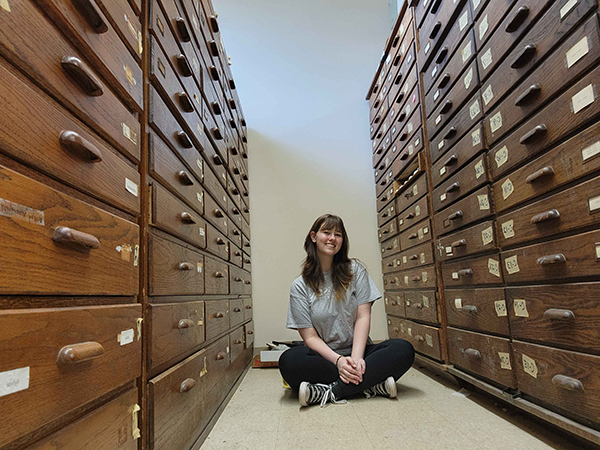
The position has also prepared her for fieldwork in ways she did not expect. As the Geology and Anthropology departments merge their spaces, Elizabeth has helped locate samples scattered throughout the building over the years. Some were tucked away in unrelated labs, while others were stored in unexpected areas of the basement.
Relocating and consolidating the collection has been physically demanding, but it has given Elizabeth a greater appreciation for the behind-the-scenes work required to preserve a scientific collection.
“It has also been, somewhat unexpectedly, good preparation for the realities of fieldwork,” Elizabeth said. “You have to be organized, adaptable and willing to haul boxes full of miscellaneous rocks across a building.”
Elizabeth’s passion for geology began long before graduate school. Growing up in Lancaster, South Carolina, she often slipped decorative rocks from her grandmother’s garden into her pockets. Without realizing it, she was already beginning to build the curiosity that would shape her future career.
“Working with a formal geological collection feels like a full-circle moment, and it’s a reminder that the curiosity that got me here has always been there,” Elizabeth said.
Funding provided through the State of Kansas applied learning initiative has allowed Elizabeth to focus more fully on her education, research and professional development.
“Graduate school comes with financial pressures that can make it difficult to concentrate fully on your work, and this support helped relieve that burden so I could show up to both my position and my coursework with more energy,” Elizabeth said.
Wichita State's applied learning program gives students hands-on, paid experience with industry partners, helping them build careers before graduation.
For more information, contact the Shocker Career Accelerator at (316) 978-3688, SCA@wichita.edu, or visit wichita.edu/Career. You can also stop by in person at the Marcus Welcome Center, Suite 139, on the Wichita State campus.
 Courtesy Photo
 Courtesy Photo
 Courtesy Photo
 Courtesy Photo