

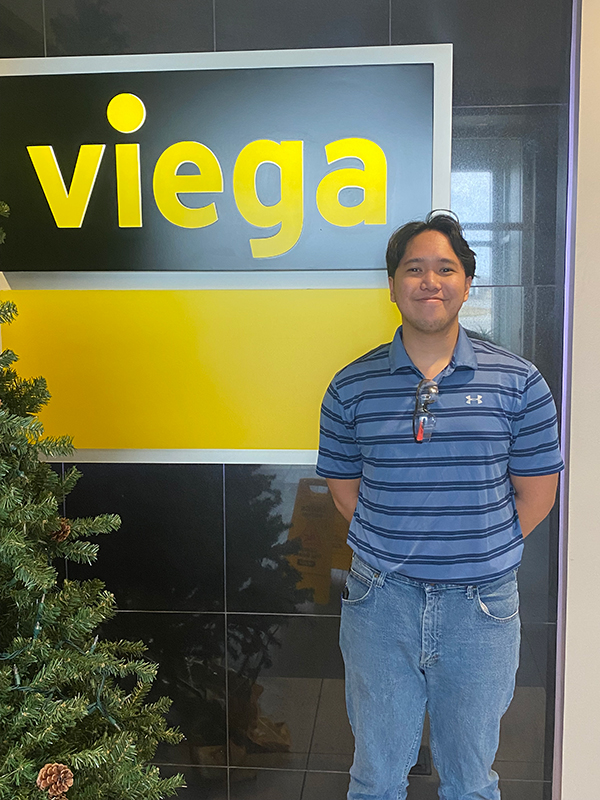
After receiving more than 50 job rejections, Wichita State University mechanical engineering student Isiah Tiongson knew he needed a different approach. With support from the Shocker Career Accelerator—and a meaningful connection made at the Engineering & IT Career Fair—he secured a Summer 2025 internship with Viega that developed into a part-time role during the school year.
Isiah, who is set to graduate in December 2026, first turned to the Shocker Career Accelerator for help with his job search. He met three times with Career Coaches Aaron Evans and Sara Leftwich, who helped him rebuild his resume, strengthen his networking skills, explore different job-search platforms and regain the confidence to keep trying.
“I continue to be grateful for the effort and support they gave me,” Isiah said.
His persistence paid off at the Shocker Career Accelerator’s Fall 2024 Engineering & IT Career Fair. Rather than trying to speak with every employer, Isiah approached the fair with a specific goal: identify three to five companies that genuinely interested him and build meaningful connections with their representatives.
At Viega’s table, he met Christopher Welsh from Human Resources and Herb Schoenhoefer from Quality Management. Viega is a family-owned global leader in press technology and a manufacturer of plumbing and HVAC solutions.
Attending the fair required additional determination from Isiah because he was still recovering from a knee injury.
“It was challenging for me because I had to participate in the fair with a recovering knee, so I was still limping and bandaged,” Isiah said. “Christopher and Herb respected my grit and determination to be at the fair, and they shared details about Viega’s business, culture and work environment.”
That meaningful conversation led to an interview, and Isiah was selected for Viega’s Summer 2025 internship program.
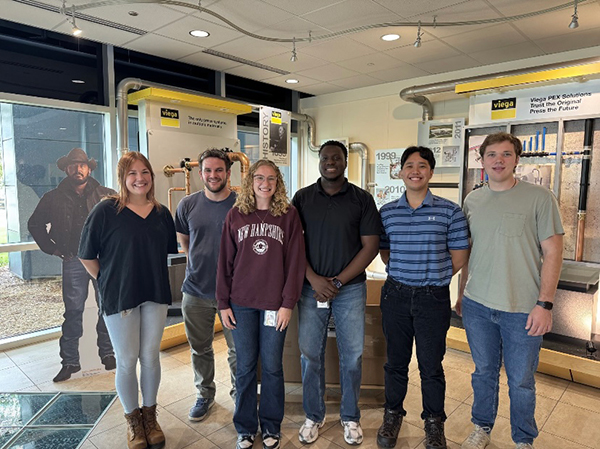
During his internship, Isiah supported Viega’s Maintenance and Reliability Department. Through weekly mentoring from the department’s specialists and engineers, he learned about the team’s daily responsibilities, procedures, technical applications and challenges.
“This allowed me to learn about the applications the team uses, the procedures that must be followed and the team’s day-to-day challenges and responsibilities,” Isiah said.
He gained experience using tools such as Systems, Applications and Products in Data Processing, commonly known as SAP, and a Computerized Maintenance Management System. He also shadowed specialists working in areas such as oil analysis, maintenance scheduling and engineering practices.
One of Isiah’s primary projects was creating a website for the plant’s Technical Documentation Library. The project involved moving existing documents to a more accessible platform while preserving the plant’s established organizational hierarchy.
The experience introduced Isiah to the maintenance and reliability needs of a manufacturing plant and demonstrated the important difference between studying engineering principles in a classroom and applying them in a production environment.
In class, Isiah learned how materials interact, how systems function and how engineering principles work. On the production floor, however, troubleshooting equipment problems and testing possible solutions carried real financial and operational consequences.
“My mistakes in class might mean losing five or 10 points, but in the industry, a mistake can cost $10,000 or more,” Isiah said.
One of his proudest accomplishments came at the end of the internship when the summer interns presented their final projects. Following his presentation, Isiah successfully answered every question he received during the question-and-answer session.
“The other managers were impressed by how much I learned in such a short time and even commended my manager for the training he provided,” Isiah said.
His performance during the internship opened the door for him to continue working part time with Viega throughout the school year. In his ongoing role with the Maintenance and Reliability team, he uses problem-solving and critical-thinking skills to help reduce unplanned machine downtime, analyze parts consumption and support maintenance planning.
The experience also helped Isiah determine what type of engineering career he wants to pursue. Spending time on the production floor, completing routes and troubleshooting equipment showed him that he prefers a hands-on work environment.
“I knew I did not want to be an engineer who would primarily sit at a desk all day,” Isiah said.
Isiah encourages other students—especially international students—to approach their career searches with focus, persistence and a willingness to seek support.
“My advice to all students, especially international students like me, is to be more intentional with your efforts,” Isiah said. “Focus on the things you really want, try relentlessly and never be afraid to ask for help.”
Wichita State's applied learning program gives students hands-on, paid experience with industry partners, helping them build careers before graduation.
For more information, contact the Shocker Career Accelerator at (316) 978-3688, SCA@wichita.edu, or visit wichita.edu/Career. You can also stop by in person at the Marcus Welcome Center, Suite 139, on the Wichita State campus.
 Courtesy Photo
 Courtesy Photo