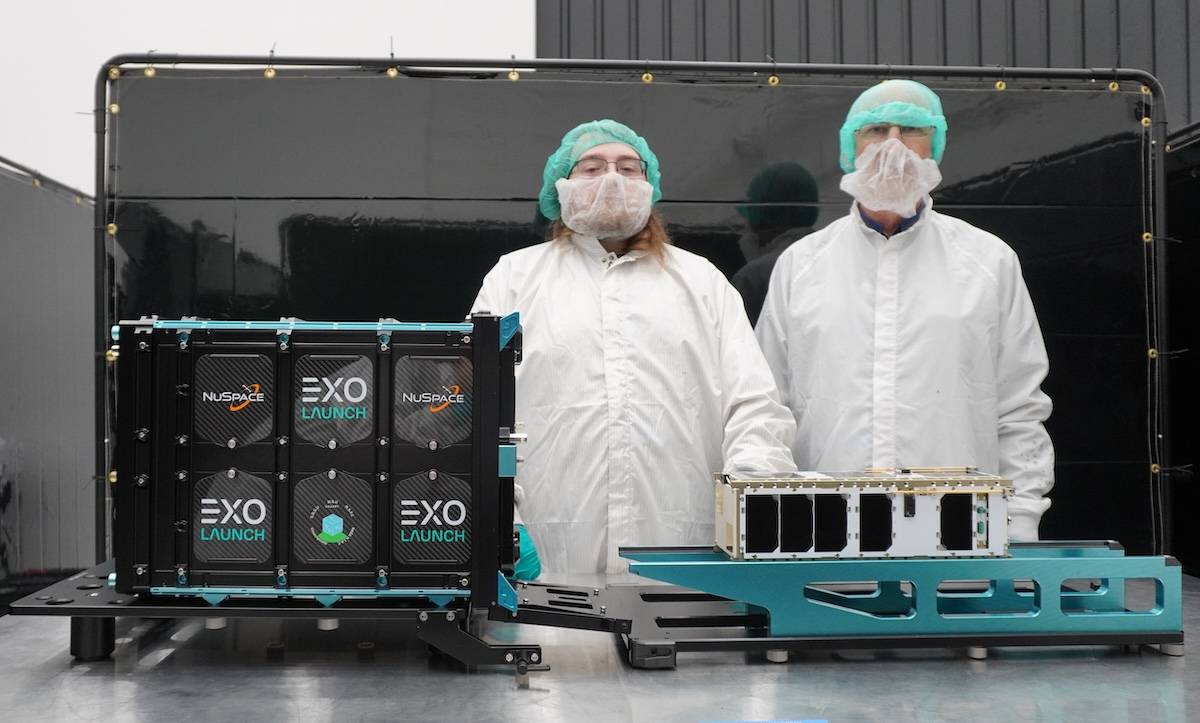
 Photo courtesy of Exolaunch
On May 3, a solar detector prototype developed by Wichita State University will be launched by NASA into low Earth orbit, toward a potential future mission close to the sun.
Integrated via Germany’s launch integrator Exolaunch, the CubeSat platform was built by NanoAvionics of Lithuania. It will carry and test the WSU-designed prototype solar neutrino detector into low Earth orbit. The spacecraft has two main goals: to prove the detector can operate in space; and measure the background rate of the double pulsed interaction signature.
The CubeSat will test a small detector in Earth orbit to measure "false signals"— random noise that can look like real solar neutrino events. This will help scientists understand the expected rates in space they will need to deal with regarding a real larger detector mission close to the sun.
A launch on a SpaceX Falcon 9 Rocket from Vandenberg Space Force Base in Santa Barbara County, California, will represent the most significant step on the project, which started in 2016.
“We do fun things here at Wichita State, like launching CubeSats into orbit and testing detectors up there,” said Dr. Nickolas Solomey, professor of mathematics, statistics and physics. “This is a great opportunity if you’re interested in studying physics.”
A watch party is scheduled for 1:30 a.m. May 3 in Jabara Hall’s room 127. Students, faculty and the public are invited to attend.
professor of mathematics, statistics, and physics
Holding the keys to understanding the universe
The mission aims to validate the feasibility of a larger detector positioned closer to the sun, where the neutrino flux from the fusion core is expected to be 1,000 times or higher than at Earth. The CubeSat project, known as SNAPPY (Solar Neutrino Astro-Particle PhYsic) CubeSat, is a NASA Innovative Advanced Concepts (NIAC)-funded collaboration.
Neutrinos are minuscule subatomic particles that are similar to electrons but have no charge and almost negligible mass. Understanding neutrinos holds the keys to understanding the structure of the universe and the origin of mass. According to neutrinos.fnal.gov, neutrinos are the second most abundant fundamental particle in the universe, mostly left over from the big-bang but the sun is the source of measurable neutrinos.
Neutrino detectors currently in use are positioned deep below the Earth’s surface. WSU’s SNAPPY will allow researchers to look at the sun in a new way, Solomey said, and perform experiments not possible on earth with solar neutrinos.
The project received its first funding in 2017. In 2021, WSU received a grant through the NASA Innovative Advanced Concepts program to collaborate with NASA’s Marshall Space Flight Center. The goal of the grant was to develop a CubeSat neutrino detector for flight demonstration. The CubeSat is a 10 by 10 by 30 centimeters box structure (3U) made mostly of aluminum. The prototype detector weighs 250 grams encased in a 1.5 kg shielding and is housed inside the CubeSat. A dedicated electronics stack, for detector power and readout purposes, is also housed inside the CubeSat . The stack was designed, manufactured and tested by the Instrument Development Team (IDT); the Astrophysics Branch; and the Electrical Design, Imaging and Sensors Branch at NASA Marshall.
Solomey leads the interdisciplinary project, which also includes Dr. Holger Meyer, professor of physics, Atri Dutta, associate professor of aerospace engineering, and Professor Hyuck Kwan, of electrical engineering. Thirty-six graduate and undergraduate students, to date, have worked on the project since its start.
“I’ve been involved in every step, from the detector design to data analysis, to the installation in California,” said Brian Doty, who is earning his doctoral degree in physics and applied math. “I’ll really feel a sense of accomplishment over my whole graduate studies.”
Deployment follows the launch by roughly an hour. The team expects first radio contact with the CubeSat as it passes over Iceland. The CubeSat is expected to remain in orbit about seven years before it burns up upon re-entry. The electronics are expected to last two to three years. Data downloads will be weekly over the large Iceland S-band antenna.
“When we say ‘Hello’ up there, and it says ‘Hello,’ back down to us, that’s when I will really feel some relief,” Meyer said.
The William E. Simon Graduate Research Assistantship in Physics and the William E. Simon Fund in Physics contributed funding to the project through contributions to the physics department.
Several entities have collaborated with Wichita State University on this project, including: NASA’s Marshall Space Flight Center & The National Space Science and Technology Center (NSSTC) in Huntsville, Alabama; NASA’s Jet Propulsion Laboratory in Southern California; the University of Minnesota; the University of Michigan; and South Dakota State University.
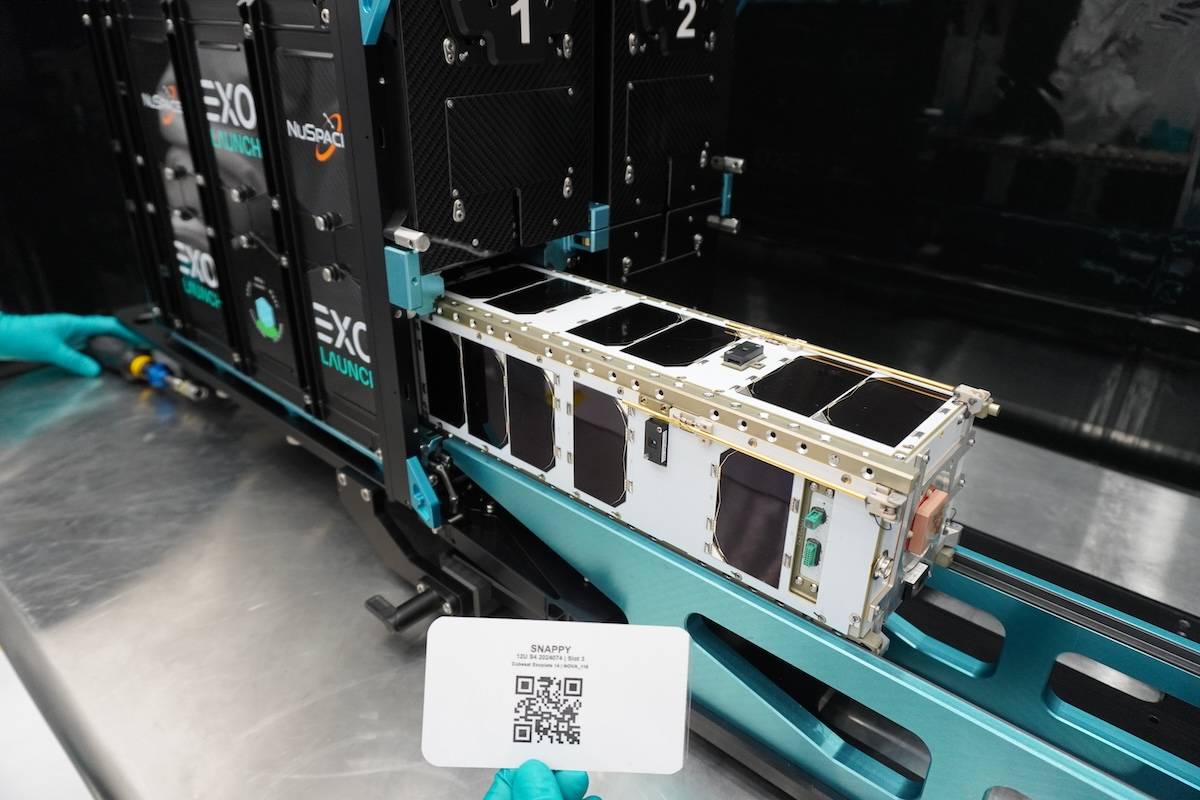 Exolaunch
About Wichita State University
Wichita State University is Kansas' only urban public research university, enrolling more than 25,000 students between its main campus and the WSU Campus of Applied Sciences and Technology (WSU Tech), including students from every state in the U.S. and more than 100 countries. Wichita State and WSU Tech are recognized for being student-centered and innovation-driven.
Located in the largest city in the state with one of the highest concentrations in the United States of jobs involving science, technology, engineering and math (STEM), Wichita State University provides uniquely distinctive and innovative pathways of applied learning, applied research and career opportunities for all of our students. The National Science Foundation ranked WSU No. 1 in the nation for aerospace engineering R&D, No. 2 for industry- and defense-funded engineering R&D and No. 9 overall for engineering R&D.
The Innovation Campus, which is a physical extension of the Wichita State University main campus, is one of the nation’s largest and fastest-growing research/innovation parks, encompassing over 120 acres and is home to a number of global companies and organizations.
Follow Wichita State on social media: