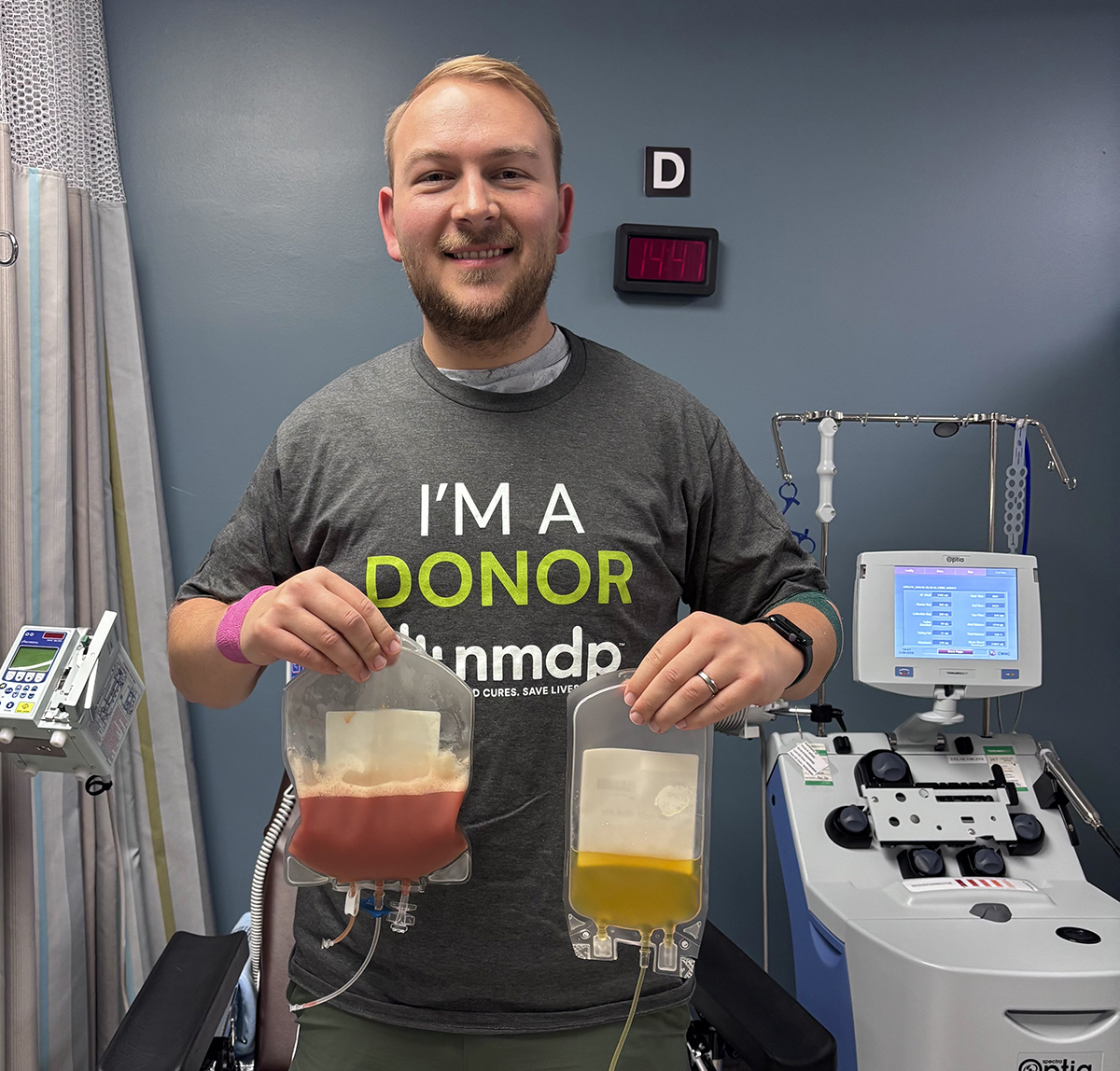
When Joshua Geisler registered as a stem cell donor, he did not expect the decision would lead to a call telling him he was a match for a patient with leukemia.
Geisler, a second-year physician associate student at Wichita State University, said his education helped prepare him to step into the role.
“I felt prepared to be a stem cell donor, based on the experience I had at Wichita State. Our professors teach us that one of the values of our program is compassionate care,” Geisler said. “I thought this was kind of a unique way to live out one of the program's values of compassionate care. Not only can we give medicine and do different procedures, but we can give ourselves.”
He signed up for the National Marrow Donor Program (NMDP) after encouragement from a fellow student, not expecting he would ever be contacted.
“Our class president recommended we sign up to the National Marrow Donor Program, and I signed up, never thinking I would get the opportunity to actually donate stem cells to a patient with leukemia.”
The registration process was straightforward, Geisler said, thanks in large part to classmates who organized the effort.
“It was a tremendous experience. I'm very grateful and kind of humbled that I got to have that experience. Our class president, Paige (Saenz), made everything really easy on us, and she got all the supplies that we needed. We swabbed our cheeks. We dropped it in an envelope, and she was gracious enough to kind of handle it from there.”
Months later, Geisler received multiple missed calls while completing a clinical rotation in Burlington, Kansas. When he returned the call, he learned he was a match.
“I was on my family-medicine rotation in Burlington, Kansas, and I got multiple phone calls, so I figured I should call back. They said, ‘You're a match.’ I called my wife. She was excited. She said, ‘You should absolutely do this.’”
From that point on, the donor program guided him through the screening and preparation process, he said.
“They set everything up. I answered some questions. They screen a few things out to make sure that you're an appropriate donor. After that, I had to do a couple of physicals. I gave some bloodwork to make sure that it was safe for the donor and safe for me to donate.”
Travel and logistics were handled by NMDP, allowing Geisler to focus on the procedure.
“All along the way, the people at NMDP were super helpful in making sure that everything was set up. They arranged flights, hotels, cars, everything, so that the donation process was pretty seamless.”
To prepare for the donation, Geisler administered medication at home to increase stem cell production.
“For about five days, I gave myself just three shots a day at home to help produce more stem cells. It made me feel like I was going through a growth spurt, but other than that, the side effects were very minimal.”
For Geisler, the experience also carried personal meaning tied to his hometown and his university.
“Growing up in Wichita, you feel pride about your city. And one of the things that gives us pride is Wichita State University. As a kid wanting to go to Wichita State basketball games, then going to undergrad and now grad school, it's kind of a surreal experience to be able to represent the university.”
About Wichita State University
Wichita State University is Kansas' only urban public research university, enrolling more than 25,000 students between its main campus and the WSU Campus of Applied Sciences and Technology (WSU Tech), including students from every state in the U.S. and more than 100 countries. Wichita State and WSU Tech are recognized for being student-centered and innovation-driven.
Located in the largest city in the state with one of the highest concentrations in the United States of jobs involving science, technology, engineering and math (STEM), Wichita State University provides uniquely distinctive and innovative pathways of applied learning, applied research and career opportunities for all of our students. The National Science Foundation ranked WSU No. 1 in the nation for aerospace engineering R&D, No. 2 for industry- and defense-funded engineering R&D and No. 9 overall for engineering R&D.
The Innovation Campus, which is a physical extension of the Wichita State University main campus, is one of the nation’s largest and fastest-growing research/innovation parks, encompassing over 120 acres and is home to a number of global companies and organizations.
Follow Wichita State on social media: