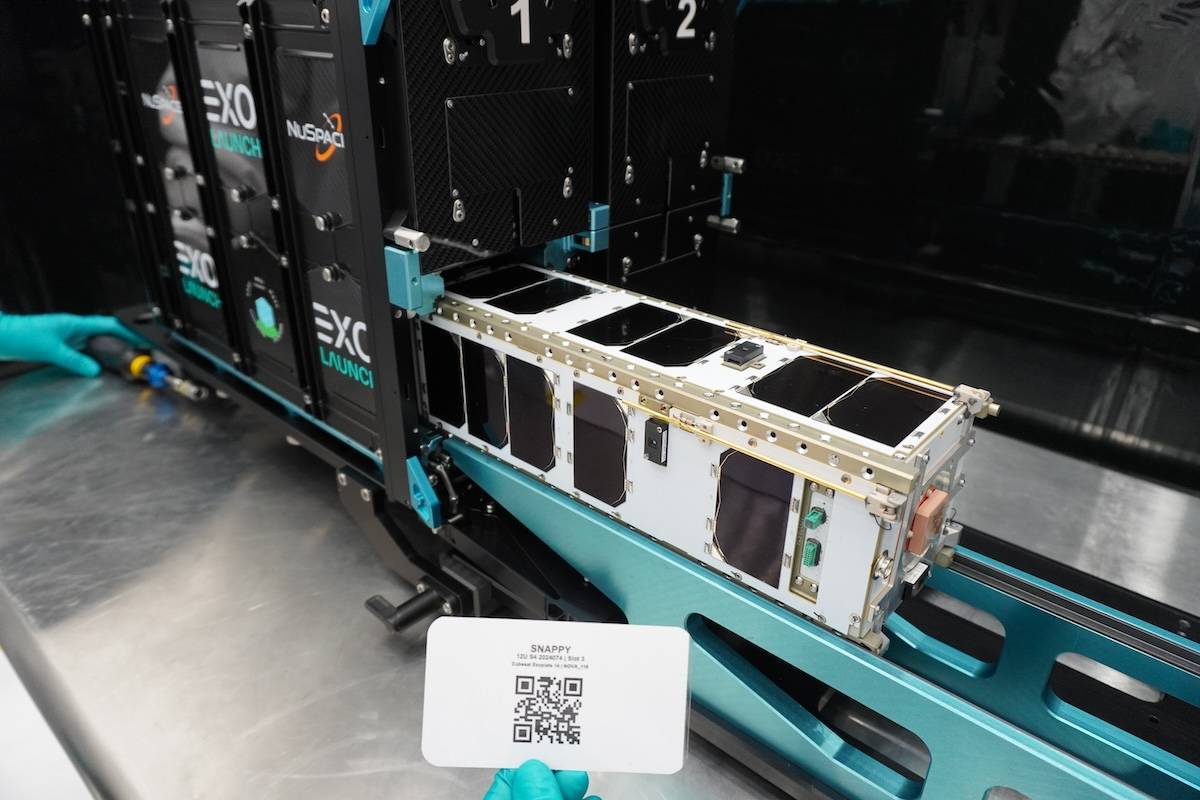
 Exolaunch
On May 3, a satellite prototype created at Wichita State was launched into low space orbit by NASA. On Aug. 4, when the first delivery of data came through, Professor Nickolas Solomey and his entire team of faculty and students breathed a huge sigh of relief.
“It’s something to be excited about for a university that prides itself on technology and educating students to do creative technology,” said Dr. Solomey, professor of mathematics, statistics and physics. “We’re out there measuring things. That is what scared me the most – ‘Is this experiment detector going to work? Because I cannot go up there and fix it like experiments in the lab on earth.’”

Solomey
The CubeSat project, known as SNAPPY (Solar Neutrino Astro-Particle PhYsic) CubeSat, is a NASA Innovative Advanced Concepts (NIAC)-funded collaboration. It aims to validate the feasibility of a larger detector positioned closer to the sun, where the neutrino flux from the fusion core is expected to be 1,000 times or higher than at Earth.
Neutrinos are minuscule subatomic particles that are similar to electrons but have no charge and almost negligible mass. Understanding neutrinos holds the keys to understanding the structure of the universe and the origin of mass. According to neutrinos.fnal.gov, neutrinos are the second most abundant fundamental particle in the universe.
The spacecraft (a 10 by 10 by 30 centimeters box structure made mostly of aluminum) has two main goals: to prove the detector can operate in space; and measure the background rate of the double pulsed interaction signature expected from solar neutrinos.
Neutrino detectors currently in use are positioned deep below the Earth’s surface. WSU’s SNAPPY will allow researchers to look at the sun in a new way, Solomey said, and perform experiments not possible on earth with solar neutrinos.
Solomey said data collection for the primary mission will continue for nine months. An extended run of data could last three to four more years. WSU will use an antenna in Chile during the winter date collection returns to Iceland in the spring.
“What it is telling us is that all the components are working,” Solomey said. “Most of this data is gamma rays. Some is charged particle solar wind mixed together. We will soon be separating this out and we will also start to count gamma ray rates in space and do a full solar wind charged particle analysis.”
The CubeSat orbits the earth every 95 minutes. When over Iceland, transmission takes about nine minutes to an S-band antenna to start its journey to WSU’s Jabara Hall, which is where Wichita State’s team sends control commands.
After the launch in May, they spent months establishing communication, debugging and stabilizing the CubeSat. On Aug. 4, they turned on the detector to start the experiment and receive data. The download reached full power on Aug. 21.
Solomey leads the interdisciplinary project, which also includes Dr. Holger Meyer, professor of physics, Atri Dutta, professor of aerospace engineering, and Professor Hyuck Kwon, of electrical engineering. Thirty-six graduate and undergraduate students, to date, have worked on the project since its start in 2017.
“We built it, we assembled it,” Solomey said. “Aerospace engineering has done a lot with our orbits and daily contact command/download operations. They get to work with a real satellite with orbits and communications and all the stuff you have to worry about.”
SNAPPY is Wichita State’s first space craft. The arrival of data is the latest landmark step in its orbital journey and mission.
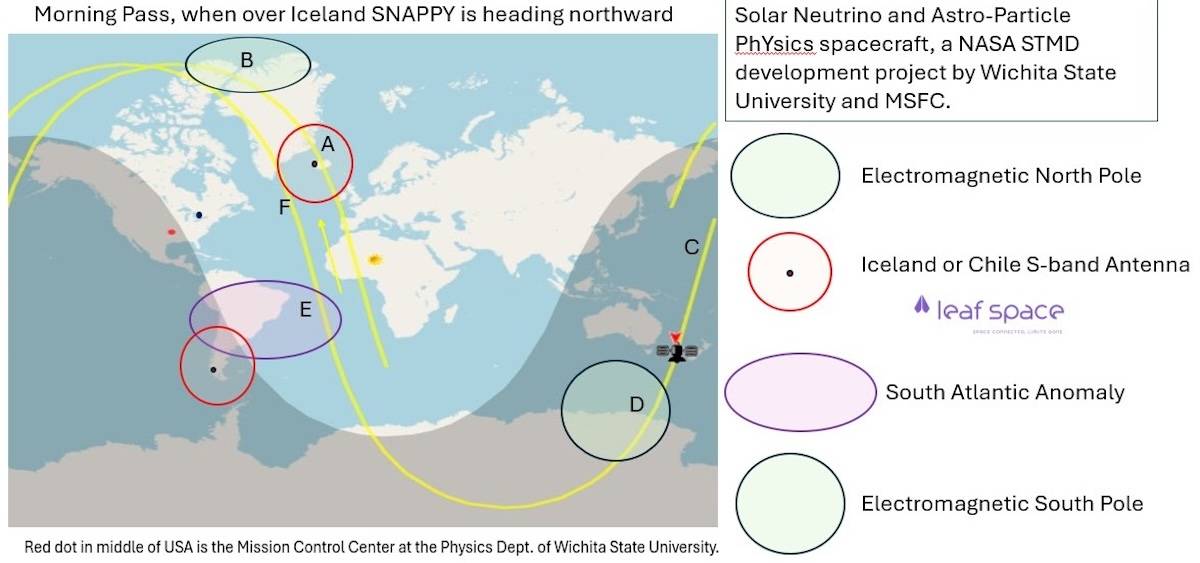 Courtesy graphic
About Wichita State University
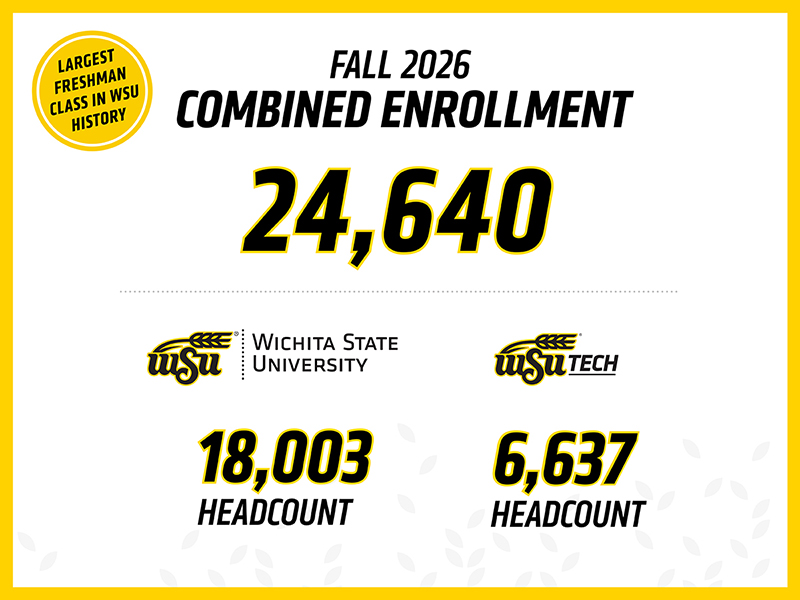
Wichita State University is Kansas' only urban public research university, enrolling more than 25,000 students between its main campus and the WSU Campus of Applied Sciences and Technology (WSU Tech), including students from every state in the U.S. and more than 100 countries. Wichita State and WSU Tech are recognized for being student-centered and innovation-driven.
Located in the largest city in the state with one of the highest concentrations in the United States of jobs involving science, technology, engineering and math (STEM), Wichita State University provides uniquely distinctive and innovative pathways of applied learning, applied research and career opportunities for all of our students. The National Science Foundation ranked WSU No. 1 in the nation for aerospace engineering R&D, No. 2 for industry- and defense-funded engineering R&D and No. 9 overall for engineering R&D.
The Innovation Campus, which is a physical extension of the Wichita State University main campus, is one of the nation’s largest and fastest-growing research/innovation parks, encompassing over 120 acres and is home to a number of global companies and organizations.
Follow Wichita State on social media: