

What do you want to know first?
What is philosophy, anyway?
As an academic discipline in the Western world, philosophy is essentially the strategic and disciplined pursuit of wisdom, particularly wisdom about the most fundamental features of the world and human life. We ask the really hard questions and we develop methods for pursuing answers.
| What's real? | Metaphysics: Space, time, God, immortality of the soul, freedom of will, the nature of existence, the existence of nature, etc. |
|---|---|
| What is good? | Value Theory: Morality, aesthetics, political and social justice, the value of lives and ways of living, etc. |
| What is it to know? | Epistemology: Ways of knowing, possible objects of knowledge, certainty and fallibility, consensus and dissent, etc. |
| By what methods can I become wise? |
(See epistemology!) Logic: Sentential and predicate logic, multivariate and fuzzy logics, non-deductive inference, fallacies and biases, etc. Narrative: Storytelling, first person perspective-taking, immersive imagination and fantasy. Thought experiments: Controlled experiments in thought when we physically or morally can't do the experiment in reality, e.g. the trolley problem, Mary's room. Experience: Pain, acquaintance knowledge, interoception, qualia, phenomenal experience. |
Sometimes we make genuine progress on very hard problems. When we make enough progress, new academic disciplines like physics, biology, and psychology spin off from philosophy. We maintain a strong connection with these disciplines through specialties like philosophy of the arts, philosophy of science, and philosophy of law.
As an activity, philosophy involves critical reflection, conceptual framework and theory development, and analysis of the reasons for or against a position.
Our topics in philosophy focus on conceptual and normative issues that cannot be addressed through empirical means, that is, questions that cannot be answered by experimenting, making an observation, or taking a survey. It's one thing to find out what most people believe is the right thing to do, and another thing to find out what's actually the right thing to do.
Eastern philosophy encompasses the same range of foundational questions as western philosophy, but focuses more on transformative methods and less on adversarial methods of reflection and evaluation. We offer courses in both!
Highly transferable philosophical skills
Our Bachelor of Arts (BA) in Philosophy helps students develop professional skills that are in high demand across a wide variety of fields:
- Ethical and Cultural Literacy: the ability to insightfully work within and across ethical theories and conceptions of value, shift perspectives across cultures and between social roles, embrace normative complexity, recruit others help, and effectively apply evaluative reasoning to make progress on difficult moral problems.
- Critical Thinking Skills: the ability to quickly and accurately discern what is relevant (and what peripheral) to an issue or problem; the ability to identify commonalities within a set of data; the ability to interpret difficult material accurately; the ability to understand difficult, sophisticated material; the ability to draw fine distinctions.
- Logical Reasoning Skills: the ability to determine precisely what follows from a set of premises or an evidence base; the ability to construct logically valid arguments to support a conclusion; the ability to recognize the strengths and weaknesses in a position, proposal, or prospectus; the ability to evaluate the soundness of a position, proposal or argument.
- Research Skills: the ability to independently determine how to explore a domain of inquiry, strategically pursue good evidence, and systematically synthesize results.
- Problem-solving and Prevention Skills: the ability to anticipate problems before they happen, analyze the causal system and its agents, discern and evaluate effective solutions, and put these into action.
- Communication Skills: the analytic ability to clearly, concisely, and precisely articulate reasons and ideas; the narrative ability to tell the story when affectively engaged first-person particularity or lived experience is essential to understanding; the ability to tailor means to ends in communication to reach the audience in the right way at the right level; the ability to present these well.
- Management Skills: The ability to analyze complicated institutional processes, problems and procedures into constituent elements; to devise strategies for addressing problems; to assess progress and evaluate performance and progress objectively.
Given the array of skills developed through the study of philosophy, it is not surprising that corporate executives believe that philosophy graduates “tend to learn fast and advance quickly” (Careers for Philosophers, American Philosophical Association).
Graduates of our program have founded companies and gone on to graduate school in philosophy, law, communications, education, and other fields. We've recently placed our graduates in PhD programs at UCLA, USC, Columbia University, the University of British Columbia, Fordham University, the University of Kansas and other excellent universities, sometimes with full funding for 5-7 years. Several of our graduates have attended law school at Harvard and Cornell. Others have pursued their J.D. at Notre Dame, UC Berkeley, the University of Iowa, Baylor University, American University, Rutgers University, the University of Denver, Washburn University, and the University of Kansas.
Career paths for philosophers
With a philosophy degree you can do just about anything you want.
Academic careers and advanced study
Many philosophy majors pursue graduate studies, whether their aim is to become a professor or to work in the public sector or private industry.
- PhD in philosophy, to become a philosophy professor, philosphical counselor, or ethics expert
- JD, to become a lawyer, judge, or other officer of the court (see our pre-law programs)
- Other graduate degrees in health and helping professions, business and leadership, or the tech sector
Leadership
According to business and industry leaders, two of the most important qualities successful executives must possess are:
- The ability to learn in new situations, and;
- The ability to analyze, interpret and evaluate information (Malnig & Malnig, What Can I Do With a Major In...?, p. 147).
Chief Philosophy Officer
As AI and a variety of other cutting edge technologies are being rapidly developed, companies are increasingly hiring philososophers to develop ethical guidelines, shape how values are baked into product design, and edge test or validate products in development. Several WSU Philosophy graduates have been very successful in engineering and computing careers.
"The thing that has now become a very rich area is this question of value alignment—essentially, what it means for the technology to be actively good,” (Iason Gabriel, Resident Philosopher at DeepMind, quoted in: To Land a Job in AI, Try Reading Kant | Wired Magazine 2026)
- Pulliam, Kit. "Don't learn to code! AI will take your job. Tech companies are hiring philosophers instead," Moneywise, June 2026, reporting on original Wired coverage.
- Anthropic. “Anthropic’s philosopher answers your questions” YouTube.
- Wallace, Benjamin. “The Revenge of the Philosophy Majors” The New York Times.Published July 5, 2026 Updated July 7, 2026.
- Limberger, Peter. “Chief Philosophy Officer,” Less Foolish (Substack), March 19, 2024.
- Percy, Sally (interview with Christian Voegtlin). “Why Your Board Needs A Chief Philosophy Officer” Forbes, March 9, 2018.
- Schuster, Sören. “Chief Philosophy Officer: Conversations on the Intersection of Business and Philosophy,” Institut für Wirtschaftsgestaltung.
- Speranskaya, Natella. “The Heart of Business: Talking with Russia’s First Chief Philosophy Officer,” MAYER&MAYER Magazine, via Medium.
- Wong, Julia Carrie. "Salesforce hires its first chief ethical and humane use officer following Benioff's criticism of Facebook," CNBC, Dec. 10, 2018.
Institutional Review Boards (IRBs)
IRBs review research proposals that involve the use of human subjects. IRB members are tasked to ensure that studies meet ethical standards of informed consent, prospective benefit, risk minimization, and justice. Professional philosophers contribute to IRBs both by carefully critiquing whether and how proposals meet the minimum standards, and are also uniquely positioned to work with researchers to improve study design - to raise the ethical bar without compromising the epistemic value of the study.
Hospital Ethics Boards
Hospital ethics committees help patients and medical professionals gain clarity and insight for decision-making in complex clinical situations such as end-of-life decisions or questions of consent by clarifying moral principles, weighing competing values, and guiding responsible, well-justified decisions. Philosophers contribute breadth of ethical knowledge and insight to this work, often also drawing on training in philosophical counseling, narrative medicine, or narrative philosophy.
Philosophical Counseling
Philosophical counselors engage with clients in reflective dialogue, conceptual clarification, and reasoned examination of beliefs to help them articulate values, confront dilemmas, and achieve greater coherence in their thinking. This work may take the form of individual sessions, group facilitation, or organizational consulting.
What Can You Do With A Philosophy Degree? (7 Careers) | Carneades.org 2022. Accessibility note: The visual information in this video consists in the text for the audio.
Who studies philosophy?
Take a look at what the American Philosophical Association has to say.
Who Studies Philosophy?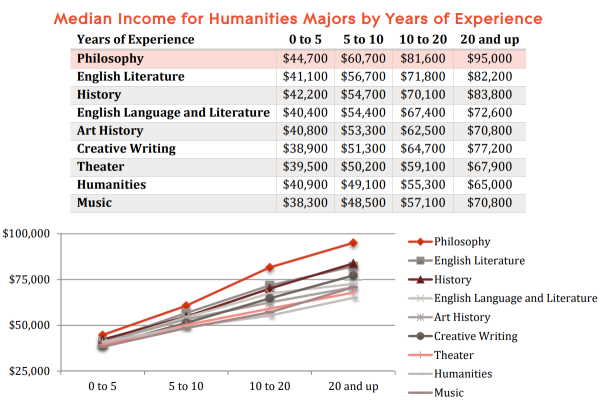 Image Credit: American Philosophical Association