


TeamSTEPPS is an evidence‑based framework designed to improve communication, teamwork, and patient safety across healthcare settings. It provides structured tools and strategies that help interprofessional teams work more effectively, reduce errors, and improve patient outcomes.

Level I
TeamSTEPPS – Level I is a step in a larger goal to expose all students to a longitudinal program called Foundations of Interprofessional Collaboration. The Level I event involves laying the foundation of interprofessional education by exposing students to the basic principles that include three of the four competencies: Values and Ethics, Roles and Responsibilities, and Interprofessional Communication.
Objectives
- Demonstrate a work ethic with individuals of other professions to maintain a climate of mutual respect and shared values.
- Define the role of health professions (including your own) within the healthcare system.
- Acquire basic TeamSTEPPS communication tools to effectively use with healthcare teams.
Activity 1 – IPE Pictionary
Videos
This activity resource is in class.
Activity 3 – Community/School Setting Video
FIPC Level 1 CUS And SBAR Scenarios
The links below are for a demonstration of our FIPC Level 1 Foundations program. These are for students to practice using the TeamSTEPPS Communication tools for CUS and SBAR.
CUS Scenarios
Situation 1: You overhear another team member say to a patient, “I know who you are. I won’t bother you with all those redundant questions” and skip the safety check.
Situation 2: You overhear another team member saying to a patient, “Look, we’re really busy. We’ve had several people call out, and we don’t have enough staff.”
Situation 3: You overhear an RN saying to a nursing assistant, “You’re great at inserting urinary catheters. I trust you. So please go Into Mrs. Smith’s room and put her catheter in, OK? I have your back if someone complains.”
Situation 4: Dr. Jones leaves your unit after seeing Mrs. Smith. You ask him if he ordered pain medication for her severe back pain. He replies, “I’m on my way to the operating room and I don’t have time to go back to the unit and enter that order. Will you please write the order as a verbal order from me?”
Situation 5: A transporter arrives at the nursing unit with a patient to be admitted from the emergency department. You overhear another nurse saying to a coworker, “Oh no! Not another admission!”
Situation 6: Mr. and Mrs. Johnston are having Happy Hour in a local sushi bar. Mr. Johnston has
a shellfish allergy so the couple is very careful about choosing an appetizer that
has no shellfish when giving their order to the server.
The appetizer is delivered by another person. The couple eats two pieces of sushi
before Mrs. Johnston notices the dish doesn’t look like what they ordered.
When the server came back to check on the food, Mrs. Johnston asked if this was the correct appetizer. After checking the server reports they have been served the appetizer for the table next to them, which has crab in it.
Situation 7: Mr. Bowles has type 2 diabetes. He completed a screening for alcohol intake at his clinic visit. The results of the screening indicate he is in the risky to harmful zone for his health risk.
Situation 8: A patient is undergoing a total hip replacement. The nurse notices that the surgeon has contaminated the sleeve of his/her gown.
Situation 9: A patient is in isolation for C. difficile You notice a health care provider leave the room without washing their hands.
Situation 10: After happy hour one night you and your friends decide to move on to dinner. However, as you go to leave, it seems clear that one of your group may have gotten a little more happy than the rest of the group. Your friend is swaying and slurring his/her words. You are concerned because your friend is driving.
Situation 11: You have called an Uber to take you home from the airport after attending a conference. It’s snowing outside and you are on the Interstate heading to your home. Your Uber driver seems distracted by his phone and is driving faster than you are comfortable with given the weather.
SBAR Scenarios
Situation 1: Mary is 80 years old being admitted to the nursing home for rehab following a hospital stay for septic bursitis. She had many complications following surgery. The nurse admitted that Mary had had three episodes of diarrhea since she arrived six hours ago. The nurse is concerned about the cause of the diarrhea, knowing that Mary has been on antibiotics, and wonders if a potential cause could be C. difficile. She is preparing to call the physician.
Situation 2: Joey Black, is a 6-year-old with a history of asthma. He is in the office for a well-child visit, but his asthma has not been well controlled. He has wheezing on most days, which limits his physical activity. He is otherwise well. His mother has expressed some confusion with his medications, and how to administer inhalers. Joey has not had a seasonal flu shot this year, and his mother has questions about why he needs so many vaccines – both seasonal flu and H1N1 immunizations have been recommended for him this year.
Situation 3: A patient has just shown up for his appointment, exactly at the right time, unfortunately, he’s a day early! Assume the member/patient has traveled a good distance and is willing to wait a reasonable amount of time to be seen. You know his primary care provider (Dr. Smith) is busy but sending the member/patient back home is going to be unsatisfying to him.
Situation 4: Patients and visitors are entering the medical center through the wrong doors and getting lost trying to find their destination. The campus has many buildings and is accessible from both Rainbow Blvd and Olathe Street. Other entrances are more noticeable than the hospital’s main entrance. MD offices do not have good maps to mark and hand to patients when sending them to our campus, and they often misdirect patients.
Situation 5: Margaret is 85 years old and has been attending exercise classes at a fitness facility for 15 years. Recently, Margaret was notified the cost of the classes will be increasing. Margaret is on a specific budget to manage her cost of living. The increase in the cost of her exercise classes is beyond what she has available to spend.
Situation 6: `Stanley is 88 years old and has been living in an assisted living facility for two years. He enjoys eating meals with the other residents and engaging in card games with a group of friends he has gotten to know. His daughter also visits him several times a week. Due to a recent public health emergency, the facility is no longer allowing visitors (which includes family), residents are required to eat meals in their rooms, and socialization is restricted within the facility. While Stanley’s daughter recognizes the need for physical social distancing and safety for all, she is also concerned her father will become isolated and withdrawn.
Situation 7: Terri is a 38-year-old living with multiple sclerosis. Terri enjoys spending time with friends, working as a paralegal, and being outdoors. Terri uses a manual wheelchair for mobility. Recently she reported that every time she has attempted to go to the grocery store to pick up items for the week, all the accessible spots are taken which makes it a challenge for her to safely get her wheelchair out of the vehicle.
Situation 8: Your best friend has confided in you about concerns regarding her father. She shared that her dad has been having trouble remembering things. She indicated that he has been known to forget that he has items on the stove, forget to take his medications, and lose his train of thought mid-sentence. Her greatest concern is that her dad lives alone and continues to drive.
SBAR
S – Situation: What is happening now?
B – Background: Explain the circumstances leading up to this situation. Put the situation
into context for the reader/listener. (what factors led up to this event?)
A – Assessment: What do you think the problem is? What do you think is going on?
R – Recommendation: What would you do to correct the problem? What do you think the
next step should be? Or you can ask for a recommendation from the person you are giving
the SBAR to.
CUS
I am Concerned!
I am Uncomfortable!
This is a Safety Issue!
This project is/was supported by the Health Resources and Services Administration (HRSA) of the U.S. Department of Health and Human Services (HHS) under grant number UD7HP25056 and Nurse Education, Practice, Quality, And Retention – Interprofessional Collaborative Practice project: Interprofessional collaborative acute care practice: Pediatrics (ICAP-Peds) for grant amount $997,000. This information or content and conclusions are those of the author and should not be construed as the official position or policy of, nor should any endorsements be inferred by HRSA, HHS, or the U.S. Government. . “Manos, E. L. (2012 – 2015). Interprofessional collaborative acute care practice: Pediatrics (ICAP-Peds). Collaborative Partnership/Grant funded by Health Resources & Services Administration (HRSA) Grant Number UD7HP25056. University of Kansas School of Nursing. Kansas City, KS.”
Level II
As part of the Team STEPPS model, Level II expands on the framework learned through engaging in Level I activities to continue building teamwork skills. By using the information below, students will learn how to use tools necessary to integrate communication, leadership, situation monitoring and mutual support into a variety of settings.
Intended learner outcomes:
- Engage diverse healthcare professionals who complement one’s own professional expertise, as well as associated resources, to develop strategies to meet specific patient care needs
- Choose effective communication tools and techniques, including information systems and communication technologies, to facilitate discussions and interactions that enhance team function
- Engage other health professionals appropriate to the specific care situation-in shared patient centered problem solving.
Introduction to TeamSTEPPS
Basic Assumption: We believe that everyone participating today is intelligent, capable, cares about doing their best, is a valuable part of the healthcare team and wants to learn ow to provide the best quality and safest patient care possible.
TeamSTEPPS Level II: MAIN IPE Case Study Activity I
This video is used for the WSU and KUMC-ICT Campus TeamSTEPPS Level 2 student event. The video demonstrates why good interprofessional teamwork is so important to patient safety.
Activity 1
Review the patient case below and prepare profession-specific recommendations for discussion with your interprofessional team. Develop a collaborative plan of care that addresses the patient's medical, functional, psychosocial, and discharge needs.
Patient Introduction
- BA is a 73-year-old female residing in Kansas City.
- She lives independently and follows up with her primary care provider every 3 to 6 months. Her most recent visit occurred 5 months ago.
- She is independent with activities of daily living (ADLs) and most instrumental activities of daily living (IADLs), although she no longer drives.
- Residual right-sided weakness from a previous stroke affects her primarily after prolonged activity.
- She experienced two falls within the past year but is unwilling to use a cane.
- She has received care from primary care, neurology, nursing, pharmacy, physical therapy, occupational therapy, and nutrition professionals.
- She has not received dental care for many years because of limited dental insurance coverage.
- Past medical history includes hypertension, type 2 diabetes, osteoarthritis, ischemic stroke, dyslipidemia, peripheral neuropathy, asthma, and depression.
- She takes 11 medications for chronic disease management.
- She appears undernourished but maintains independent living, enjoys watching game shows, and regularly attends church.
Inpatient Case Overview
BA presented to the emergency department with slurred speech, generalized weakness for two days, and right lower extremity weakness for approximately six hours. The patient delayed seeking care because she did not want to bother anyone. After developing right arm and hand weakness, she contacted a church friend, who called emergency medical services.
Stroke evaluation and CT imaging identified a new ischemic stroke (small lacunar infarct) as well as evidence of previous infarcts. Because of delayed presentation, the patient was not eligible for thrombolytic therapy. She was admitted for observation by Family Medicine, with Neurology consultation. After approximately 60 hours of hospitalization, the team is preparing discharge to a skilled nursing facility (SNF) for rehabilitation.
Medical and Social History
| Past Medical History | Social History |
|---|---|
|
|
| Family History | Allergies |
|---|---|
|
No known allergies. |
Day 1 Medications and Immunizations
| Medication Category | Medication |
|---|---|
| Asthma |
|
| Hypertension | Hydrochlorothiazide 25 mg every morning |
| Hyperlipidemia | Atorvastatin 20 mg daily |
| Stroke Prophylaxis | Aspirin 81 mg daily (changed to Clopidogrel 75 mg daily on admission) |
| Arthritis |
|
| Peripheral Neuropathy | Gabapentin 300 mg three times daily |
| Diabetes |
|
| Depression | Paroxetine 20 mg every morning |
Immunizations
- Influenza vaccine
- Pneumovax
- Varicella vaccine
Vital Signs
| Vital Sign | October 1, 2013 | October 2, 2013 | October 3, 2013 |
|---|---|---|---|
| Blood Pressure | 175/90 (Admission) 165/80 160/82 158/78 |
155/80 148/82 150/80 |
144/75 145/80 |
| Pulse | 89, 85, 86, 90 | 90, 80, 82 | 84, 82 |
| Respiratory Rate | 15, 19, 20 | 14, 12 | 14 |
| Pulse Oximetry | 96%, 97% | 93%, 95% | 96% |
| Height / Weight | 5'5" / 216 lbs | — | — |
Activity 2
Complete Discharge Form:
Interprofessional Plan of Care - Discharge Documentation Form – Fill out form
Additional resources and materials to access for the Level II event:
Additional Information for Audiology:
Audiology:
Pure tone audiometry indicated that B.A. has a mild-to-moderate, gradually sloping, sensorineural hearing loss, bilaterally. Word recognition testing was not completed due to patient’s word finding difficulty and because the testing was completed bedside in the inpatient unit. Communication difficulty was observed when visual cues were withheld and was more pronounced at the end of the test session when B.A. was fatigued.
Discussion Questions:
- B.A.’s medical history suggests she has diagnosed with a hearing loss several years ago. You do not have access to her previous tests; however, why might she be experiencing more difficulty communicating now, even if her hearing loss has not progressed?
- Do you think her hearing loss will have an impact on her ability to carry out the recommendations of any of the other team members?
- Do you think she is a candidate for hearing aids or other assistive devices? If so, what would be appropriate for her? What social and physical issues influence your recommendations in this regard and how can you meet her needs?
- What non-technology based recommendations do you have for B.A. and her health-care team regarding ways to improve her ability to communicate and understand instructions?
Additional Information for Dental Hygiene
Dental Hygiene:
She presents with a full upper denture and tooth pain. In addition she has foul odor that she states her children have complained about. You notice the odor as periodontal concerns. You also notice an acetone odor from her mouth as well. She states that her lower jaw aches as a generalized rule and the upper denture does not stay in. Her hard palate has been sore as well with a white non removable lesion. She has extreme difficulty eating with the denture and her diet is mostly soft foods. You also note her ability to move her left side of her tongue is impaired and note food impaction on this side.
Discussion Questions:
- What are the concerns you have with her oral health? How would you address the oral pain on her mandibular arch if you are asked to screen her mouth?
- What might the acetone odor indicate? What lab values would indicate that this is becoming a medical emergency? Who would you notify about this problem?
- What type of education would help her with the periodontal odor? What recommendations could you give her in the acute care setting? What recommendations would you give for her at discharge?
- What would be your recommendation for the left side of her mouth with chewing?
- What questions would you ask her about the non removable lesion on her hard palate. What recommendations would you have?
Additional Information for Medical Laboratory Sciences:
Type II Diabetes Overview
As an MLS, you know that Type II Diabetes is a condition which is associated with insulin resistance and glucose intolerance, which means that the cells are no longer responding to insulin’s signal to allow glucose in, so glucose stays in the plasma, meaning that the cells are intolerant to glucose.
Glucose Results
All 3 glucose labs are elevated. Note: the case did not indicate that the patient was fasting, but based on the reference ranges listed, the patient was fasting - 8-hr. fast is recommended for glucose, and a 10-12 hr. fast is recommended for a lipid panel, which was also drawn on Day 3. The diabetic level for fasting specimens is >126 mg/dL, which all 3 levels on Day 1, Day 2, and Day 3 were higher than.
Hemoglobin A1C
An Hgb A1C was also drawn on Day 1. Hgb A1C is a test which indicates how well a diabetic patient has been keeping their blood glucose in check over a period of 2-3 months. Levels >7% indicate poor glycemic control. The patient’s result was 9.7% which indicates poor control of blood glucose levels.
Dyslipidemia and Cardiovascular Risk
Complications of Type II DM include dyslipidemia, which is associated with increased triglycerides and LDL. In the body, excess glucose gets stored as triglycerides. Triglycerides are the main component of VLDL, which then gets broken down to LDL. Increased levels of LDL are associated the development of atherosclerosis, when can lead to occlusion in the blood vessels causing heart attack, stroke, DVT, pulmonary embolism, et cetera.
HDL is our “good” cholesterol and helps to remove LDL from the body. The patient’s combination of elevated TC, triglycerides and LDL, and decreased HDL put a patient at increased risk of complications associated with dyslipidemia.
Note: scenario lists >40 mg/dL as the reference range for HDL, but NCEP optimal levels are actually >60 mg/dL.
Renal Impairment and Creatinine
Increased levels of creatinine are associated with renal impairment. Kidney function can be detrimentally affected by high glucose levels over an extended time period. Filtering capacity is diminished, so substances that normally would be easily filtered through the kidneys and excreted, get retained.
Creatinine is commonly measured as an indication of renal function, because creatinine is not normally retained in body. Typically, the main reason that we see increased levels is when normal kidney function is decreased.
Questions:
- Why are the creatinine levels often elevated in Type II Diabetic patients?
- Explain the significance of getting fasting levels versus random when monitoring glucose and lipids levels?
- Explain the significance of performing a HgbA1C? What does it tell us about how a diabetic patient is keeping their disease under control? What is the ideal level that diabetics should keep their Hgb A1C levels under? How often do Hgb A1C levels need to be monitored?
- What other testing would be appropriate to monitor renal function and increasing permeability of the renal filtering system?
- Establish a timeline for collecting follow-up lab after discharge
Additional Information for Medicine and PA:
Medicine and PA:
The inpatient team began formulating a safe discharge plan at admission. For BA, this is her second stroke. To prevent further strokes, the inpatient Family Medicine team initiated interventions to reduce her risk for stroke and improve management of her chronic conditions of Hypertension, Hyperlipidemia and Type 2 Diabetes.
Discussion Questions:
- What medical interventions were initiated during the hospitalization to reduce her risk for recurrence of an ischemic stroke and improve management of her chronic conditions?
- What barriers exist that may prevent her from benefiting from these interventions once discharged?
- What resources exist that may facilitate benefit from these interventions once she is discharged?
- What potential harm is associated with the medical interventions initiated during her hospitalization?
- If so, what can we do to mitigate the risk of harm?
Additional Information for Nursing:
Nursing:
As BA’s primary nurse, you assess her right arm and right lower leg weakness and inability to use her fine motor skills in signing her name for consent of treatment. When you administer BA her morning medication, she mentioned that sometimes she was not the best at remembering some of her medications. She was able to recall the majority of her medications and she recognized the remaining meds when you said their name. However, she only knew she was taking aspirin to prevent another stroke and her inhalers for her “breathing” and her “hydrocodone when her knees ached real bad”. She knew she was on meds for her “pressure” and diabetes but was not clear which one was for what. She tells you that she is not sure the she will be able to give herself that “diabetes shot”. You notice that BA has few visitors. In visiting with BA about going home, you discover that she lives alone in an apartment and has never been married. Her apartment is on one level but there are several steps to get into the front door. She has expressed concern about “getting around” at home, and is hopeful that her time at the skilled nursing facility will get her stronger so she can manage on her own at home and get back to church.
Discussion Questions:
- What education does BA need regarding her medications before she can return home? What suggestions do you have to assist BA in taking her medications correctly?
- What additional assessment need to made regarding BA’s ability to give her insulin injections? What other professionals would you want to coordinate for this assessment and teaching?
- What additional assessments of the home needs to be made before the patient can return to her home? What professionals would you want to consult to prepare the home for BA?
- In coordinating the transition-of-care planning, how will you coordinate care of all of the professionals that are working with BA to assist her transition from hospital to skilled nursing facility to home?
Additional Information for Pharmacy:
Pharmacy:
Upon meeting with the patient for a detailed medication reconciliation and history during Day 1 you find out the patient fills her medications at Walmart Pharmacy. She mentioned that sometimes she was not the best at remembering some of her medications and she just took all of them out of the pill bottles when she remembered. She was able to recall the majority of her medications and she recognized the remaining meds when you said their name. However, she only knew she was taking aspirin to prevent another stroke and her inhalers for her “breathing” and her “hydrocodone when her knees ached real bad”. She knew she was on meds for her “pressure” and diabetes but was not clear which one was for what. You called Walmart Pharmacy and determined the patient had not picked up the following medications regularly and adherence was an issue: Atorvastatin, HCTZ, Symbicort, and Metformin. When asked, the patient said she had difficulty remembering her meds and also had issues getting a ride to go pick up her meds at the pharmacy because she doesn’t have a car. The patient understands that her medications are important and she is willing to listen to education and wants to do better, in addition you discussed the possibility of insulin therapy at home and the patient was open to this if it was the best thing for her health.
Discussion Questions:
- What recommendations do you have for optimizing medications or the specific medication regimen for this patient?
- What education does the patient need about her medications, how will you provide this education, and what other professions should you coordinate with?
- What social issues does the patient have that influence her medication regimen? What suggestions do you have and who should you coordinate with?
- What physical limitations does this patient have that may influence some of her medications? What suggestions do you have and who should you coordinate with?
Additional Information for Physical Therapy:
Physical Therapy:
On Day 2, when testing her lower extremity strength sitting at the edge of the bed prior to attempting ambulation, she developed shortness of breath. Throughout the day, the patient made steady progress and was able to go from sitting to standing with moderate assistance. However, static standing balance was only fair. Day 3 (Today), the patient needed only minimal assistance with bed mobility and sit to stand, but required moderate assistance and verbal cues during ambulation (< 20 feet). During ambulation, the patient used a right AFO and rolling walker. The patient demonstrates mild ataxia during ambulation. Due to a few episodes of postural hypotension, significant transition time has been allowed between supine to sit and sit to stand. The patient has high fall risk and has fair safety awareness. She has expressed concern about “getting around” at home, and is hopeful that her time at the skilled nursing facility will get her stronger so she can manage on her own at home and get back to church. She is also concerned about falling at home. The patient understands that she may need to use an assistive device for a while, but wants to be able to “walk without a cane” as soon as possible. She is highly motivated. We have discussed the importance of “safety first” and she seems to be receptive to this. We’ve had some initial discussion about her home environment, and some modifications may be necessary.
Discussion Questions:
- Do you need any additional information to better understand her clinical and/or home picture? What other professions or people would you like to consult with?
- Considering the information from her recent hospital stay and her past medical history, what PT recommendations would you make to ensure quality care and appropriate preparation for returning home in a couple weeks (after the SNF facility)?
- What patient education will be needed related to her current functional status and/or returning home? With which other professions should you coordinate your patient education?
Additional Information for Speech:
Speech Note:
The patient’s speech is mildly dysarthric; articulation is mildly imprecise, speech AMRs are slow, mildly harsh vocal quality, and mild hyper nasality. Word-finding difficulty during conversational speech is evident, and she does not appear to be using any strategies for communicating her ideas when she becomes stuck on a word.
Discussion Questions:
- What type of dysarthria does she have?
- What is the prognosis for improvement of her dysarthria?
- What other areas of speech-language and/or cognition do you want to assess? What measures (standardized or nonstandardized) will you use to assess each of these areas?
- Do you think that her communication skills will have an impact on her ability to carry out the recommendations of any other of the team members?
- Do you think she is a candidate for speech-language therapy? If so, which areas of speech, language, or cognition would you target? For each target area identified, what would be your short-term goals?
- Can you partner with one or more members of the team to help the patient reach a goal that has been suggested by another team member?
Additional Information for Public Health Sciences
Public Health Sciences
As you assess the situation for BA, you notice there are several care providers. Communication among the care team is key. This includes BA. Education on the patient portal could be key prior to her dismissal and as a health manager, it’s key to consider drivers of health that resulted in her need for and access to care.
There are also several components that require plain language communication techniques. It is important to ensure that there is clear understanding of her medications, how to take her medications, her understanding of her current condition, and a plan for her care and safety when she arrives home. As discussed with the nursing staff, she does not remember the names of her medications but does remember them once the name is stated. It is key the care team assesses her health literacy and uses plain language to describe her medications, diagnosis and prognosis, and what she should do if she has another “episode” and is home alone.
Discussion Questions:
- What education does BA need regarding the use of a patient portal before she can return home? What suggestions do you have to assist BA in using the portal for tasks such as scheduling future appointments and reading appointment summaries?
- How could you advise the care team to assess BA’s health literacy for using a telehealth option?
- Consider the materials that need to be reviewed by the team with BA prior to her dismissal. Describe how you could encourage care team providers to incorporate the Teach Back and Show Me methods during BA’s dismissal.
- Consider the larger health services system implications in caring for BA. Who else should be involved in coordinating the transition-of-care plan to assist her adjustments from hospital to skilled nursing facility to home? What drivers of health are “up-stream” or root causes of BA’s current health issues that should also be addressed?
- What services are available to BA upon her return home? How could policy change or infrastructure investment promote or improve elements of BA’s healthcare experience?
Complete Activity 2 Reflection Questions:
TeamSTEPPS Level II, Activity II, Reflection Questions – Fill out form
Activity 3
Entrenched Conflict Skills: The Shannon-Kim Model
| Step | Key Elements | Threats and Tips |
|---|---|---|
| 1. Get ready |
|
|
| 2. Create space |
|
|
| 3. Do the work |
|
|
| 4. Close and affirm |
|
|
Thomas-Kilmann Conflict Mode Instrument (TKI)
[Click image to enlarge]
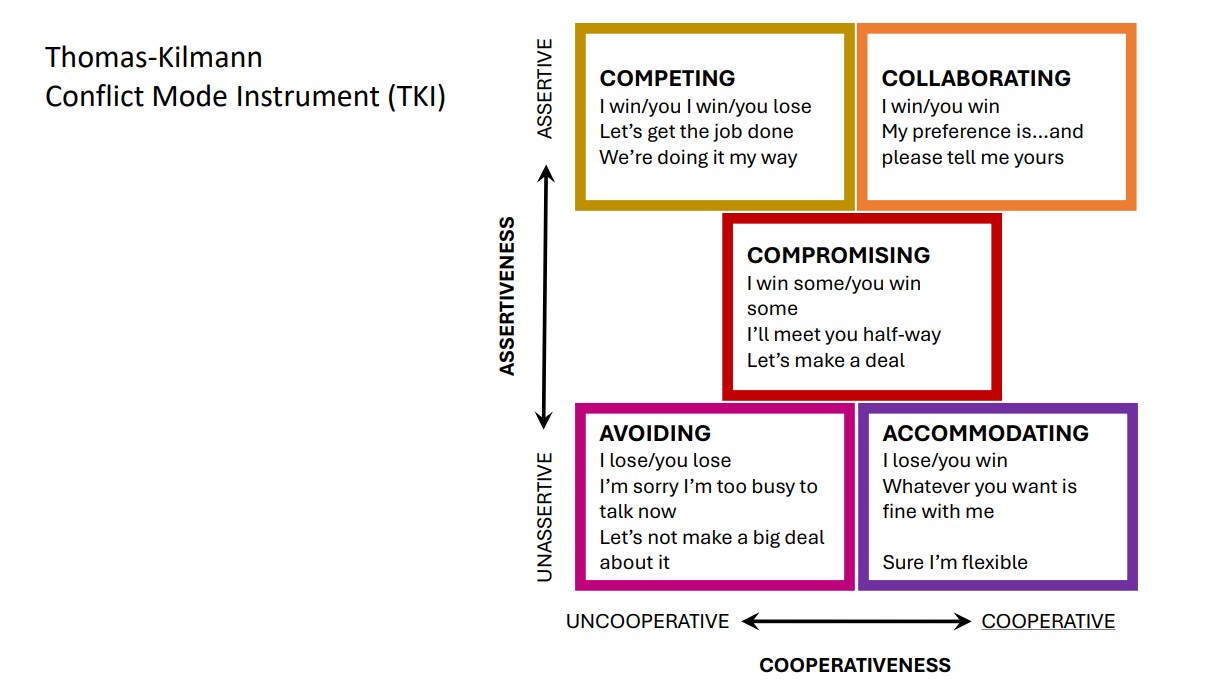
[View text version in the table below]
| Conflict Style | Assertiveness Level* | Cooperativeness Level* | Characteristics |
|---|---|---|---|
| Competing | High | Low |
|
| Collaborating | High | High |
|
| Compromising | Moderate | Moderate |
|
| Avoiding | Low | Low |
|
| Accommodating | Low | High |
|
*Assertiveness: The extent to which an individual attempts to satisfy their own concerns.
*Cooperativeness: The extent to which an individual attempts to satisfy the other person's concerns.
Conflict Resolution Video: