

About CMH-17
The Composite Materials Handbook is a product (the multi-volume handbook and associated
database of material properties), an organization of nearly 200 people, and a process.
This page gives a brief orientation to the products and process.
- Engage with experts from the field on a regular basis to discuss critical technical issues for advanced material structural applications, with an emphasis on increasing overall product safety.
- Provide comprehensive, practical engineering guidance that has proven reliable for the design, fabrication, characterization, test and maintenance of advanced materials.
- Be a comprehensive source of material property basis values and design information that can be shared within the industry through providing reliable data linked to control of processes and raw materials.
- Provide a resource for advanced materials education with examples, applications and references to support engineering work.
- Establish guidelines for use of information, identifying the limitations of the data and methods.
- Provide guidelines with references to proven standards and engineering practices.
- Provide periodic updates to maintain the all-inclusive nature of the information.
- Provide information in formats best suited for user needs.
- Employ collective knowledge and lessons learned to serve the needs of the international advanced materials community in all industries represented by members.
CMH-17 is a volunteer organization consisting of participants from industry, government, and academia. Activity is organized into coordination groups that focus on each of the major material technologies: Polymer Matrix Composites, Ceramic Matrix Composites, and Metal Matrix Composites. An organization chart for one of the coordination groups is shown below. The Executive Team and Handbook Chairman oversee coordination and activity for all groups.
Secretariat
- Wichita State University
Handbook Chairs
-
Cindy Ashforth, FAA AVS
- Ahmet Oztekin, FAA ANG
Senior Advisors
- Larry Ilcewicz, FAA
- John Tomblin, WSU
PMC Industry Leader(s)
- Carl Rousseau, LMCO
- Steve Ward, Retired
CMC Industry Leader(s)
- Doug Kiser, NASA
MMC Industry Leader(s)
- TBD
AM Industry Leader(s)
- Rick Cole, NRC
Handbook Volumes
- Vol. 1 Guidelines for Characterization of Structural Materials, Release H, September
2022
Volume 1 explains the methods by which materials property data should be obtained, and criteria for their acceptance for publication in the Handbook. Data obtained and selected according to Volume 1 is published in Volume 2. The current version is the H release, which is available from SAE. - Vol. 2 Polymer Matrix Composites: Material Properties, Release H, July 2018
Volume 2 contains the actual material property data for polymer matrix composites. The data is arranged in categories depending on the reinforcement class and matrix class. Within a category, the the data is in chronological order (based on when data was submitted). There is also a Volume 2 Annex which segregates data for which export control restrictions apply. The current version is the H release, which is available from SAE. - Vol. 3 Materials Usage, Design and Analysis, Release H, October 2025
Volume 3 discusses usage of the data for material procurement, quality control, design, structural analysis, and reliability. Because of the three volume format, information on a given subject may be found in more than one volume. For example, thick section composites are discussed in both Volume 1 (testing methodology) and Volume 3 (analysis techniques). The current version is the H release, which is available from SAE. - Vol. 4 Metal Matrix Composites, Release B, August 2013
Volume 4 is a handbook specifically for metal matrix composites. The internal structure of the handbook follows the Vol. 1-3 structure of the PMC handbook. The current version is the B release, which is available from SAE. - Vol. 5 Ceramic Matrix Composites, July 2017
Volume 5 is the ceramic matrix handbook. The internal structure of the handbook follows the Vol. 1-3 structure of the PMC handbook. The current version is the A release, which is avalable from SAE. - Vol. 6 Structural Sandwich Composites, Initial Release, August 2013Volume 6 captures much of the data and technology that was available in MIL-HDBK-23, but has been updated to reflect the current state-of-the-art. The 1st release is available from SAE.
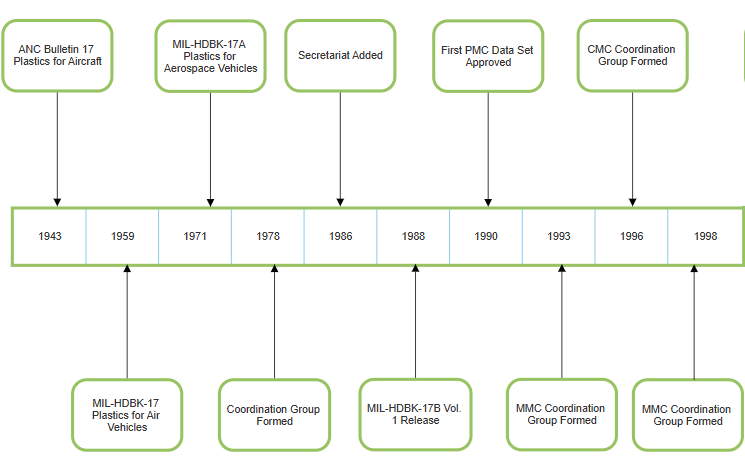
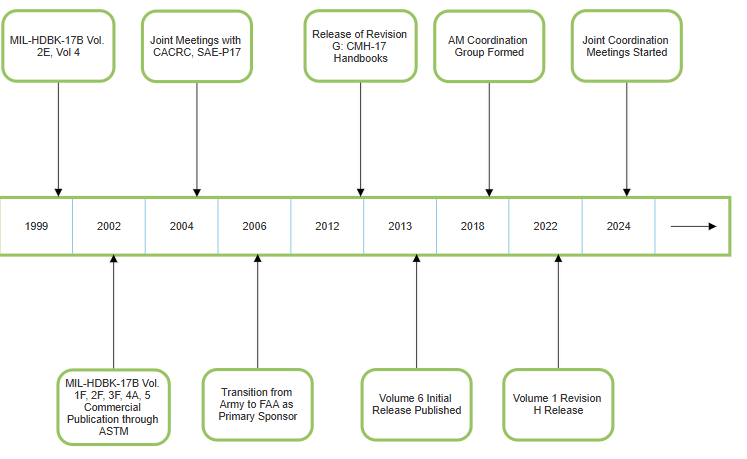
History of the Composites Handbook
Coordination Groups & Working Groups
Contacts
- Data Review:
Seeking Co-Chairs - Design and Analysis:
Sung Park, NGC Aerospace Systems
Elisa Buckner, NGC Aerospace Systems - Guidelines:
Rick Cole, NRC Aerospace
Bijan Deris, Boeing - Materials and Processes:
Fei Liang, Group Head, Completions Materials and Process Engineering
Chloe McGuffin, Markforged
Eric Moyer, Additive Manufacturing Innovation Center, BCA Engineering - Statistics:
Elizabeth Clarkson, National Institute for Aviation Research, Wichita State University
Stefan Kloppenborg
Lindsay Jones, Boeing - Testing:
Brian Kitt, Spirit AeroSystems
Royal Lovingfoss, National Institute for Aviation Research, Wichita State University
Joe Costanzo, Boeing
- Data review working group
- Design and anaylsis working group
- Guidelines working group
- Materials and processes working group
- Statistics working group
- Testing working group
Contact
- Ms. Cindy Ashforth, FAA Aircraft Certification Services, Policy, and Innovation Division
CMH-17 is the primary and authoritative source for characterization and statistically-based property and performance data of current and emerging advanced ceramic matrix composites. It reflects the best available data and methodologies for characterization, testing, analysis and design, and includes data development and usage guidelines in support of design methodologies for components.
- Data review working group
- Design and anaylsis working group
- Engine applications working group
- Materials and processes working group
- Testing working group
Contacts
- Dr. Larry Ilcewicz, FAA/Seattle Aircraft Cert. Office
- CMH-17 Secretariat, Nation Institute for Aviation Research, Wichita State University
- Bonding processes task group
- Certification task group
- Composites for spacecraft working group
- Core task group
- Crashworthiness working group
- Damage tolerance task group
- Data review working group
- Design task group
- Disbond and delamination task group
- Engine applications working group
- Guidelines working group
- Guidelines vol 3 ch 10 task group
- Materials & process working group
- P-17 task group
- Safety management working group
- Sandwich working group
- Statistics working group
- Supportability working group
- Testing working group
Definitions
Leaders of the entire Handbook activity, including all of the individual Coordination Groups. Traditionally, the Chairmen have come from the sponsoring government agencies (FAA, and DoD), and thus have a special and unique interest in the development of the handbook.
Establishes overall Handbook goals, direction, and operating procedures. The EG establishes long-term Handbook plans, and is concerned with user needs and the long-term viability of the activity.
Approves new additions to the handbook, and can elect to remove existing material from the handbook. Currently, there are three Coordination Groups. The groups cover the distinct material technologies of Polymer Matrix Composites (PMC), Metal Matrix Composites (MMC), and Ceramic Matrix Composites (CMC). The Coordination Group determines the interaction between the Working Groups, resolves issues of overlapping responsibility.
Form the core of the technical work and section writing for the handbook activity. The Working Groups have a charter to cover a specific technical area of the handbook. It is expected that these technical areas will continue to evolve for the duration of the handbook activity.
Are created by a Working Group. These groups are given a specific technical topic to investigate, and report back to the WG. Generally, Task Groups are expected to produce new material for the handbook, which will then go through the normal approval procedure as WG sections.
Provides professional support for the Handbook. Provides publication services to ensure that the book is organized, edited, printed and distributed as a high-quality product. Organizes meetings of all the Coordination Groups and including meeting services such as site selection, invitation, on-site support, and distribution of proceedings. Responsible for maintaining material databases, providing technical review of the data, and statistical data analysis.
Role of the Secretariat
- The Secretariat performs funded activity directed by the FAA. Functions include:
- Expedite work of coordination group
- Prepare and publish CMH-17 Handbook
- Perform statistical data reduction and assist with data review
- Plan, coordinate and provide onsite support for meetings
- Maintain a participant database
- Generate proceedings and maintain archives
- Maintain software
- Promote CMH-17
- Maintain website
- Perform additional special projects as assigned by Chairman
The Secretariat is a contracted organization. The current secretariat is Wichita State University through the National Institute for Aviation Research.