

Skip the contents list and go to the document
Wichita State University Intercollegiate Athletic Association Mission Statement
Wichita State University Intercollegiate Athletic Association, Inc. (“ICAA” or “Athletic Department”) offers its student-athletes an opportunity to compete at the highest level in The American Conference and nationally. ICAA brings positive recognition to Wichita State University (“WSU” or “University”), develops pride in the community, and bonds alumni and friends while complimenting the University’s mission.
ICAA is committed to providing an environment where student-athletes are able to become champions athletically, academically and socially. ICAA subscribes to the rules and regulations of the National Collegiate Athletic Association (“NCAA”) and is committed to providing equal opportunities for all of its student-athletes and staff while maintaining a pinnacle standard of integrity. More information on student-athletes can be found in the Student-Athlete Handbook.
Athletic Department Vision Statement
ICAA will be a national leader within intercollegiate athletics with all sports annually competing in NCAA postseason play and positioned as the premier program in its conference, while perennially being recognized among the nation’s elite in academic performance and graduation rates, experiencing widespread growth of its support base, providing fans with the highest entertainment value and promoting integrity and sportsmanship to unprecedented levels of excellence.
Applicability of ICAA Policies & Procedures Manual
This ICAA Policies & Procedures Manual (“ICAA Manual”) is a compilation of departmental policies and expectations that apply to all employees performing work for ICAA, whether officially employed by ICAA or by WSU (hereinafter collectively referred to as “employees,” “staff,” or “Athletic Department employees”). Where no policy exists within this ICAA Manual, WSU Policies and Procedures shall apply. In circumstances where a subject matter is addressed in both this ICAA Manual and WSU Policies and Procedures, the provisions of this ICAA Manual shall be read in conjunction with, and not in lieu of, the applicable WSU Policies and Procedures. In the event of any inconsistency or where the WSU Policies and Procedures provide greater detail, specificity, or coverage, the WSU Policies and Procedures shall govern.

Student-Athlete Development
Developing leaders of character, competence and consequence for athletics and life.
Student + Person + Player = Professional
Core Values
- Character
- Integrity
- Knowledge
- Stewardship
Raise the Wheat
Competitive Excellence
Maximizing results by matching resources to expectations. Comprehensive, broad-based athletics program.
- Conference championships to Conference Commissioner’s Cup
- NCAA post-season play to Directors’ Cup
1. ATHLETICS OVERVIEW
1.1. Athletic Facilities
Select the WuShocks at each location to view information on the athletic facilities.
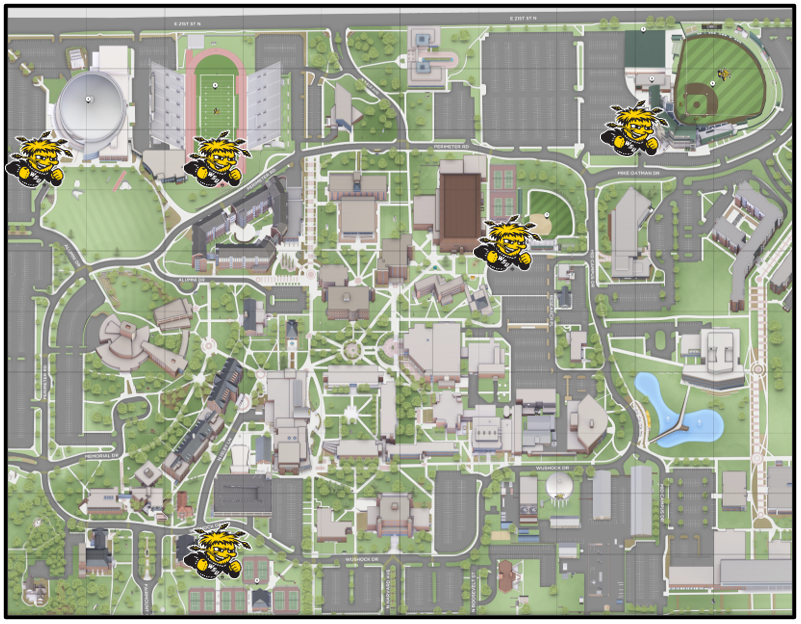
Athletic facilities on the Wichita State campus
1.2. Sponsored Sport Programs
Select the sport program name to be directed to their page.
- Baseball
- Sport Admin: Taylor Spyker
- Men’s Basketball
- Sport Admin: Kevin Saal
- Women’s Basketball
- Sport Admin: Madison Stein-Mason
- Women’s Bowling
- Sport Admin: Cole Chisholm
- Men’s Cross Country
- Sport Admin: Kevin Saal
- Women’s Cross Country
- Sport Admin: Kevin Saal
- Softball
- Sport Admin: Madison Stein-Mason
- Men’s Tennis
- Sport Admin: Brad Pittman
- Women’s Tennis
- Sport Admin: Brad Pittman
- Men’s Track and Field
- Sport Admin: Kevin Saal
- Women’s Track and Field
- Sport Admin: Kevin Saal
- Volleyball
- Sport Admin: Alex Johnson
1.3. ICAA Governance
- Presidential Authority. As Chief Executive Officer of the institution, the President of the University (“President”) has the ultimate authority for the conduct of the intercollegiate athletics program. Responsibility for day-to-day operation of ICAA rests with the Director of Athletics who reports directly to the President.
- Faculty Athletics Representative. The President will appoint a faculty athletics representative (“FAR”), who will serve
at the pleasure of the President. The responsibilities of the FAR include the following:
- Represent the University to The American Conference and the NCAA.
- Certify, after consultation with and certification by the Office of the Registrar, the athletic eligibility of all student-athletes.
- Serve as a member on the ICAA Board of Directors.
- Serve as faculty liaison to the Student-Athlete Advisory Committee.
- Assist with matters related to rules compliance including the investigation of possible rules violations.
- ICAA Board of Directors. The ICAA Board of Directors (“ICAA Board”) shall serve in an advisory capacity to
the President and the Director of Athletics. The ICAA Board shall consist of nineteen
members, three of whom are ex-officio members, who shall be appointed by the president
from the following constituencies:
- Twelve Athletic Board positions shall include the following University personnel members
(nine voting, three non-voting):
- Six (6) members of the teaching faculty, one of whom will be appointed by the University President to serve as chair.
- Faculty Athletic Representative
- Vice-President for Administration and Finance (or designee)
- Vice-President for Student Affairs (or designee)
- Direct of Athletics (ex-officio/non-voting)
- Sr. Associate Athletic Director/CFO (ex-officio/non-voting)
- General Counsel (ex-officio/non-voting)
- Three Athletic Board positions shall include the following student members:
- Student Government Association President (or designee)
- Two (2) students, one of whom shall be a member of the Student-Athlete Advisory Committee
- Four Athletic Board positions shall include the following community members:
- President of the Shocker Athletic Scholarship Organization (or designee)
- Shocker Athletic Scholarship Organization designee
- President/CEO of the WSU Foundation and Alumni Engagement (or designee)
- Vice President/President of Alumni, within the WSU Foundation and Alumni Engagement (or designee)
- Twelve Athletic Board positions shall include the following University personnel members
(nine voting, three non-voting):
- Shocker Athletic Scholarship Organization Board of Directors. The Shocker Athletic Scholarship Organization (“SASO”) Board of Directors, headed
by the SASO President, is composed of a minimum of fifteen (15) members representing
various SASO membership levels and community interests.
The SASO Board of Directors shall also contain ex-officio, non-voting, members including the Director of Athletics, ICAA’s Lead Development Officer (or one who occupies a comparable position), and any other ICAA staff member(s), as designated by the Director of Athletics.
- WSU Foundation and Alumni Engagement Board of Directors. The Wichita State University Foundation and Alumni Engagement (“Foundation”) is the custodian for various financial accounts representing funds raised from private individuals and corporations. The Director of Athletics frequently briefs the Foundation Board of Governors on the affairs of the ICAA and its financial state of affairs. The expending of Foundation funds follows the same procedures as other ICAA funds and is subject to the approval of the President of the University.
- ICAA Staff
- Executive Team. The Executive Team is composed of senior leaders who oversee the strategic direction and daily operations of ICAA. This team includes the Director of Athletics and designated administrators including but not limited to: Deputy, Senior Associate, and Associate Athletics Director. The Executive Team ensures the athletic program aligns with the University's mission and compliance standards.
- Sport Administrators. Sport Administrators are responsible for supporting the mission and core values of the department of athletics and ensuring program alignment while assisting the Director of Athletics with day-to-day sport oversight responsibilities. Sport administrators are responsible for efficiently and effectively managing and measuring all facets of their assigned/respective sports program. In tandem, Sports Administrators, Head Coaches, and the Director of Athletics maintain accountability for every aspect of program administration, and all outcomes. Sports Administrators must carry out their responsibilities and duties in accordance with the ICAA Sport Administrator Resource Manual.
- Head Coaches. Head Coaches are responsible for the overall leadership and management of their sport programs. This includes head coach control, meaning they are accountable for all aspects of program operations, such as coaching, recruiting, compliance, student-athlete conduct, budget oversight, and staff supervision. They are expected to foster a positive team culture aligned with ICAA and university values.
- Assistant Coaches/Administrative Staff. Assistant Coaches and Administrative Staff must have clearly defined roles and responsibilities as assigned by the Head Coach and/or direct supervisor. They are expected to represent ICAA in a first-class manner and uphold all ICAA and University policies. Professionalism, integrity, and support for student-athlete success are essential in all aspects of their work.
- Student-Athlete Advisory Board. The Student-Athlete Advisory Board is comprised of student-athlete representatives
from each of the varsity sports teams. The group meets with the Director of Athletics,
Senior Woman Administrator, and the FAR approximately once per month during the academic
year. Each respective Head Coach recommends representatives. The primary purpose
of the committee is to serve as a direct means of communication between student-athletes
and the ICAA executive team in the effort to effectively address issues of concern,
generate ideas for the continued development of the entire athletic program, as well
as promote The American Conference and ICAA initiatives.
2. REPORT IT
This section is a hub for anything an employee may need to report. You can also find information on the University’s Report It webpage (wichita.edu/reportit). If you see something or are made aware of something that gives you cause for concern, please submit any information you have through the appropriate form and/or seek additional assistance from your supervisor or ICAA Human Resources.
2.1. Emergencies
If you need to report an emergency, call the Wichita State University Police Department at 316-978-3450 or dial 911.
2.2. CARE Team
The Care Team accepts referrals and incident reports from any person who is concerned about the health or safety of a WSU student, employee, visitor, or the campus community at large. Referrals and incident reports may be submitted to the Care Team on the Concerning Behavior Submission Form, which can be located on the CARE Team webpage (https://www.wichita.edu/services/careteam/)
2.3. Athletics Compliance
- Policy Statement
Athletics compliance is a shared responsibility. All individuals associated with ICAA are expected to uphold NCAA, Conference, ICAA, and University rules and regulations. Every member of the ICAA community serves as a compliance officer and must promptly report any suspected or known violation.
Reports may include, but are not limited to:
- Extra benefits or impermissible gifts
- Academic misconduct
- Recruiting violations
- Eligibility concerns
- Employment or compensation issues
Failure to report a known or suspected violation may itself constitute a violation of NCAA, Conference, ICAA, and/or WSU policy.
- Procedures for Reporting
Any employee who becomes aware of a potential or actual NCAA, Conference, ICAA, and/or WSU violation must report the information to the ICAA Compliance Office as soon as practicable, but not later than 3 days from discovery. Reports may be submitted in person at the Compliance Office in the Student-Athlete Center or by emailing the Associate Athletic Director for Compliance directly at ktorgerson@goshockers.com.
- Confidentiality and Retaliation
Confidentiality will be maintained to the highest extent possible. Retaliation against any individual who, in good faith, reports a concern or violation is strictly prohibited and may result in disciplinary action, up to and including termination.
- Education and Annual Attestation
Each year, all ICAA staff must complete annual compliance education and sign a compliance attestation affirming their understanding of, and commitment to, NCAA, Conference, ICAA, and WSU rules.
- Enforcement and Accountability
Violation of this policy may result in corrective or disciplinary action in accordance with NCAA, Conference, ICAA, and/or WSU policies and processes, up to and including termination.
2.4. Title IX / Discrimination
WSU is committed to providing an educational and working environment free from discrimination on the basis of sex and all forms of protected characteristic discrimination. Reports of discrimination may be submitted on the Civil Rights, Title IX, and ADA Compliance Form. For more information about Title IX, please review WSU Policy 3.06 / Sexual Harassment, Discrimination and Retaliation for Employees, Students and Visitors or contact the Office of Civil Rights, Title IX & ADA Compliance (CTAC), at (316) 978-3186 or CTAC@wichita.edu.
2.5. Student Conduct and Community Standards Incident Response
Concerns regarding conduct that is disruptive to the campus community, infringes on any person’s ability to successfully pursue their academic progress, violates the Student Code of Conduct, or puts others or themselves in danger may be reported on the Incident Reporting Form. For more information on the student conduct process, please visit the Student Conduct and Community Standards webpage (https://www.wichita.edu/about/student_conduct/).
2.6. Academic Integrity
Any individual wishing to report a violation of Policy 2.17 / Student Academic Integrity of the WSU Policies and Procedures, may file an Academic Integrity Report (https://cm.maxient.com/reportingform.php?WichitaStateUniv&layout_id=6).
2.7. Clery Crime Report
The Clery Crime Report Form must be used by individuals who have been designated by Wichita State University as a Campus Security Authority (CSA) to report crime incidents as required under the Jeanne Clery Disclosure of Campus Security Policy and Campus Crime Statistics Act (Clery Act). To learn more about the Clery Act, please visit WSU’s Clery Home webpage (https://www.wichita.edu/about/clery/).
2.8. Reporting Resource Contact List
| Resource | Contact information |
|---|---|
| Director of Mental Health & Performance | Dr. Mouhamad Ballout 316-644-6568, mballout@goshockers.com |
| Athletics Staff Directory | https://goshockers.com/staff-directory |
| Primary Healthcare Administrator | Taylor Spyker 304-610-6755 |
| Counseling and Preventative Services | 316-978-4792 |
| CARE Team | 316-978-3149 |
| Civil Rights, Title IX, and ADA compliance | CTAC@wichita.edu |
| Deputy Title IX Coordinator | Taylor Spyker 304-610-6755 |
| Faculty Athletic Rep | Dr. Clay Stoldt 316-978-5441 |
| Real Response | 66595 |
| Senior Woman Administrator | Taylor Spyker 304-610-6755 |
| Student Affairs | 316-978-3021 |
| Student-Athlete Conduct | Gretchen Torline 316-978-5518 |
| Student Health | 316-978-5177 |
| University Police | 316-978-3450 |
| Wichita Area Sexual Assault Center Rep | 316-263-0185 |
| Human Resources | Diana Austin – Human Resources Business Partner 316-978-6149 |
3. BUSINESS AND TRAVEL
3.1. Budget Process
- Budgeting. All budget processes shall be handled in accordance with the ICAA Business Operations Manual.
3.2. Purchases
- General Purchases. ICAA Purchases must maximize value and require prior approval of the respective budget manager and Business Office administration. Documentation of all purchases, including an item description, cost per item and total cost, vendor, discounts, and transaction date, must be submitted to the Business Office.
- Emergency Purchases. Emergency Purchase must be approved by the Athletic Director. Unauthorized emergency purchases may not be reimbursed and could become the personal responsibility of the purchaser.
- Unauthorized Purchases. Any purchase made without prior approval from the Business Office will be the personal responsibility of the purchaser. Sales tax must be charged for personal-use items purchased from ICAA inventories.
- Reimbursement Approval. All reimbursement requests must be approved by a superior of the requestor to avoid any possibility of inappropriate influence or perception of inappropriate influence in the approval process. For instance, reimbursement requests for Director of Athletics should be approved by University President or his/her designee.
3.3. Credit Cards
- Issuance. Each sport program and designated division manager may be issued a ICAA departmental credit card for official business use. These cards are intended to streamline operations, reduce the need for cash advances, and improve receipt tracking and reconciliation.
- Requirements for Use. Use of a departmental credit card must comply with the following:
- Cardholder Responsibility. One individual per program or division must be designated as the sole cardholder. The designated cardholder is responsible for the card, but may authorize other employees within their division/program to use the card. The designated cardholder must ensure that the card is used in compliance with all applicable policies and procedures. Cards shall not be used by student-athletes.
- Monthly Limits. Each card will initially carry a $25,000 monthly limit. This limit may be adjusted based on usage and departmental needs.
- Receipt Submission. All receipts must be submitted to the ICAA Business Office as soon as possible after purchases are made to ensure timely reconciliation.
- Pre-Approval for Large Purchases. Any expense over $2,500 must receive prior approval from the assigned Sport Administrator or Senior Associate/Deputy Athletic Director. A request form is available at the Business Office for this purpose.
- Restricted Purchases. Cards may not be used for alcohol, tobacco, or gaming-related expenses. Usage must comply with all applicable university and departmental policies.
- Tax Exempt Status. ICAA is tax-exempt in Kansas, Texas, and Florida. Cardholders are expected to utilize tax exemption when possible. Relevant documentation can be provided by the Business Office.
- Misuse. Use of a departmental credit card is a privilege and must align with allocated budgets and the ICAA’s core value of stewardship. Misuse may result in revocation of privileges and/or disciplinary action, up to and including involuntary separation from employment.
3.4. Official Hospitality Expenditures
- Business Practices for Official Hospitality. Coaches and staff members of the Athletic Department often conduct business where it becomes necessary to provide official hospitality of food and drink for outside guests. Fiduciary responsibility must be exercised in all expenditures for official hospitality and shall be limited to those instances in which the department can reasonably expect that the expenditure will assist in fulfilling an objective or goal bearing a valid relationship to its Strategic Plan. In no situation will reimbursement be allowed for any gathering which does not have a clear business purpose.
- Documentation. All expenditures for official hospitality and departmental business shall be documented
with the following information:
- The name or a description of the group and the number of official guests. When practical, include a list of attendees.
- The objective, goal, or business purpose of the expenditure.
- A receipt of expenses is required. It is recommended to include detailed receipts.
- Review. The Business Office may refer expenditure requests deemed to be questionable or beyond authorization of this policy to the appropriate senior staff supervisor for review and approval.
3.5. Tax Exemption Status/Certification
- ICAA Tax Exempt. ICAA is a tax-exempt entity for all purchases of tangible personal property and services in Kansas except purchases of goods for human habitation and indirect purchases by a contractor for a real property project. A signed tax exemption certificate must be provided to the retailer and can be obtained through the ICAA Business Office. Please note that only direct purchases are exempt, meaning employees cannot purchase items themselves and claim tax exemption on behalf of ICAA.
- Form of Payment. All invoices must be paid directly by ICAA’s checking account or departmental credit card in order to qualify for exemption from sales tax. An employee must pay tax on all items for which they use personal funds, even if the department will be later reimbursing them for these items. ICAA is also tax-exempt in Texas and Florida. Cardholders are expected to utilize tax exemption when possible. Relevant documentation can be provided by the Business Office.
3.6. Reimbursable Moving Expenses
- Eligibility. ICAA may reimburse for moving expenses for purposes of recruitment. All
moving expenses should be clearly stated in the candidate’s offer letter. Actual expenses
deemed relevant and reasonable are generally authorized for up to 7% of the new employee’s
annual salary. Any moving expenses exceeding this 7% threshold must be specifically
authorized by the Athletics Director and explicitly stated in the offer letter. Amounts
reimbursed for moving expenses constitute taxable income.
Questions regarding moving expenses should be directed to the Business Office. - Allowable Expenses. Reimbursable moving expenses include the following:
- Packing, shipping, and storage of household goods and personal effects.
- Costs of commercial movers, rental trucks/vans, fuel, and labor/materials for packing/unpacking.
- Insurance charges for moving and rental companies.
- Travel directly associated with the move, including mileage for personal vehicles and enroute lodging for the employee and immediate family members.
- Special Items. Expenses for large or unusual items (e.g., automobiles, antiques, pianos, boats, works of art) are not generally reimbursable unless specifically approved by the Athletics Director in advance.
- Reimbursement. Reimbursement for moving expenses shall be subject to the following requirements:
- Reimbursement will only be made after the employee’s official hire date;
- Reimbursement will be made only upon submission of receipts and/or other documentation of actual expenses; and
- Under no circumstances will reimbursement exceed the actual amount paid by the employee.
3.7. Travel Policies
- Travel Schedules. Head Coaches are responsible for developing competitive schedules for their respective
sports. Scheduling should be done to maximize competition opportunities while keeping
travel as economical as possible. Schedules should be made so that as few class days
as possible are missed. All sports schedules should be coordinated with ICAA Administration,
as needed, and the American Conference to ensure that ICAA, conference, and the NCAA
requirements are met.
All schedules must be approved in advance by the Director of Athletics or their designee. All sports contracts are prepared and signed by the Athletic Director's office. Any financial arrangements in a contract must be approved in advance by the Director of Athletics or their designee.
- Travel Approval and Costs. Before traveling, a staff member must submit a request including full travel details to their direct supervisor. All travel must be approved in advance. Advances will be made for meals (up to the maximum daily meal allowance) only. Credit cards should be used for hotels, rental vehicles, gasoline, and other expenses. Receipts shall be turned in for reimbursement with a completed travel form upon returning from a trip. Failure to comply with travel policies will result in future travel advances being withheld and/or a delay in the processing of other purchase requisitions for the budget area. For any international travel, employees must also comply with WSU Policy 13.20 / Out-Of-State And International Travel; provided that ICAA employees are not subject to the Wichita State University Travel Handbook.
- Travel Allowances. ICAA payment for travel expenditures shall be made in accordance with the following:
- Lodging:
- Accommodations must be substantially equitable across all sports.
- Head Coaches may have single rooms; all others are double occupancy unless gender prohibits.
- For odd-numbered teams, the Head Coach decides between one single room or one triple.
- No spending cap, but staff should be conservative in making reservations.
- Meals:
- $46 shall be the daily allowance for the following cities: New York, San Francisco, San Diego, San Jose, Boston, Washington DC, Miami, Los Angeles, Seattle, Denver, Chicago, Portland, Atlanta, Austin, Dallas, Tampa, Orlando, Philadelphia, Phoenix, Boise.
- $40 shall be the daily allowance for all other cities.
- When distributing meal money to student-athletes, the same amount must be given to each athlete and funds should be distributed on a daily basis.
- The breakdown for meals should be:
$40 rate → $8 breakfast / $12 lunch / $20 dinner
$46 rate → $9 breakfast / $14 lunch / $23 dinner
- Teams are encouraged to eat together when appropriate, and team meals must align with the above limits unless prior approval is granted.
- Teams traveling by bus may purchase drinks and reasonable snacks (e.g., fruit).
- Mileage:
- $0.35/mile reimbursement for staff-owned vehicles.
- Actual gas expenses for courtesy vehicles.
- Airfare:
- All tickets must be coach class.
- Trips should be booked well in advance using discount fares when possible.
- Charter flights, if required, must be arranged through Anthony Travel.
- Lodging:
- Funding for Spouse, Dependents, or Other Family Travel
- Generally Prohibited. In order to ensure compliance with Internal Revenue Service (IRS) regulations, ICAA generally prohibits the funding of travel expenses for spouses, dependents, or other family members when accompanying staff members who are traveling on ICAA business. Unless otherwise memorialized in a contract with the employee, any exceptions to this policy must be specifically approved by the Director of Athletics or his/her designee. An example of this type of exception is spouse, dependents, or other family members’ participation in selected regular season, holiday, or post-season travel.
- Taxable Income. ICAA is required to include in employees’ taxable income the costs incurred from spouse, dependent, or other family members’ travel to athletic events (e.g., holiday trips, post-season championships, etc.). The amount calculated as taxable income will be included on bi-weekly payrolls. Additional income taxes are withheld on those amounts.
- Reduction and Taxable Items. The resulting reduction in the net pay attributable to spouse, dependents, and other
family members’ travel taxable income will depend on the income level and the number
of exemptions employee has claimed for tax withholding. In general, the taxable items
include the following:
- Airfare for spouses, dependents, and other family members, except for charter flights where greater than 50% of the plane is occupied by working personnel and student athletes.
- 100% of meal money or meal costs for spouses, dependents, or other family members.
- The cost of additional hotel rooms attributable to dependents or other family members.
- The cost of game tickets and any other entertainment provided to spouses, dependents, or other family members.
- Regular Season Travel
- Budget. Every sport is expected to operate within their annual operating budget. Team travel is a component of the sport’s operating budget. Departure times from campus to the competition site and from the competition site to return to campus shall be in accordance with NCAA Bylaws and shall minimize time away from campus.
- Travel Party. Team travel parties shall not be excessive and shall be limited to those individuals who have a role to serve on the trip. The Head Coach may limit the team’s travel party at his/her discretion, subject to the parameters listed below. All travel parties shall be approved in advance by the Sport Administrator to ensure appropriate support of WSU student-athletes and coaches while providing sound fiscal management of event.
Routine members of the travel party will normally be limited to the following:
- Coaches, including NCAA permissible graduate assistant coaches and volunteer coaches;
- Eligible student-athletes;
- Director of Operations (where applicable and approved by Sport Administrator);
- Primary athletic trainer);
- Communications staff member (when necessary and with approval of Associate AD for Strategic Communications);
- Managers shall be limited in number as approved by the Sport Administrator and have defined responsibilities;
- Strength & Conditioning Coach (when needed and approved by Sport Administrator); and
- Video/Creative staff member (when needed and approved by Sport Administrator).
Recognizing the role the families of coaches, staff and others affiliated with the University and ICAA have played in the team’s success but cognizant of maintaining fiscal integrity, ICAA will provide to additional members of the travel party specifically listed below, $1000 or actual transportation cost (whichever is less) to and from the competition site and one hotel room unless otherwise noted. Any per-diem, additional lodging or other costs will be the responsibility of that employee. These costs provided by ICAA are subject to taxable benefits under IRS regulations.
Additional members of the travel party if approved by Director of Athletics:
- University President and spouse;
- Director of Athletics;
- Sport Administrator;
- Support Staff (e.g., Academic Advisor, Administrative Assistant, Compliance Personnel, Team Physician, etc.) – Support staff may be invited on a trip by the Head Coach, with approval of the Sport Administrator. Cost of travel will be considered when selecting trips for additional support staff, and preference will be given to ground transportation trips. Those approved will be the exception and not the rule;
- Guests – on a limited basis, the Head Coach may invite guests who are not Athletic Department employees provided there is a legitimate reason (e.g., development opportunities, etc.) for extending the invitation and the request is approved in advance by the Sport Administrator, Director of Athletics and Associate AD for Compliance. Potential donors should be accompanied on team trips by a member of the Development staff whenever possible;
- Spouse of Head and Assistant Coaches – A coach’s spouse may travel with approval of the Sport Administrator and Director of Athletics. The coach must pay for the spouse’s meals, any transportation cost above $1000, game tickets and any additional hotel rooms; and
- Spouses or children of Athletic Department staff – the spouses and children of staff may travel only with approval of the Director of Athletics. The staff member must pay for the child’s transportation, meals, game tickets and additional hotel rooms.
4. EMPLOYMENT
4.1. Hiring
- Commitment to Excellence. ICAA is committed to employing the most qualified individuals for all staff positions with the goal of achieving excellence throughout ICAA. As vacancies occur, every effort will be made to identify a strong pool of qualified candidates. In addition to using the University’s standard advertising methods, ICAA may also use additional advertising methods to reach a broader range of talent through appropriate organizations, professional associations, and targeted advertising mediums.
- Process. All hiring must be consistent with WSU Policy 3.20 / Recruitment, Hiring and Onboarding and comply with Equal Employment Opportunity requirements. The University’s Human Resources (HR) office oversees recruitment, hiring, and onboarding for the University and must be consulted during each step of the hiring process.
- Background Checks
- Employees. To ensure a safe environment for student-athletes and participants in camps, clinics, and other activities involving minors, background checks are required of all employees as a condition of employment. For Assistant and Head Coaches, background checks must include review of NCAA records for investigations and violations.
- Volunteers. Volunteers shall undergo background checks in accordance with WSU Policy 3.63 / Volunteer Policy and the WSU Volunteer Webpage.
- Key Contacts for Hiring. Questions related to hiring should be directed to the following:
- Employment Questions & Process Support: employment@wichita.edu
- Athletics HR Business Partner: Diana Austin | hrbp@wichita.edu
- General HR Contact: hr@wichita.edu | (316) 978-3065
4.2. Timekeeping
- Timekeeping. ICAA employees must follow the WSU policies and procedures for timekeeping, which
can be found on the WSU Timekeeping webpage.
- Full-Time Non-Exempt. Full-time non-exempt employees must report time and leave through the online Time Sheet located in the myWSU portal. For more information on submitting the online Time Sheet, visit the Leave Report & Web Time Entry webpage.
- Full-Time Exempt. Full-time exempt employees must report leave through the online Leave Report located in the myWSU portal. For more information on submitting the online Leave Report, visit the Leave Report & Web Time Entry webpage. Full-time exempt employees do not submit a timesheet.
- Part-Time and Temporary. Unless directed otherwise by the Business Office, the time worked and pay rate for part-time and temporary employees must be submitted by the employee’s supervisor to the Business Office on the ICAA Timesheet. The Business Office will enter the hours submitted for part-time and temporary employees into the Banner payroll system.
- Approval for Overtime. Overtime hours for non-exempt employees must be approved in advance by the supervisor AND the Athletic Director or Sr. Associate Athletic Director Business Operations.
4.3. Leave
There are several types of leave available to eligible employees. For information on the types of leave, eligibility requirements, and the procedures for using leave, please visit the Leave Administration webpage and/or contact the designated Human Resources Business Partner for the Athletics Department or the HR Total Rewards Team.
4.4. Performance Development
- Development Process. ICAA is committed to fostering a culture of accountability, growth, and excellence. Performance development ensures that every staff member sets meaningful goals, receives consistent feedback, and has opportunities for professional development. The process provides clarity of expectations, aligns individual performance with departmental goals, and supports career progression.
- Annual Expectation. All staff must have documented goals, accountability measures, and a development plan each year.
- Leadership Reviews
- Head Coaches complete an annual review process with their Sport Administrator and the Director of Athletics.
- Head Coaches are responsible for the performance development of their Assistant Coaches.
- Department Heads/Managers facilitate the process for administrative staff and other unit members.
- Ongoing Conversations. Supervisors are expected to engage in monthly “4x12” conversations with staff, covering accomplishments, priorities, obstacles, and support needs.
- Performance Review Process
- Planning. Supervisors and staff establish competencies and goals for the review cycle.
- On-Going. Supervisors track progress through the year with check-ins and documented feedback.
- Results. End-of-cycle evaluations focus on competency ratings tied directly to job duties and the collaboratively identified goals at the beginning of the cycle.
- Accountability and Alignment. Performance reviews are designed to provide recognition, constructive feedback, and guidance for training, promotions, compensation, and career growth.
- Communication. Timelines, process updates, and required approvals are communicated and reinforced annually by Athletics administration.
4.5. Separation from Employment
- ICAA is an "at-will" employer, meaning either the Employee or ICAA may end the employment relationship at any time for any lawful reason, with or without notice or cause, subject to applicable ICAA or University policies, including WSU 3.41 / Separation of Employment, or agreements.
4.6. Complimentary Athletic Tickets
- Purpose and Use. Complimentary tickets are a tool for public relations and recruiting, and misuse of complimentary tickets can result in lost revenue, NCAA administrative sanctions, or loss of ticket privileges. Complimentary tickets cannot be sold, traded, bartered, or given to prospective student-athletes. No complimentary tickets will be issued without proper authorization.
- Employee Season Tickets. Subject to availability, each full-time employee is authorized to receive up to four (4) complimentary season tickets for personal use, which are eligible for seat location renewal each year. Any additional tickets must be purchased at the faculty/staff rate.
- Single-Game Tickets
- Home Games. Subject to availability, employees may be authorized for additional complimentary tickets for single games at the discretion of the Director of Athletics, in accordance with NCAA rules.
- Away and Neutral-Site Games. Complimentary admissions for away and neutral-site games are determined by the Director of Athletics and Head Coach, in accordance with NCAA rules. Employees that have a working purpose to attend an away game will either be placed on a pass list or provided a working credential. Non-working employees may request these tickets through the Chief Revenue Officer/Director of Operations for each sport, but tickets are not guaranteed and will not be authorized until all internal needs are met.
- Requests and Deadlines. Requests for complimentary season tickets must be made on an annual basis. The exact deadlines for season ticket requests will be determined annually by the Chief Revenue Officer and will typically be two (2) weeks before the first game of each respective sport. Requests for complimentary tickets for a single game are due 24 hours before the game. Requests can be made by emailing tickets1@goshockers.com or visiting the Ticket Office in person.
- Taxable Income. An employee’s receipt of complimentary athletic tickets may constitute taxable income. Employees shall be responsible for any taxable amounts due for receipt of complimentary tickets for themselves or their family members. Valuation for taxable complimentary tickets will be calculated in accordance with all local, state, and federal laws. Any taxable amounts will be added to an employee’s paycheck or reported on a 1099 for contracted employees.
- Parking Passes for Athletic Events. Parking passes are only provided if attendance at the athletic event is required
for work duties and will be subject to availability. No parking pass for staff is
guaranteed at any point and is subject to change yearly based on demand.
5. FACILITIES AND OPERATIONS
5.1. Telephone Policies
- Telephone Use. Phone usage by ICAA employees must comply with the requirements of this ICAA Manual and the WSU Policy 19.07 / Cell Phone Usage.
- Cell Phones and Stipends. Employees within the Athletics Department, as approved, may be issued a cell phone
or cell phone stipend. These are approved based on the decision of the budget supervisor
and budgetary allowance.
- If allocated a cell phone, the device must be returned to the Business Office, direct supervisor, or Sport Administrator upon separation of employment. Employees are not authorized to make any changes to their issued device, their calling, texting, data plans, or phone service. All such changes need to be requested through the ICAA Business Office.
- Alternatively, employees may opt to receive a stipend, if offered, to cover their cell phone bill instead of using a department issued device. If they choose this option, they will receive a monthly reimbursement receipt confirming the reimbursement has been processed.
- Data Line. Coaches with direct contact with prospective and current student-athletes are required to have an ICAA issued data line.
- Student-Athlete Phone Use. Employees are not permitted to allow student-athletes to use an employee’s long-distance access code or department issued cell phones to make a long-distance phone call.
5.2. Vehicle Use and Operation
- ICAA Vehicles. “ICAA Vehicles” include all motorized vehicles that are owned, leased, or rented by ICAA, and other vehicles when used for ICAA business (e.g., privately-owned vehicles and courtesy vehicles).
- Requirements for ICAA Vehicle Use. ICAA Vehicles must be used and operated in accordance with WSU Policy 20.19 / Driving State-Owned Or Leased Vehicles Or State-Operated Vehicles and the following requirements:
- ICAA Vehicles must be used and operated in compliance with all governing municipal, state, and federal laws;
- Drivers must be employees of ICAA;
- Drivers must be at least 21 years of age to transport student athletes;
- Drivers must have the advance written authorization of the Director of Athletics;
- Drivers must have a current operator’s license issued in the United States. A copy of license must be on file in Business Office. ICAA reserves the right to conduct a driver’s license check and may withhold authorization based on information from said check;
- Drivers must be insurable under ICAA’s automobile policy;
- Drivers and passengers must be engaged in official ICAA business on behalf of ICAA and/or the University;
- The individual who picks up an ICAA Vehicle that is owned, leased, or rented by ICAA must be the driver of the ICAA Vehicle and may not turn the ICAA Vehicle over to someone else;
- Drivers will be responsible for the safe use of the ICAA Vehicle and its passengers;
- Drivers shall not operate the Vehicle under the influence of alcohol;
- Drivers will be personally responsible for any and all traffic or parking citations, tickets, or fines received while operating the Vehicle;
- All occupants must use a seat belt at all times of operation;
- No Vehicle will be used to transport or carry more than its listed capacity (including the driver) at any one time; and
- Luggage shall not be stored or placed on top of Vehicles, except for privately owned vehicles.
- ICAA Vehicle Requests and Accidents. Requests to use an ICAA Vehicle that is owned, leased, or rented by ICAA must be submitted to the ICAA Business Office. Any accident involving an ICAA Vehicle must be reported in accordance with WSU Policy 20.19 / Driving State-Owned Or Leased Vehicles Or State-Operated Vehicles, as applicable; provided that accidents in ICAA Vehicles shall be reported to the ICAA Business Office rather than the University Fleet and Property Managers.
- Courtesy Vehicles
- Courtesy vehicles are dealership-owned vehicles (including any replacement/loaner vehicles) that are provided for use by ICAA employees pursuant to agreement.
- Courtesy vehicles must be used and operated in accordance with the employee’s agreement with ICAA, the trade agreement with the dealership providing the courtesy vehicle, and all agreements between the employee and the dealership.
- Courtesy vehicles may be used for personal matters, but only as authorized in writing by the Director of Athletics.
- Courtesy vehicle accidents must be reported to the employee’s supervisor, the Business Office, and the dealership.
- Forklift Training. Drivers must complete training/safety class provided through the University prior to the operation of the forklift. To the extent that an employee is required to attend forklift training, it will be provided through the myTraining webpage.
5.3. Apparel and Equipment
- Provision of Apparel and Equipment. ICAA provides all athletic apparel and equipment necessary for sport programs and retains ownership of these items. The equipment staff, based in Charles Koch Arena, is responsible for ordering, receiving, issuing, inventory, storage, and maintenance of all apparel and equipment, as well as ensuring compliance with ICAA, American Conference, and NCAA rules. All purchases must go through the assigned equipment manager in coordination with the Head Coach or designee, and no orders may be placed directly with vendors. Unauthorized purchases will be the personal responsibility of the staff member making them.
- Partnership with Nike. ICAA has an exclusive partnership with Nike as the sole provider of athletic apparel and footwear, and each sport is allocated a budget to order Nike products. Exceptions to Nike apparel or footwear must be reviewed and approved on a case-by-case basis by the Sport Administrator, in consultation with the equipment administrator.
- Branding Standards. Any embellishments, including logos and trademarks, on apparel or equipment must follow University branding standards and be approved by the Director of Equipment Operations.
- ICAA Property. All apparel and equipment purchased with ICAA funds remains the property of ICAA and must be inventoried and distributed through the Equipment Office. Any apparel or equipment issued to staff are for official use only, and any lost or damaged items may result in replacement charges. It is impermissible to sell, barter, or trade issued items. Any sale or donation of equipment must be pre-approved by the Director of Athletics and Compliance.
- Laundry Services. Laundry services are provided by the Equipment Office for official ICAA apparel only.
5.4. Facility Rental & Use
Rental and use of ICAA facilities must comply with ICAA Rental Prices and the Camps and Clinics Procedures Manual.
5.5. Keys
The Director of Facilities and Events is responsible for the issuance of keys. The Director of Facilities and Events will assign keys to athletic department offices and facilities and maintain records of the keys held by all personnel as well as the keys for each office and/or facility. Lost or stolen keys must be reported immediately. If it is necessary to change locks and reissue keys due to lost keys, the cost of doing so will come out of that individual’s budget. Lost key fobs will be charged directly to the individual and will only be replaced after the fee is paid. If additional keys are needed, requests are to be made through the Director of Facilities and Events. All costs associated with cutting new keys will be charged to the respective department budget. Card access to facilities will be coordinated by the Director of Facilities and Events and run through University ITS. Physical keys to exterior locks will only be given if necessary and no electronic device exists on the building.
5.6. Lost or Stolen Property
Any ICAA property that has been lost or stolen must be promptly reported to the University Police Department, the Athletics Business Office, and the employee’s supervisor. The Athletics Business Office will report any insured stolen property to the insurance company.
5.7. Emergency Protocols
The emergency protocols have been prepared for each of the athletics facilities and are available through the following links:
Bombardier Learjet Practice Facility
Cross Country Practice Off-Campus
Student-Athlete Center Weight Room
Student-Athlete Success Center
6. SHOCKER HEALTH AND PERFORMANCE
6.1. Emergency Action Plans
Mental Health Emergency Action Plan